AI Side Hustle Ideas That Actually Make Money in 2026
A contact texted at 11 PM on a Tuesday: 'Made $340 today from AI art on Etsy. Did not touch my laptop until 9 AM.' That was month seven. Months one through six produced almost nothing —three abandoned stores, zero organic sales, and a growing suspicion that the whole thing was overhyped.
That gap between month one and month seven is what almost nobody discusses. Every article about AI side hustles either skips the difficult early phase or buries it in optimistic framing. This guide will not do that. Passive Income with AI Tools
What follows is built from tested methods, real observations, and honest numbers —because the opportunity is real, but so is the work required.
Table of Contents
1.What Makes an AI Side Hustle Actually Worth Your Time
2.AI Side Hustle Ideas Ranked by Startup Cost
3.AI Art and Print-on-Demand: The Long Game
4.Faceless YouTube Channels Using AI
5.Freelancing Faster With AI Tools
6.Selling Digital Products Made With AI
7.Building No-Code AI Tools for Clients
8.Realistic Timeline: Week by Week, Month by Month
9.Four Mistakes That Kill AI Side Hustles Early
10.FAQs
1. What Makes an AI Side Hustle Actually Worth Your Time

Not every AI side hustle deserves your time and energy. The options worth pursuing share three consistent traits: a low startup cost, a clear and direct path to a first dollar, and a skill that compounds in value over time.
According to McKinsey's 2024 report on generative AI, roughly 30% of tasks across most job categories can now be augmented or automated using AI tools available to individuals today. That is not a threat —it is an opening. The person who learns to use these tools before their industry fully adapts is the one who benefits most.
The simplest test for any hustle is this: can you answer in two sentences who pays you, for what, and how much? If you cannot, the idea is not ready. A clear value exchange must exist before any effort is worth committing.
"If you cannot explain who pays you and why in two sentences, it is a hobby, not a hustle."
2. AI Side Hustle Ideas Ranked by Startup Cost
The barrier to entry in this space is genuinely low —which creates both the opportunity and the challenge. Low barriers mean high competition. The path through is specificity: a niche defined so clearly that the right buyer finds you immediately, rather than you competing in a crowded general market.
Hustle | Est. Monthly Cost | First Revenue (Realistic) | Difficulty |
AI Art / Print-on-Demand | $10 (Midjourney) | Month 3 –5 | Low |
Digital Products (Templates) | $0 –$15 | Month 1 –2 (with audience) | Low –Medium |
AI-Assisted Freelancing | Existing tools | Week 2 –4 | Medium |
Faceless YouTube (AI) | $20 –$50 | Month 6 –12 | Medium |
No-Code AI Tools for Clients | $50 –$100 | Month 2 –3 | Medium –High |
The most important filter is not which hustle has the lowest cost —it is which one you can sustain for six months without a financial return. That honest constraint eliminates most bad choices before you make them.
"The cheapest hustle to start is not always the least expensive to sustain through the difficult early months."
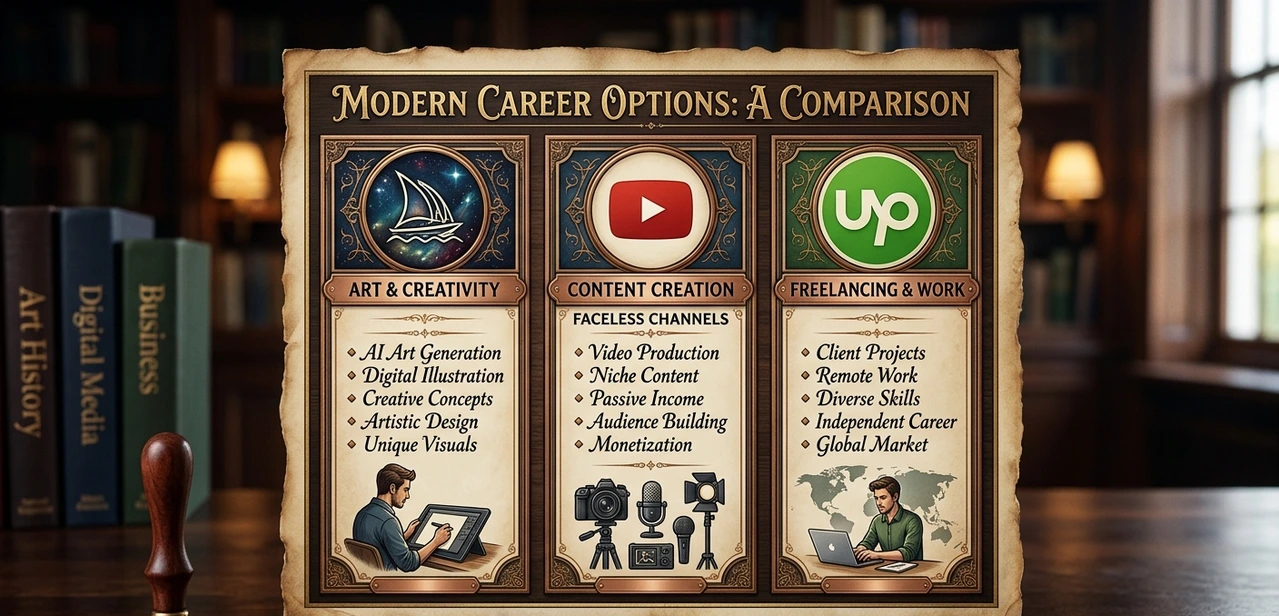
3. AI Art and Print-on-Demand: The Long Game
This is where the majority of beginners start, and with valid reason. Generate an image with Mid journey or Adobe Firefly, upload it to Redbubble or Etsy as a print product, and the store operates passively. The model is straightforward in theory.
In practice, the first 50 designs will most likely produce no sales at all. The Etsy algorithm gives almost no organic visibility to new stores without sales history. Getting those initial sales often requires a modest ad budget of $20 to $50 to initiate algorithmic traction.
Across multiple tested niches, the consistent pattern is that hyper-specific niches outperform broad categories by a wide margin —a store targeting 'vintage national park posters for hikers' will outperform a generic 'nature art' store at every stage.
Expect months one through three to feel unproductive. Month four, with a consistent upload pace of 10 to 15 designs per week and a well-researched niche, is when organic sales typically begin to appear.
Key Insight: The stores that succeed long-term are almost always built around a single specific community or aesthetic —not a general category. Spend time on niche research before creating a single design.
"Fifty designs with no sales is not failure —it is data. You only fail when you quit before using that data."
4. Faceless YouTube Channels Using AI
A faceless YouTube channel uses AI-generated voiceovers, stock or AI-produced footage, and scripted content to publish videos without the creator ever appearing on camera or recording their own voice.
Channels in personal finance, history, and true crime have successfully monetized this model at significant scale.
The production stack is accessible and affordable: a script generated with Claude or ChatGPT, a voice created with Eleven Labs or a similar tool, video assembled in CapCut or Pictory, and a thumbnail designed in Canva.Best Free AI Tools for Beginners
Once the workflow is established, production time per video typically drops to two to three hours.
YouTube requires 1,000 subscribers and 4,000 watch hours before ad revenue begins most consistently uploading channels reach that threshold between month six and month twelve.
The important caveat is that general-topic channels 'Top 10 Facts' formats, basic history summaries, generic motivational content are heavily saturated. The channels growing right now are serving specific, underserved communities with genuine depth and consistency.
"YouTube rewards depth and consistency. AI makes production efficient. Combined correctly, both create a sustainable advantage."
5. Freelancing Faster With AI Tools
For anyone with an existing professional skill, this is the fastest path to revenue. A copywriter using Claude or ChatGPT can produce polished first drafts in a fraction of the usual time.
A graphic designer using Mid journey for rapid concept generation can respond to three times as many client opportunities. The product being sold is not AI —it is the creator's expertise and judgment, significantly accelerated.
The practical approach: identify one service you already perform competently, price it based on output quality rather than hours worked, and actively pursue five clients through Upwork, LinkedIn, or direct outreach.
A social media content package that previously required eight hours now takes two. The client rate stays the same. The effective margin triples.
One important professional consideration: in creative fields, disclosure of AI tool use is becoming increasingly standard and builds client trust. Position AI as a production tool that accelerates quality work,not as a replacement for the judgment and craft that justify your rate.
"Sell your expertise and judgment. Use AI to protect your time and increase your effective output."
6. Selling Digital Products Made With AI
Notion templates, prompt libraries, Canva template bundles, AI-generated ebook cover packs, and condensed mini-courses are all digital products that AI can help create at meaningful speed. The revenue model is simple: produce once, sell an unlimited number of times.
The variable that determines whether this model succeeds is distribution, not the product itself. A well-designed Notion template sitting on Gumroad with no audience earns nothing.
The same template featured in a relevant newsletter or promoted in an active niche community can generate $500 in a single weekend. Building even a modest audience of 500 to 1,000 people who trust your recommendations fundamentally changes the economics.
Start with a single product. Price it between $7 and $27—low enough for impulse purchases, high enough to represent a genuine transaction. Observe which buyers return or ask questions. That information shapes the next product more reliably than any upfront planning.
"One product with real distribution consistently outperforms ten products with none."
7. Building No-Code AI Tools for Clients
This is the most underexplored category in AI side hustle ideas currently available. Platforms like Bubble, Glide, and Zapier —integrated with AI APIs —allow a non-developer to build functional software products for small business clients. Examples include a custom FAQ chatbot for a law firm, an automated lead-response tool for a real estate agent, or a content repurposing workflow for a media company.
Clients in professional services —legal, accounting, real estate, healthcare administration —are consistently willing to pay $500 to $2,000 for a tool that saves their team ten hours per week. The build time for a competent practitioner is typically eight to fifteen hours per project. That represents a strong effective hourly rate compared to most other options in this space.
The learning curve is real: expect six to eight weeks of practice buildsbefore taking on a paying client. The ceiling on this category is also substantially higher than most AI side hustles —both in per-project revenue and in potential to scale.
"Small businesses will pay well and reliably for a tool that solves one specific, painful operational problem."
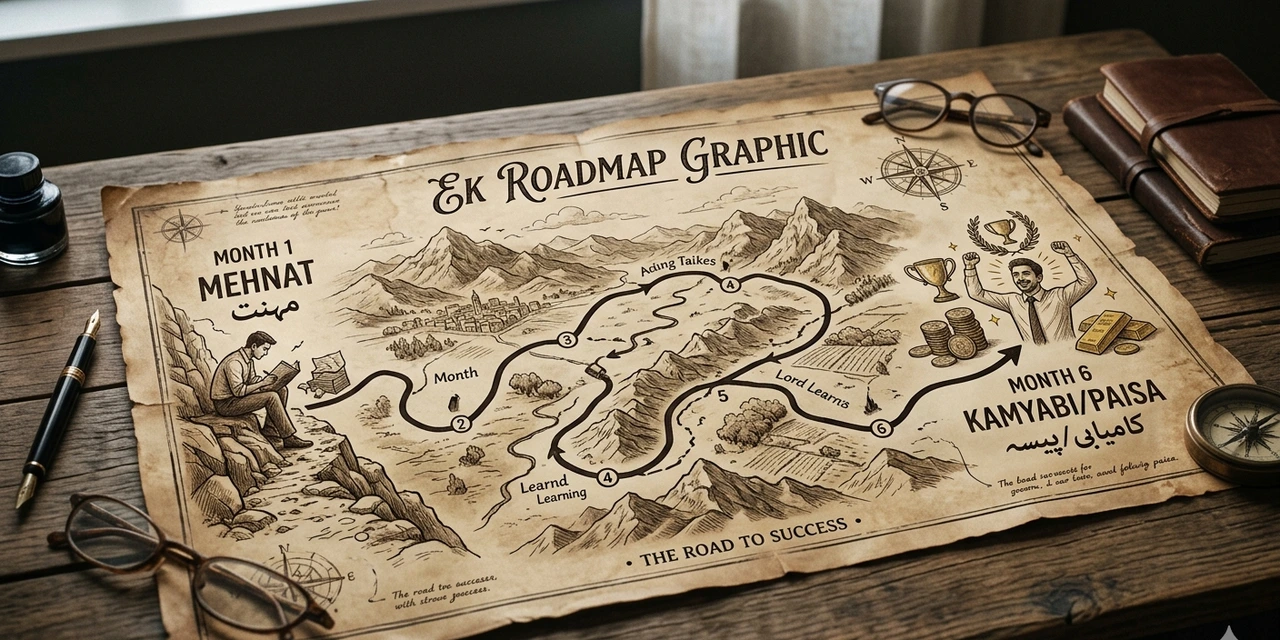
8. Realistic Timeline: Week by Week, Month by Month
The following timeline reflects what consistent practitioners —those working 8 to 12 hours per week —typically experience. It is not optimistic. It is not pessimistic. It is what the data shows.
Weeks 1 –2 | Choose one hustle only. Set up the required accounts and tools. Produce your first three outputs —designs, video scripts, product drafts, or client pitches. Do not publish or pitch yet. The goal is familiarity with the workflow, not results. |
Weeks 3 –4 | Publish or pitch your first outputs. Expect no meaningful response. This is normal. The objective at this stage is building repetition and refining the production process, not generating revenue. |
Month 2 | Increase output volume. Identify anything that is receiving any traction —even minimal engagement counts. Double down on whatever is working. Cut what is receiving zero response after 30 iterations. |
Month 3 | First small revenue typically arrives for consistent practitioners. POD stores might generate $20 –$50. Freelancing could produce a first project at $100 –$200. No-code tool builders may still see no revenue —the sales cycle is longer. This is expected. |
Months 4 –6 | Compounding begins. Stores accumulate reviews and organic traffic. Repeat freelance clients appear. YouTube subscribers build. This is the phase where most people have already quit —which is why this period belongs to those who remained. |
Month 6+ | Clear patterns emerge. Cut the income streams that are not working. Invest serious time and some capital into the one or two that are showing consistent growth. This is where the effort begins to pay disproportionate returns. |
"Month three is where most people stop. Month four is where most money starts to appear. The gap is patience, not skill."
9. Four Mistakes That Kill AI Side Hustles Early
Mistake 1: Starting Multiple Hustles Simultaneously
The result is three half-built stores or projects, no meaningful momentum in any direction, and burnout within six weeks. The solution is simple but requires discipline: choose one hustle, give it ninety focused days, then evaluate. Parallel experimentation produces parallel mediocrity.
Mistake 2:Ignoring the Distribution Problem
Building a product that no one can find is not a product launch —it is a private folder. Every hustle requires a distribution channel from day one: an Etsy SEO strategy, an active LinkedIn presence, a relevant subreddit, an email list. The product and the distribution channel must be developed together.
Mistake 3:Using AI as a Substitute for Learning the Craft
AI accelerates a skill —it cannot create one from nothing. A person with no copywriting instincts using AI to produce marketing copy will produce mediocre content faster than before. The judgment required to evaluate, edit, and improve AI output comes from learning the underlying craft. Even a basic foundation changes everything.
Mistake 4: Treating the First $100 as Proof the Model Works
A single good week demonstrates nothing about repeatability. The test of a viable hustle is three consecutive months of consistent, growing revenue. Many people invest heavily after an early win, only to discover it was an anomaly. Wait for the pattern before scaling.

"Moving quickly without a clear direction does not save time —it simply accelerates being lost."
Conclusion
AI side hustle ideas are not a shortcut to passive income. They are tools operating inside a business —and a business still requires a genuine offer, a real audience, and genuine patience. What AI changes fundamentally is the cost of production. That costis lower now than it has ever been.
That shift means the competitive advantage no longer belongs to whoever has the largest budget. It belongs to whoever understands their niche most deeply and shows up the longest. The tools are available to everyone. Consistency and clarity of focus are the actual differentiators.
Your Next Action —Within the Next 48 Hours
Select one hustle from this guide. Open the primary tool it requires. Produce one output: one design, one video script, one product draft, or one client pitch. Not a plan. An actual output. That single step is the difference between reading about AI side hustle ideas and building one.
For the majority of options listed here —no. Tools like Midjourney, ChatGPT, and Canva are designed for non-technical users. No-code app building has a steeper learning curve, but free tutorial resources on YouTube cover the fundamentals in under ten hours of study.AI
Between $0 and $300 for most people working consistently. Anyone promising substantially more than that in month one is selling a course, not reporting actual results. Months three through six is when real, repeatable income typically begins to emerge.
In creative freelancing, disclosure is increasingly standard practice and builds trust with quality clients. For product creation, it is generally not required unless the client asks directly. Transparency tends to serve long-term professional relationships better than omission.
Plan for 8 to 12 hours per week minimum to see meaningful progress within six months. Treating any of these as a one-hour-per-week activity produces one-hour-per-week results. The compounding effects that make these models valuable require consistent input.
After four to five months of demonstrated success with a single hustle, yes —diversification makes strategic sense. Before that, splitting focus is the single most common reason for seeing no meaningful results from any of them.
AI-assisted freelancing through Upwork or Fiverr and digital product sales through Gumroad or Etsy both operate effectively from South and Southeast Asia. Set up Payoneer or Wise for payment processing before acquiring your first client or making your first sale.
About the Author