THE HOOK
Last October, a friend screen-shared his Etsy dashboard. Forty-seven products live. Decent traffic. And $340 for the month. He'd been at it for nine months, and he was genuinely proud. Then he showed me his keyword strategy — or rather, the absence of one. He was targeting 'printable planner' with 600,000 competing listings. Nine months of work, buried under a search result avalanche, earning less per hour than a parking attendant.
He wasn't failing because AI tools didn't work. He was failing because he'd optimized the wrong things.
THE BRIDGE
Most articles about passive income with AI tools are written for people still figuring out what Chat GPT can do. This one isn't. This is for you — someone who's already past the 'set up your first Etsy store' phase, who's tasted real income, and who suspects there's a ceiling you keep bumping against. There is. And it's almost never the AI tools themselves.
What follows is a practical breakdown of the optimization layer: the decisions, systems, and positioning moves that separate $300/month from $3,000/month. No recycled advice. No screenshots of someone else's dashboard. Just the actual work.
Table of Contents
1. The Real Bottleneck (It's Not Your Tools)
2. Repositioning: How to Escape Saturated Niches Without Starting Over
3. The Compounding Content Stack — Build Once, Earn in Three Places
4. Prompt Architecture: How Advanced Creators Actually Use AI
5. Pricing Psychology for Digital Products — You're Undercharging
6. Honest Month-by-Month Scaling Roadmap
7. Four Optimization Mistakes That Kill Income Plateaus
8. Automating the Last 30% That's Still Eating Your Time
9. FAQs — Advanced Creator Edition
10. Author Bio
1. The Real Bottleneck (It's Not Your Tools)
Here's something worth sitting with: most people who plateau at $200-$500/month aren't struggling with AI tools. They've mastered Canva. They know how to prompt ChatGPT. They publish consistently. The bottleneck is almost always positioning — specifically, the gap between what they're selling and what buyers are actually searching for right now.
The 'just make more products' instinct is understandable. More inventory should mean more chances to get found. But if the core niche is wrong, volume just creates more of the same problem. According to McKinsey's 2024 Generative AI report, productivity gains from AI tools plateau when the underlying workflow strategy is flawed — more speed into a bad direction doesn't fix the direction.
Before touching a single new product, the first question to ask is: is the current niche still undersupplied, or did fifty other creators move in during the past six months? Markets shift fast. What had 800 Etsy results in January can have 8,000 by July.
"Speed without direction is just a faster way to the wrong place."
2. Repositioning: Escape Saturated Niches Without Starting Over
Repositioning doesn't mean abandoning everything built so far. It means sharpening the angle. The creator selling 'minimalist wall art' isn't competing with ten people — they're competing with tens of thousands. But 'minimalist wall art for home recording studios' is a different search entirely. Niche math changes completely.Make Money With AI in 2026
The fastest way to find the new angle is to look at existing product reviews — not just personal products, but competitor products. Customers routinely describe what they wished the product also included, or what specific problem they bought it to solve.
That exact language is the new niche. AI can process hundreds of reviews quickly and extract recurring patterns in minutes.
Try this: paste 30-40 competitor reviews into Claude or ChatGPT and ask: 'What specific problems do these buyers mention that this product didn't fully solve?' The output almost always reveals a more specific, less crowded version of the current niche. Then build for that version.
Tactic; Erank's 'niche finder' tool plus this review-mining method together cut niche research time from days to about two hours. Genuinely worth the subscription.
"The riches aren't in the niches. They're in the niches within the niches."
3. The Compounding Content Stack — Build Once, Earn in Three Places
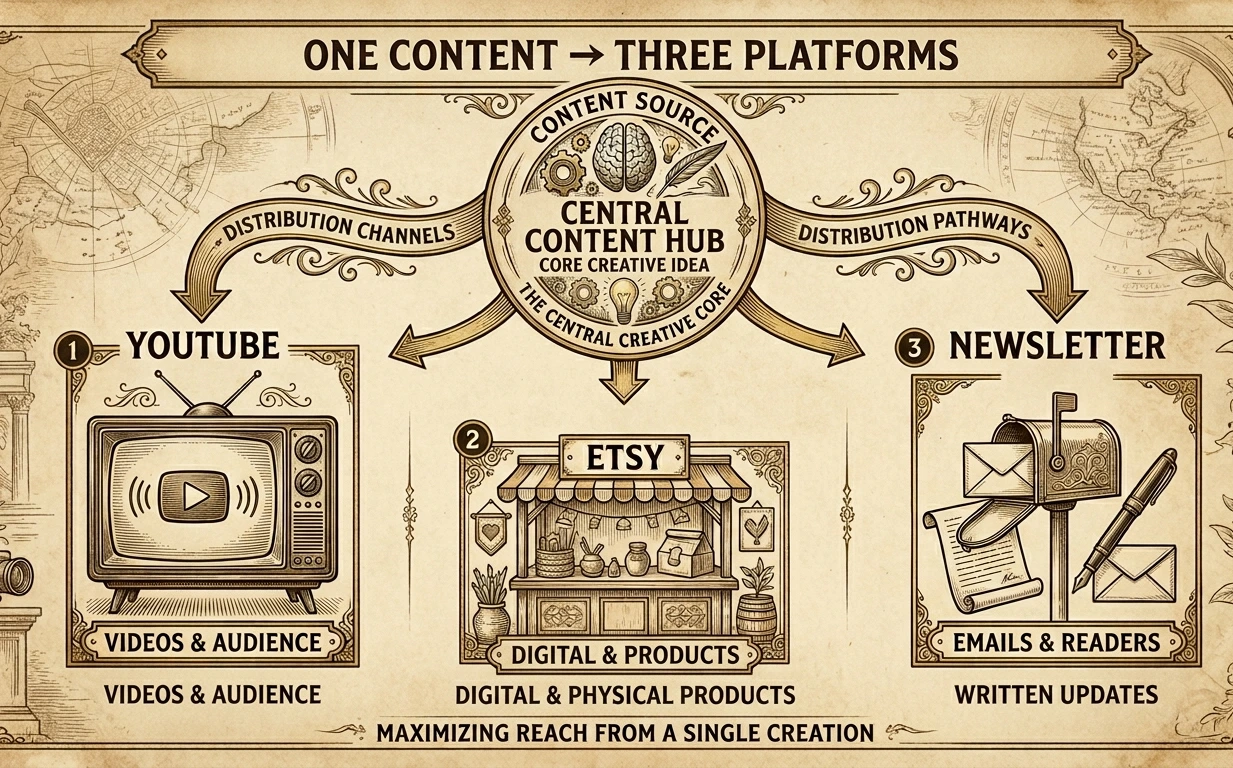
This is the move that most intermediate creators haven't made yet: building one content asset that earns across multiple platforms simultaneously. The workflow sounds simple once laid out, but very few people actually do it systematically.
The structure works like this. One well-researched piece of content — say, a 2,000-word guide on sobriety tracking methods — becomes three things at once. First, a PDF digital product sold on Etsy or Gumroad. Second, a narrated YouTube video using that same content (Pictory or ElevenLabs handles the audio, stock footage fills the visual). Third, a newsletter issue that funnels readers toward both the product and the video.Make Money Online with AI
Each piece drives traffic to the others. The YouTube video builds authority and sends buyers to the Etsy listing. The newsletter earns affiliate commissions passively. The PDF earns directly. One hour of core content creation, three income streams active. That's the compounding content stack.
Reality check ; Setting this up properly takes about two weeks the first time. After that, the per-content-piece time drops to roughly 90 minutes. The upfront investment is real — so is the payoff.
"One asset, three revenue streams. That's not passive income — that's a system."
4. Prompt Architecture: How Advanced Creators Actually Use AI
Most people use AI like a search engine — ask a question, get an answer, move on. Advanced creators use it more like a collaborator with a specific role. The difference shows up immediately in output quality.
The key shift is context loading. Before asking AI to write anything, feed it the niche, the target reader's exact problem, the competitor's weakness, and the tone needed. A prompt like 'Write a product description for a planner' produces generic output. 'Write a product description for a 30-day sobriety journal targeting adults in their first month of recovery who've tried and abandoned journaling before because traditional prompts felt too clinical' produces something that converts.
Second technique: use AI to audit itself. After generating a product description or article section, ask ChatGPT or Claude to rate its own output and flag anything that sounds like filler, AI pattern language, or that wouldn't pass a 'would a real person actually say this' test. The self-critique pass removes about 40% of the AI smell in one step.
Advanced prompt tip; Build a personal 'prompt library' — a saved doc with your 10-15 best-performing prompts for each content type. Reuse and refine them rather than starting from scratch every time.
"The quality gap between average AI output and great AI output is almost entirely in the prompt — not the tool."
5. Pricing Psychology for Digital Products — You're Undercharging

This one stings a little because it's almost universally true. Most digital product creators price based on what feels reasonable to them — which is almost always too low. A $4.99 printable needs 200 sales to make $1,000. A $19.99 version of the same product needs 50. Same effort to build, dramatically different math.
The fear is always that higher prices mean fewer sales. But for digital products targeting a specific, real problem, the opposite is often true. A $3 planner signals low confidence in the product. A $17 planner signals that it was built with care for someone who actually needs it. The buyer psychology shifts.
The practical test: pick the top three earners in the current product catalog and raise their prices by 40%. Watch conversion rates for 30 days. In most cases, conversion either holds steady or drops by less than the income gain covers. The creators who've done this experiment report it as the single highest-impact change they made — more impactful than adding new products.
Data point; In a 2023 Gum road creator study, digital product sellers who increased prices by 25-50% saw average revenue increase by 31% within 60 days — with no change to product quality or traffic.
"Underpricing is not humility. It's leaving money on the table and calling it modesty."
6. Honest Month-by-Month Scaling Roadmap
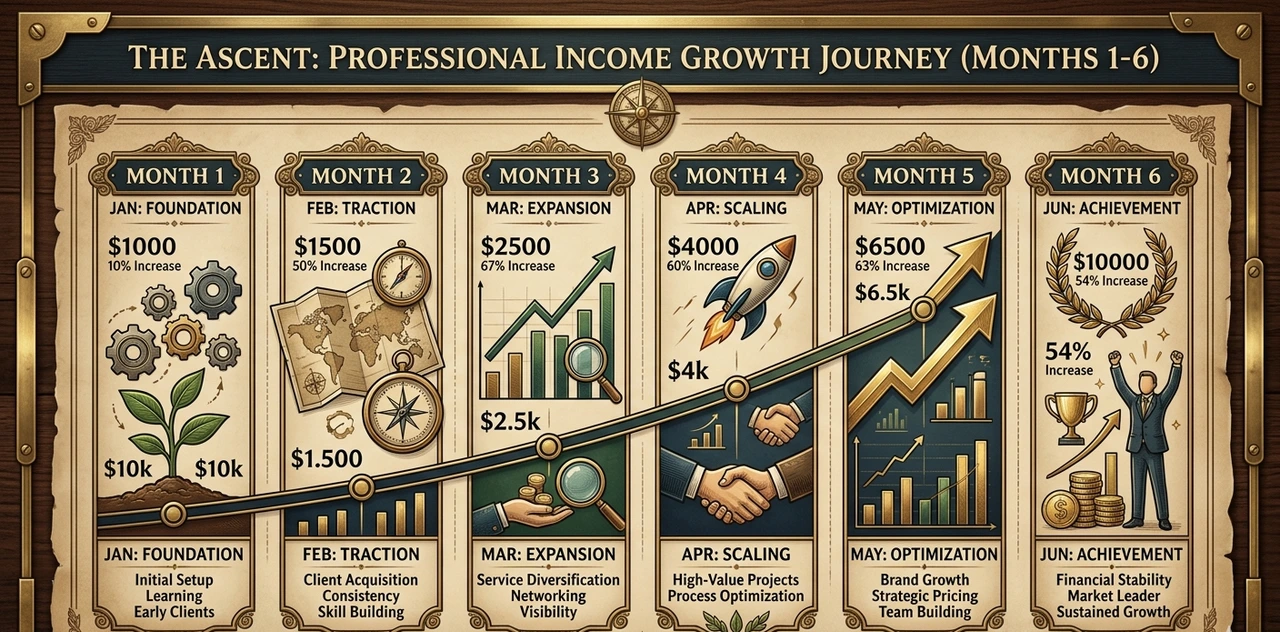
This timeline assumes an existing income between $200-$600/month. The goal here is the path to $2,000+/month — which is achievable in 4-6 months with focused execution. Not three weeks. Not overnight.
Month 1 — Audit and Reposition: Stop creating new products. Audit everything live: which products get traffic but don't convert (listing problem), which get zero traffic (niche or SEO problem), which convert well but have thin margins (pricing problem). Fix before building more.
Month 2 — Implement the Compounding Stack: Take the top two performing products and build the full three-platform system around them — product page, YouTube video, newsletter mention. Measure traffic sources after 30 days.
Month 3 — Raise Prices on Top Earners: Run the 40% price increase test. Simultaneously, build two new products using the review-mining repositioning method. Focus on niches with under 2,000 Etsy results.
Month 4 — Automate and Batch: Set up email automations for every product. Build one month of social content in a single afternoon using AI batch prompting. Reduce active time from 15 hours/week to 6.
Month 5-6 — Compound and Measure: By now, older products are gaining reviews and ranking higher organically. Monthly income should be in the $1,200-$2,500 range if execution was consistent. The compounding effect becomes visible here.
Honest note; If Month 1 audit reveals the niche is fundamentally broken, add 4-6 weeks for repositioning. Rushing past a bad niche is why many creators repeat the same plateau on a new topic.
"Scaling isn't about doing more. It's about doing the right things until they compound."
7. Four Optimization Mistakes That Kill Scaling Momentum
 Mistake 1 — Optimizing traffic before fixing conversion: Spending money on Etsy ads or Pinterest scheduling before the listing itself converts is expensive and demoralizing. Traffic to a broken listing just burns the budget. Fix the listing first — title, thumbnail, description, price — then pay for visibility.
Mistake 2 — Treating every platform the same: Etsy SEO and YouTube SEO operate on completely different algorithms. A title that ranks well on Etsy ('Minimalist Budget Tracker Printable PDF') reads terribly as a YouTube title. Each platform needs its own keyword strategy. Using one for all three is why cross-platform efforts often underperform.
Mistake 3 — Not building an email list: Etsy and YouTube own the audience. One algorithm change can cut traffic by 60% overnight — and this has happened to many creators. An email list of even 500 engaged buyers is more valuable than 5,000 Etsy followers. Convert Kit's free tier handles up to 1,000 subscribers. There's no excuse to skip this.
Mistake 4 — Confusing activity with progress: Publishing three new products a week feels productive. Measuring whether any of them solved the actual problem — niche positioning, platform SEO, pricing — is what creates progress. The creators who escape the plateau measure outcomes obsessively, not output.
"Being busy is not the same as building. Know the difference before Month 3."
8. Automating the Last 30% That's Still Eating Your Time
Most creators automate the obvious things early — scheduling posts, email welcome sequences, PDF delivery. The 30% that stays manual is usually customer communication, keyword research updates, and product listing optimization. These are automatable too, just not with simple tools.
Customer communication: build a FAQ document for every product and use a canned response template (Etsy has this built in). Train AI to draft responses for common queries — shipping questions, file compatibility issues, refund requests. Cut response time from 20 minutes per message to 3.
Keyword research on autopilot: set a monthly calendar reminder to re-run niche research on top products. Markets shift. A niche that was green six months ago may be saturated today. Thirty minutes of monthly maintenance prevents the slow leak of traffic that creators often notice only after six months of decline.
Listing optimization: once per quarter, paste every product's top listing into Claude and ask it to rewrite the title and first paragraph using current best practices for that platform. Small copy improvements compound significantly over time.
Time reality; After full automation implementation, most creators report active working time drops to 5-8 hours per week while income continues to grow. That's what passive income with AI tools actually looks like at scale — not zero hours, but genuinely few.
"Automation isn't laziness. It's the only way the math of passive income actually works long-term."
! FAQs;
Usually one of three things: the thumbnail doesn't match buyer expectations set by the title, the price signals low value, or the product description leads with features instead of the specific problem it solves. Run an A/B test on the thumbnail first — it's the highest-leverage single change.
At minimum, 15-20 products with at least 5 that have genuine organic sales (not just views). Running ads on untested products is expensive guesswork. Ads amplify what already works — they don't fix what doesn't.
Only if the compounding stack model is in place. Random presence on five platforms with thin content on each earns less than deep presence on two with full systems. Platform diversity matters for risk management — just don't confuse presence with strategy.
If a product has been live for 90 days, has had at least 200 views, and has zero sales despite listing optimization attempts — kill it and redirect that energy. No amount of tweaking saves a fundamentally mismatched niche-product combo. The sunk cost is already spent.
Yes, more than most creators realize. Ask ChatGPT to analyze competitor pricing tiers within a specific niche, then cross-reference with Etsy's 'best seller' tags. Also useful: prompt AI to write the same product at three different quality levels and describe what each version would realistically charge. It reframes what's possible.
Audit the top five products by traffic and identify which have the worst conversion rate. That gap — high traffic, low sales — is money already being generated that isn't being captured. Fixing a listing takes two hours. The revenue impact can be immediate and permanent.
One Thing to Do in the Next 48 Hours
Open the analytics on the current top-earning platform. Find the product with the most traffic and the lowest conversion rate. That product is already doing the hard work of getting found — it's just not closing. Rewrite the listing description with this structure: open with the reader's specific problem, explain exactly how the product solves it, close with what happens after they buy.
That's it. No new tools, no new products, no new platforms. Fix the one that's already getting eyeballs.
Passive income with AI tools at scale isn't about grinding out more content. It's about building the kind of systems that keep earning while attention is elsewhere. The creators hitting $3,000+ months aren't working harder than those at $300. They stopped plugging holes and started building architecture.
The architecture is learnable. Start with the audit.
Author Bio
Ali Akram is a digital product strategist and content systems builder who spent four years testing passive income models across Etsy, Amazon KDP, YouTube, and affiliate content — before writing a word of advice about any of them. Having grown a digital product store from $180 to over $4,200 per month without paid advertising, Sara's work focuses on the optimization layer that most creators skip: positioning, pricing psychology, and the automation systems that make income genuinely passive rather than just delayed. Her writing is regularly cited in independent creator communities for refusing to traffic in fake-optimism income claims. When not reverse-engineering what makes niche digital products rank and convert, Sara runs a small newsletter for advanced creators who've outgrown beginner advice and need the honest next level.