AI coding assistants like GitHub Copilot, Claude, and Cursor can now write entire functions, tests, and even full features in seconds. That speed raises an obvious question for every engineering team: does a human still need to review AI-generated code, or can you trust the output and ship it?

The short answer is yes AI code review by a human is still necessary, and skipping it is one of the most common ways teams introduce bugs, security holes, and unmaintainable code into production. AI models are excellent at pattern completion, but they don't understand your business logic, your architecture, or the actual consequences of a wrong assumption. This article breaks down why human oversight still matters, what specifically goes wrong when it's skipped, how much AI-generated code is really slipping through in 2026, and how to build a review workflow including automated gates and risk-based triage that lets you use AI-generated code safely and efficiently.
What Is AI Code Review?
AI code review is the process of evaluating code written (fully or partially) by an AI coding assistant checking it for correctness, security, performance, readability, and alignment with a codebase's existing patterns before merging it. It can be done manually by a developer, automatically by AI-powered review tools, or (most commonly and most safely) through a combination of both.
This is distinct from AI-assisted code generation itself. Generation is the model producing code from a prompt. Review is the separate step of deciding whether that code is actually correct and safe to ship.
Why Human Review Still Matters
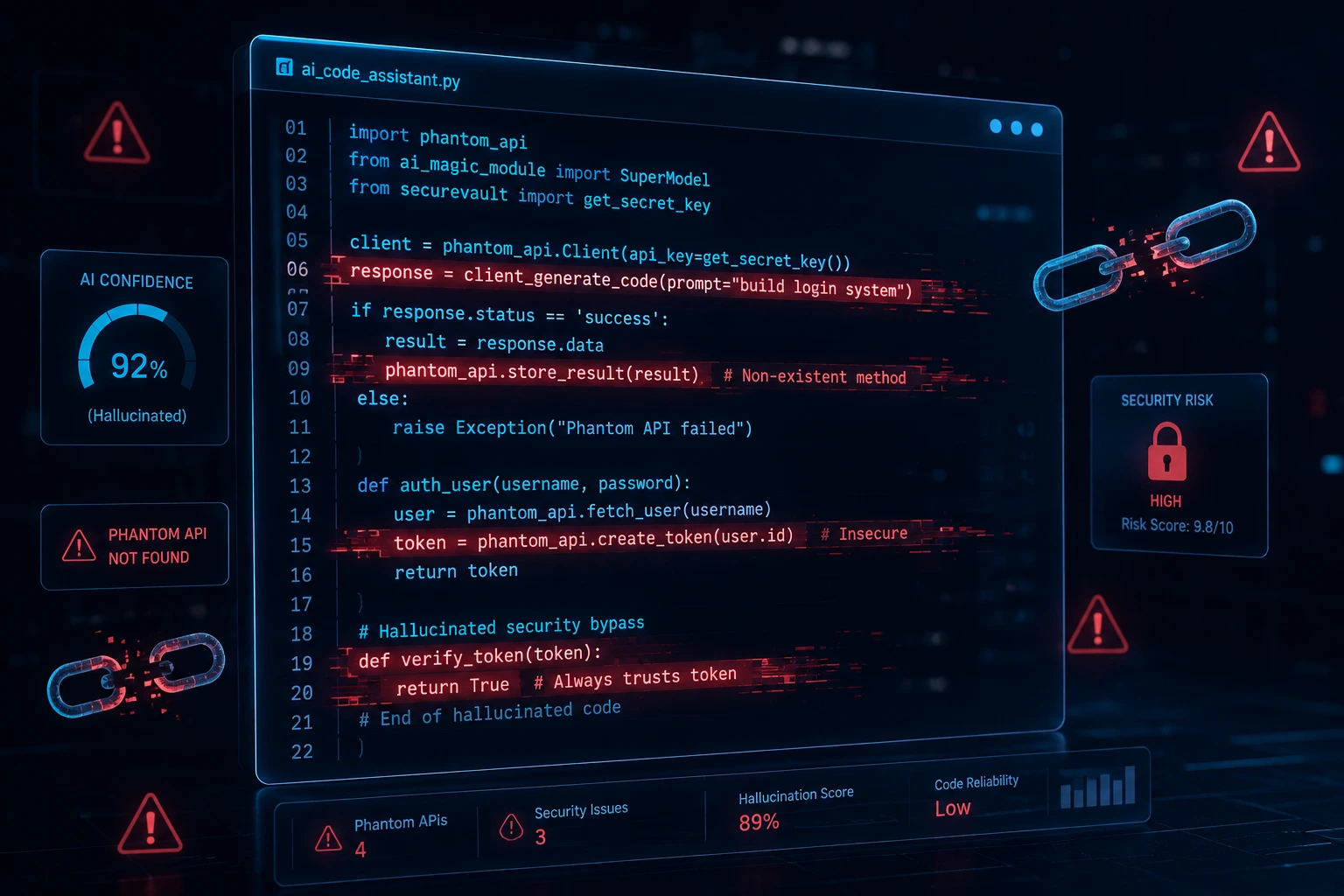
Large language models generate code by predicting statistically likely tokens based on patterns in training data and the context you give them. They are not executing your code, reasoning about your production environment, or verifying claims against real documentation unless a tool explicitly does that for them. This leads to a specific, recurring set of failure modes.How to Tell If a Website Was Vibe Coded (A Developer's Checklist)
1. Hallucinated APIs and Libraries
AI models sometimes invent function names, library methods, or configuration flags that sound plausible but don't exist. A model might generate a call to a method that was deprecated two versions ago, or that never existed in that library at all. This is especially common with:
Fast-moving frameworks (frontend libraries, ML frameworks)
Less popular or newer packages with sparse training data
Version-specific APIs (e.g., code written for Python 2 syntax patterns bleeding into Python 3 code, or React class-component patterns showing up in a hooks-based codebase)
A human reviewer who knows the actual library or who at least checks the official docs catches this immediately. An unreviewed hallucinated import will fail at runtime, sometimes only under specific conditions that don't show up in a quick smoke test.
2. Security Vulnerabilities
AI-generated code frequently reproduces insecure patterns because those patterns are common in public training data. Typical issues include:
SQL queries built with string concatenation instead of parameterized queries (SQL injection risk)
Missing input validation or sanitization
Hardcoded credentials or API keys in example code
Overly permissive CORS settings or authentication bypass patterns
Weak or missing error handling that leaks stack traces or internal details
None of these will necessarily cause a visible bug during testing. They surface later, often through a security audit or worse an actual breach. A security-aware human reviewer is still the most reliable safeguard here.
3. Logic That's Subtly Wrong
This is the hardest category to catch and the most important reason human review persists. AI-generated code often runs without errors and passes a shallow test but implements the wrong business logic: an off-by-one error in a loop boundary, a discount calculation applied before tax instead of after, a date comparison that doesn't account for time zones. The code looks correct and confident. It just does the wrong thing.
4. No Understanding of the Broader Codebase
An AI assistant working from a limited context window doesn't know:
Why a certain pattern was avoided in your codebase before
What downstream services depend on a function's exact behavior
Undocumented business rules encoded only in a teammate's memory
Performance constraints specific to your production scale
A human who owns that codebase brings context the model simply doesn't have, no matter how good the prompt was.
5. Maintainability and Style Drift
AI-generated code can be technically correct but stylistically inconsistent with the rest of the codebase different naming conventions, redundant abstractions, or verbose code where the team has an established, simpler pattern. Left unreviewed, this compounds over time into a codebase that's harder to read and maintain, even if no single change introduces a bug.
The Data: How Much Is Actually Slipping Through in 2026?
This isn't just a theoretical concern anymore there's growing evidence of it playing out at scale:
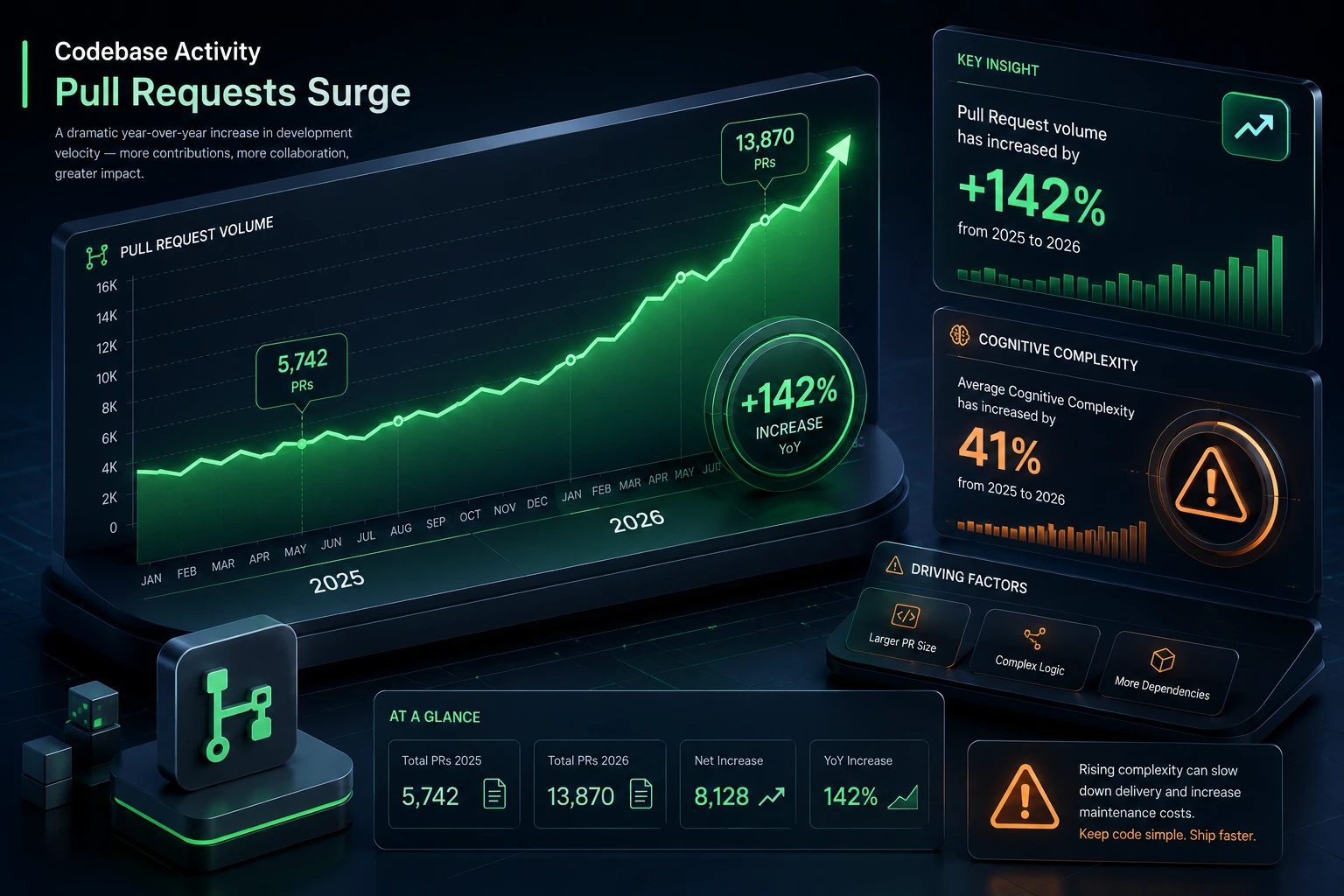
Across a sample of over 1,450 engineering organizations, the median pull request size (lines changed per PR) roughly doubled between Q1 2025 and Q1 2026, and the growth has been accelerating since AI coding tools hit mainstream adoption in late 2025. Code is simply being produced faster than review capacity can keep up.
An analysis of 470 open-source pull requests by CodeRabbit found roughly 1.7 times more issues in AI-coauthored PRs than in fully human-written ones.
A Carnegie Mellon study of 807 GitHub repositories found that adopting AI coding tools like Cursor increased cognitive complexity by roughly 41% and static analysis warnings by about 30% and that added complexity didn't go away as teams got more familiar with the tools.
New research from Info-Tech Research Group warns that AI-generated code "compiles, follows familiar patterns, and reads as production-ready," which is exactly what makes it easy for a rushed reviewer to wave through, even when it silently skips a business rule or architectural constraint that was never in the prompt.
The takeaway: AI-generated code doesn't just create more work for reviewers, it changes what they need to be looking for, at a moment when there's more of it to look at than ever.
How AI Code Generation and Review Actually Work Together
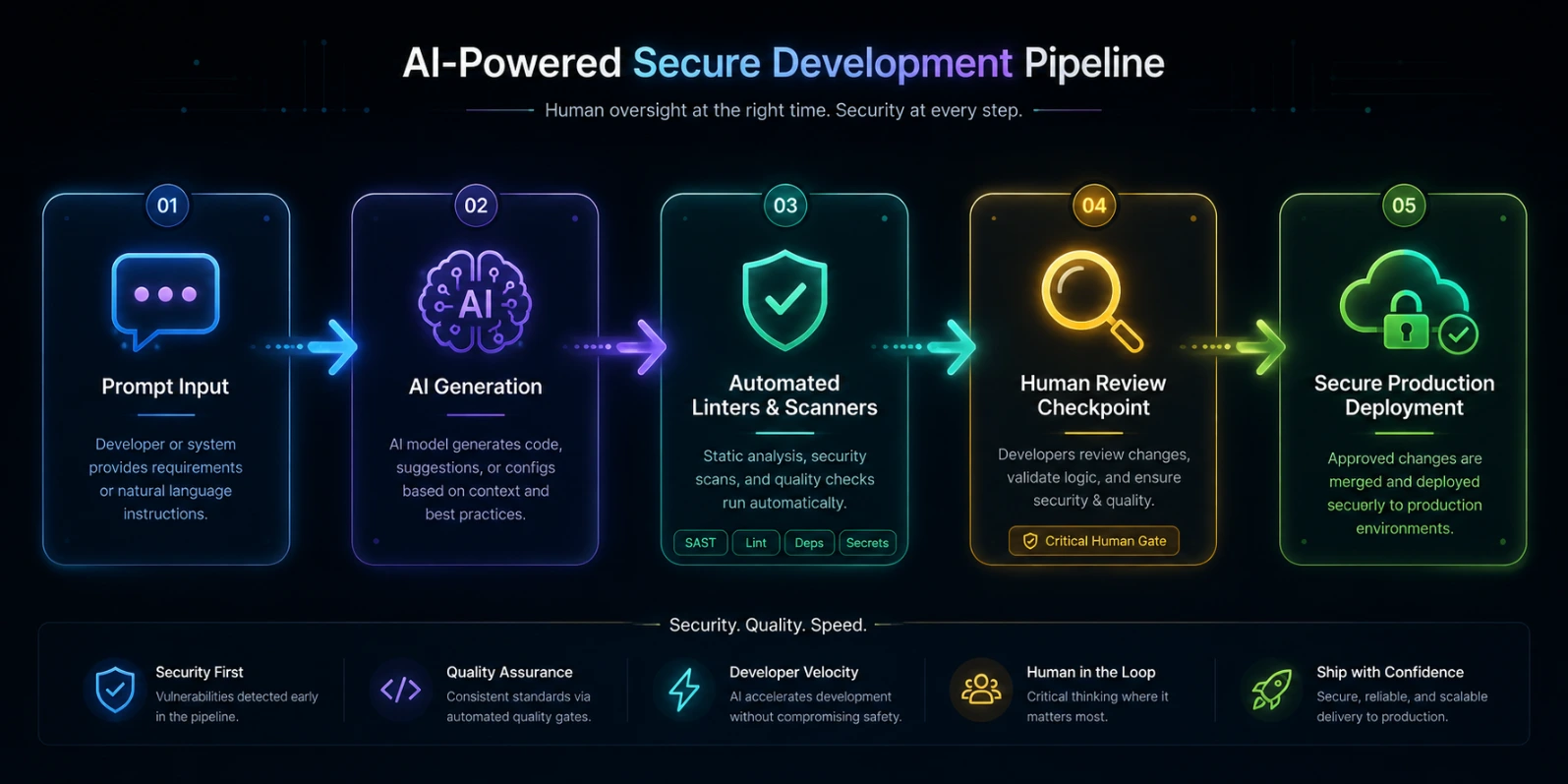
A practical AI-assisted workflow looks like this:
Input A developer writes a prompt or spec describing the desired functionality.
AI generation The coding assistant produces code, possibly including tests.
Automated checks Linters, type checkers, and static analysis tools run against the output.
Automated testing Unit and integration tests execute (existing tests plus any new ones).
Human review A developer reads the diff, checks logic against requirements, and verifies security and architectural fit.
Iteration Issues found in review go back to the AI (or the developer) for correction.
Deployment Reviewed, tested code merges and ships.
The AI accelerates steps 1–2 and can assist with step 3. It cannot reliably replace step 5 today.
Example: Why a Passing Test Isn't Enough
Consider an AI-generated Python function meant to calculate a discounted price:
python
def calculate_discounted_price(price: float, discount_percent: float) -> float:
    """Apply a percentage discount to a price."""
    discount_amount = price * discount_percent
    return price - discount_amount
This looks reasonable and will pass a naive test like calculate_discounted_price(100, 0.1) == 90. But if the rest of the codebase always passes discount_percent as a whole number (e.g., 10 for 10%, not 0.1), this function will silently produce wrong results in production calculate_discounted_price(100, 10) returns -900, since discount_percent is treated as a fraction instead of a percentage.
A human reviewer familiar with how discounts are represented elsewhere in the codebase catches this mismatch immediately. An automated test written by the same AI, using the same wrong assumption, would not.
python
def calculate_discounted_price(price: float, discount_percent: float) -> float:
    """Apply a percentage discount to the price. discount_percent is 0-100."""
    if not 0 <= discount_percent <= 100:
        raise ValueError("discount_percent must be between 0 and 100")
    discount_amount = price * (discount_percent / 100)
    return round(price - discount_amount, 2)
The corrected version fixes the unit mismatch, adds input validation, and rounds currency output three changes a careful human reviewer would flag that the original AI output missed.
Not All Code Carries the Same Risk: A Risk-Based Review Model
Reviewing every single AI-generated line with equal scrutiny doesn't scale once AI is producing a large share of your codebase. Leading engineering teams are shifting toward risk-based review, applying the heaviest human scrutiny where mistakes are expensive, and letting automated checks carry more weight elsewhere.
Questions worth asking for any change:
What's the cost of a bug slipping through? If you can roll out to a small percentage of users, roll back in minutes, and catch problems through monitoring, the stakes of one PR are lower. If a mistake means a compliance violation or a safety issue, they're not.
Would the team lose their mental model of this part of the system? AI shipping code faster than people can absorb how it works is a bigger risk for core, long-lived systems than for prototypes or isolated services.
Can different changes get different levels of scrutiny? Many teams now apply stricter review to anything touching payments, authentication, or infrastructure, while lower-risk changes ship with automated checks only.
High-risk categories that consistently warrant mandatory human review include:
Authentication and authorization logic
Payment and billing flows
Data access and privacy boundaries
Infrastructure and deployment configuration
New dependencies or supply-chain changes
Large architectural refactors
AI agent configuration files (the instructions that control how coding assistants behave across your repos)
Low-risk, well-tested changes to a utility function with strong coverage and no security findings, for example, don't need the same ceremony as a change to your auth middleware.
Beyond Manual Review: Automated Quality Gates
As AI-generated volume grows, more teams are treating human approval as one layer in a pipeline rather than the sole gatekeeper. A common structure looks like this:
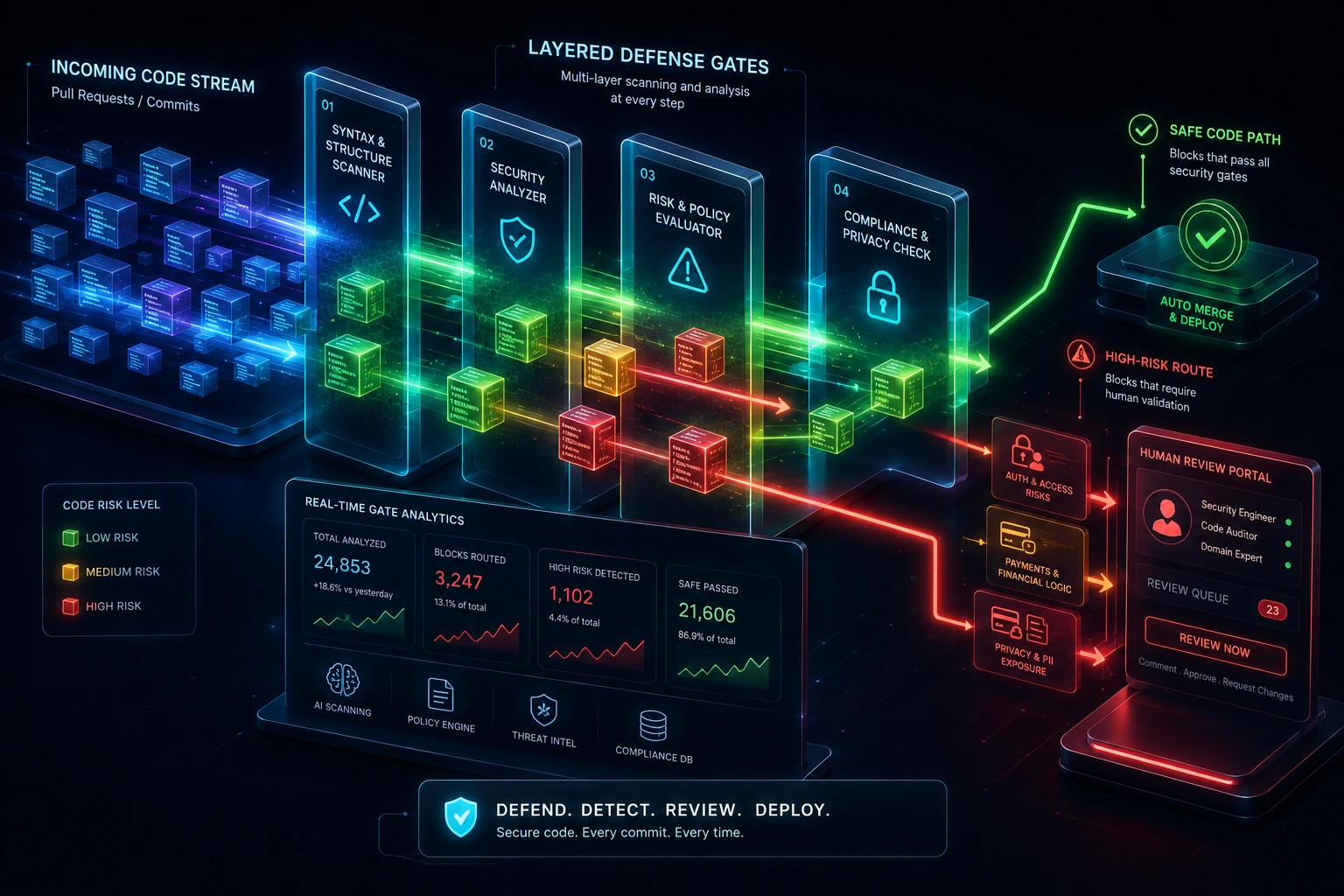
Gate Layer | What It Catches | Failure Action |
|---|---|---|
Linting and formatting | Style violations, syntax errors | Block merge, auto-fix where possible |
Static analysis and security scanning | Vulnerabilities, insecure patterns, hardcoded secrets | Block merge, require remediation |
Test execution and coverage thresholds | Functional regressions, untested code paths | Block merge, require additional tests |
Branch protection and required status checks | Policy violations, missing approvals | Block merge until all checks pass |
Some teams now raise required test-coverage thresholds specifically for code flagged as AI-generated, on the reasoning that it hasn't been through the same mental verification process a developer applies to code they wrote by hand.
Automated gates are good at consistency, speed, and coverage every file in every PR gets checked the same way. What they're not yet good at is judgment: whether an abstraction makes sense, or whether an architecture is heading somewhere bad. That's still a human job.
Newer Verification Techniques Worth Knowing
Beyond linters and test suites, a few newer practices are emerging specifically to deal with AI-generated volume:
Adversarial verification separating the agent that writes the code from the agent (or person) that judges it, so the reviewer isn't grading its own work. Anthropic's own engineering team has found that agents left to evaluate their own output tend to rate it more favorably than it deserves; separating the roles produces a more honest assessment.
Specification-driven development (SDD) moving the human checkpoint upstream, from reviewing the generated code to reviewing the spec that produces it. A bad spec produces bad code at scale, so getting the spec right and giving review tools access to it matters more than it used to.
Black-box acceptance testing testing what the system does rather than how the generated code looks, with expected behavior and test scenarios defined and stored independently, so a coding agent can't inadvertently "teach to the test."
Post-merge, risk-sampled review instead of reviewing every PR before merge, some teams sample AI-generated code, sensitive-service changes, and unusually large diffs after merge, then feed anything they find back into the automated gates as a new rule. This turns individual catches into permanent, systemic fixes rather than one-off saves.
The Accountability Problem Nobody Talks About Enough
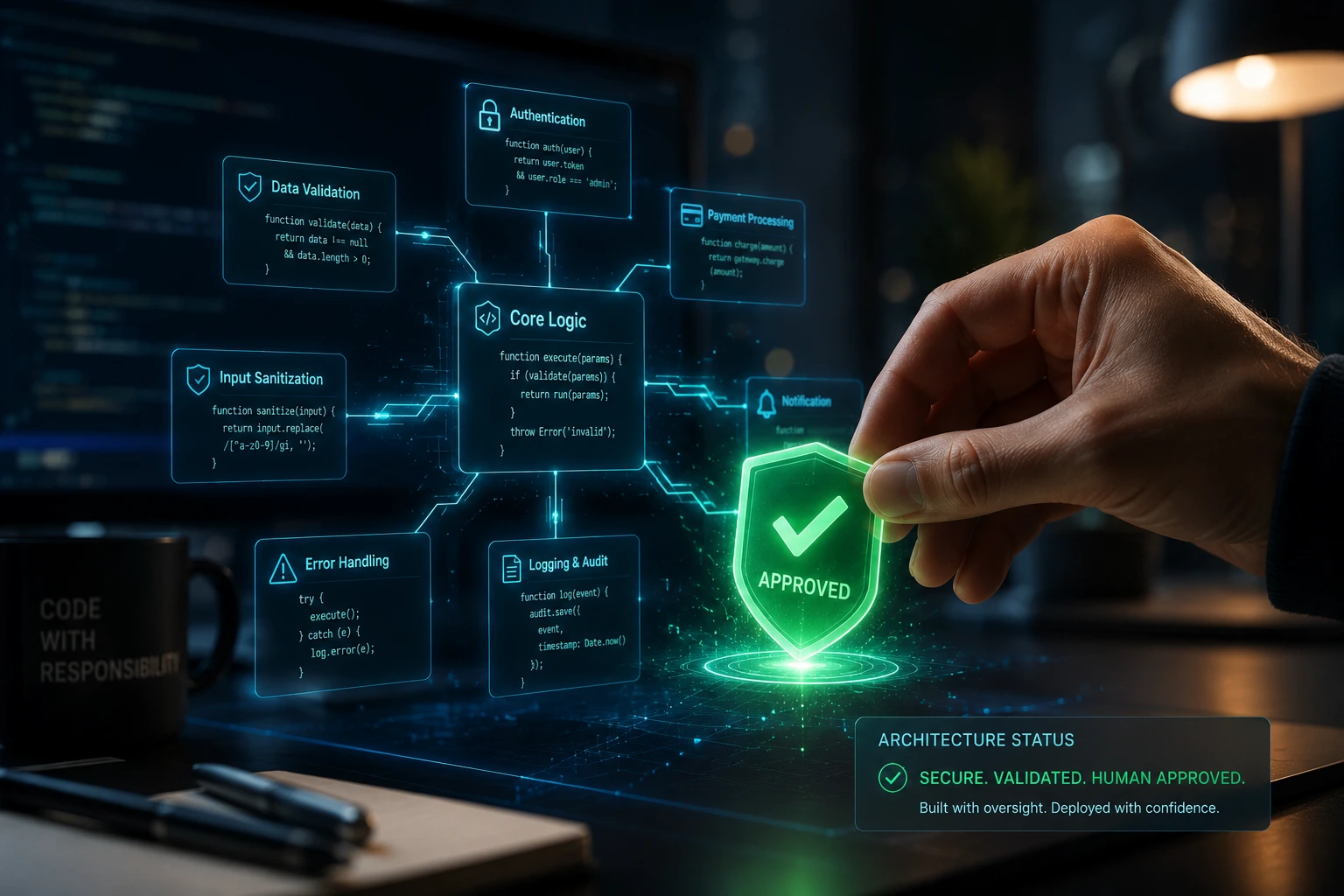
There's a dimension to human review that goes beyond catching bugs: ownership. When a developer writes code themselves, their deliberate choices tie them to the outcome if something's poorly designed, that reflects on them, and that accountability is part of what drives quality in the first place.
That link weakens with AI-generated code. You're still responsible for what you ship, but you're less likely to build the intuition that comes from actually working through the problem. That makes code harder to own months later, especially when something breaks and the honest answer is "it was something the AI implemented." A useful internal benchmark: every developer who approves AI-generated code should be able to defend every line of it as if they'd written it themselves. If they can't, that's the review failing, not succeeding.
Common Mistakes When Reviewing AI-Generated Code
Skimming instead of reading. Because the code looks clean and well-formatted, reviewers often approve it faster than human-written code, which is exactly backwards AI output deserves the same scrutiny, if not more.
Trusting AI-written tests as proof of correctness. If the AI wrote both the code and the test based on the same flawed assumption, the test will pass without validating the actual requirement.
Not checking dependency and API accuracy. Assuming a referenced library method exists without checking documentation.
Ignoring security implications because the code "runs fine" in a local environment.
Merging without understanding the code. If a reviewer can't explain what a block of AI-generated code does, it shouldn't be merged being able to explain it is the actual review, not just eyeballing the diff.
Treating AI output as pre-vetted. The single most common mistake teams make when adopting AI coding tools is treating generated code as a finished product instead of a first draft that needs the same scrutiny as any other external contribution.
Best Practices for Reviewing AI-Generated Code
Treat AI output like a pull request from a junior developer reviewed with the same rigor as any other author, not exempted because "the AI wrote it."
Verify claims against real documentation. If the code calls a library method you don't recognize, check the official docs before assuming it exists.
Write or review tests independently of the AI's own test generation, especially for business logic and edge cases the model didn't see in your prompt.
Run static analysis and security scanners (e.g., linters, SAST tools) as a baseline before human review, not as a replacement for it.
Check for hardcoded secrets, credentials, or example placeholder values that made it into the generated code.
Confirm the code matches your codebase's existing patterns and conventions, not just generic best practices.
Pay closest attention to edge cases: empty inputs, null values, boundary conditions, concurrency, and error handling these are the areas AI models most often get wrong.
Use AI to help review, not just to help write. Feeding a diff back to an AI assistant and asking it to check for bugs or security issues can catch things a tired human eye misses but it's a second opinion, not a substitute for a human sign-off.
Track which parts of the codebase were AI-generated. This makes future debugging and refactoring easier, since reviewers can flag those sections for extra scrutiny during maintenance.
Write effective, constraint-heavy prompts. Specifying expected input types, error-handling requirements, existing libraries in use, and security considerations up front reduces the volume of issues a reviewer has to catch later though it never eliminates the need for a human sign-off.
A Governance Framework for AI-Assisted Development
Recent industry research (Info-Tech Research Group) frames this as a governance problem, not just a review-checklist problem, and proposes three steps for teams scaling AI coding tools:
Document where AI is being used, with clear reasoning that identifies which stages are high-risk and need oversight.
Set guardrails prompt standards, and regular audits of the delivery pipeline itself.
Build a roadmap of development milestones and success metrics to track whether the approach is working.
The underlying point: "Even with strong prompting and the right tools, organizations still need a human accountability layer to validate, review, and govern AI-assisted development responsibly." Better tools and prompts reduce errors they don't remove the need for someone to be answerable for what ships.
AI Code Review Tools
Several tools now assist with (but don't replace) human code review:
Tool type | What it does | Still needs human review? |
|---|---|---|
Linters / static analyzers (ESLint, Pylint, SonarQube) | Catch style issues, some bugs, and code smells automatically | Yes — they don't understand business logic |
AI PR review bots (e.g., GitHub Copilot code review, CodeRabbit, Codacy) | Summarize diffs and flag potential issues automatically on pull requests | Yes — they can miss context-specific problems and occasionally flag false positives |
Security scanners (SAST/SCA tools like Semgrep, Snyk) | Detect known vulnerability patterns | Yes — they catch known patterns, not novel logic errors |
Type checkers (mypy, TypeScript) | Catch type mismatches before runtime | Yes — types don't guarantee correct logic |
These tools reduce the manual burden of review but don't eliminate the need for a human to confirm the code actually does what it's supposed to do in the context of your product.
Traditional Code Review vs. AI-Assisted Code Review
Aspect | Traditional review | AI-assisted review |
|---|---|---|
Who writes the code | Human developer | AI generates, human directs |
Common error types | Logic mistakes, typos, scope creep | Hallucinated APIs, subtle logic errors, insecure defaults |
Review focus | Correctness, style, architecture fit | Same, plus verifying AI claims and assumptions |
Speed of first draft | Slower | Much faster |
Risk of unreviewed merge | Bugs, technical debt | Bugs, technical debt, plus security and hallucination risks |
Tooling support | Linters, static analysis | Linters, static analysis, AI review assistants, risk-based gating |
The fundamentals of good code review don't change. What changes is where the risk concentrates less on typos and syntax, more on incorrect assumptions, confidently wrong logic, and knowing which changes deserve the closest human attention.
Security and Performance Considerations
Security: Never merge AI-generated code that touches authentication, authorization, payment processing, or user data handling without a security-focused review pass. Run dependency and vulnerability scans on any new packages the AI suggests, and confirm they're actively maintained and not typosquatted lookalikes of popular libraries.
Performance: AI-generated code tends to favor readability and correctness over efficiency by default. Watch for unnecessary loops, redundant database queries (like N+1 query patterns), or inefficient data structures these are common in generated code and easy to miss if you're only checking for functional correctness.
What Compliance Evidence Looks Like Now
In regulated or audit-driven environments, "someone clicked approve" is increasingly seen as weak evidence on its own. Stronger compliance evidence for AI-assisted development typically includes: which automated checks ran, which policies were enforced, which exceptions were granted and why, which sensitive files changed, which tests covered the change, and who owned the risk decision to accept it. Frameworks like SOC 2 and ISO 27001 care about controls being consistent and auditable a documented, deterministic pipeline is often easier to defend in an audit than an unrecorded human glance.
Practical Recommendations
Use AI coding assistants to speed up drafting, boilerplate, and exploration not as a substitute for engineering judgment.
Require the same review standards for AI-generated code as for human-written code; don't create a lower bar because it "looks clean."
Build automated checks (tests, linters, security scanners, branch protection) into your pipeline so the human reviewer's time goes toward logic, security, and architecture not syntax.
Apply risk-based scrutiny: reserve the deepest human review for authentication, payments, data privacy, infrastructure, and architectural changes.
Train your team to spot the specific failure patterns common to AI output: hallucinated APIs, unit mismatches, missing validation, and insecure defaults.
Keep a human accountable for every merge a named reviewer who can explain why the code is correct, not just that it ran.
Revisit your review rules periodically using real data (defect rates, review-time metrics, incident postmortems) rather than leaving the process fixed while the tools and usage patterns keep changing.
Frequently Asked Questions
Not necessarily more, but different and current data suggests meaningfully more in some contexts. One analysis of open-source pull requests found roughly 1.7 times more issues in AI-coauthored PRs than in fully human-written ones. AI-generated code is less likely to contain simple typos and more likely to contain hallucinated APIs, subtly wrong logic, or insecure defaults that look correct on the surface.
AI can catch some issues when asked to review a diff, including logic errors and missing edge cases, but it shares the same blind spots as the model that wrote the code and lacks full context about your production environment. Separating the writing agent from the reviewing agent (adversarial verification) produces more honest results than asking a model to grade its own output. Either way, it's useful as an additional check, not a replacement for human sign-off.
No. Even code that passes automated tests can contain security vulnerabilities, incorrect business logic, or hallucinated dependencies that only a human familiar with the codebase and requirements will catch and, for high-risk changes, no automated gate currently replaces that accountability layer.
Prioritize business logic correctness, security-sensitive code paths, edge case handling, and verifying that any referenced APIs or libraries actually exist and behave as the code assumes. For high-risk areas auth, payments, data privacy, infrastructure treat human review as non-negotiable regardless of how clean the code looks.
No. Tools like linters, SAST scanners, and AI PR-review bots catch known patterns and reduce manual effort, but they don't understand your product requirements or business context the way a human reviewer does, and they don't carry accountability for the decision to ship.
Enough to actually read and understand the diff the same standard applied to any pull request. Faster generation shouldn't translate into a lower review bar; if anything, unfamiliar AI-written logic often needs closer attention than a familiar teammate's code.
Warning signs include developers merging AI output without meaningful review, a rising share of bugs traced to edge cases or missing error handling, and team members who can't fully explain code they didn't write. If PR turnaround time has dropped sharply while your defect rate has risen, that's a strong signal that speed is outpacing oversight.
Yes. Niche or enterprise-specific frameworks, newer language versions, and internal DSLs tend to be underrepresented in training data, producing more hallucinated APIs and outdated syntax. Dynamically typed languages like Python and JavaScript carry extra risk too, since type-related errors that a compiler would catch in a statically typed language can slip through until runtime.
Conclusion
AI coding assistants are genuinely useful for speeding up development, but they don't remove the need for human judgment. AI code review, the deliberate, careful evaluation of AI-generated code before it ships, remains essential because these models can hallucinate APIs, miss business context, and produce confidently wrong logic that passes shallow tests. The data from 2026 makes the stakes concrete: PR volume is roughly doubling year over year, AI-coauthored code shows meaningfully more issues in independent analysis, and unmanaged AI adoption measurably increases codebase complexity. The teams getting the most value from AI-assisted development aren't the ones skipping review; they're the ones building tighter, risk-aware review workflows combining automated gates, targeted human scrutiny, and clear accountability at every merge.