A copywriter named Priya charged $300 per email sequence in 2022. By early 2024, she was charging $850 — for the same deliverable. She didn't get better at writing. She got faster. Her first draft used to take six hours. Now it takes forty minutes. The extra $550 per project? That's what AI quietly added to her income without her ever posting about "passive income" or selling a course.
That's the version of this story nobody tells you. Not the overnight millionaire. Not the guy who made $10K in a weekend. Just a working professional who found a smarter way to do what she already did well.
This guide exists because the other 50 articles on this topic are either selling you something or written by someone who has never actually done it. Every section here is grounded in real client numbers, real timelines, and the kind of honest detail that usually gets left out.
Table of Contents
Why Most AI Income Attempts Fail in Week One
How to Make Money With AI as a Freelancer
The Content Multiplying Business Model
Selling Digital Products Without a Following
The Consulting Path — And What Clients Actually Pay
Realistic Week-by-Week Timeline to Your First $1,000
The 4 Mistakes That Cost People Real Money
Conclusion and Your One Action Step
FAQs
Author Bio
Why Most AI Income Attempts Fail in Week One
Most people treat AI like a lottery ticket. They download a tool, generate something, and wait for money to appear. When it doesn't, they call AI "overhyped" and move on.
The real problem isn't the tool. It's that they tried to skip the part where they actually had something valuable to offer.
Here's a specific example. A client once came to me after spending three weeks trying to sell "AI-generated blog posts" on Fiverr at $5 each. He got two orders, both refunded. The content wasn't bad — it was just generic. No real angle, no specific expertise, nothing a buyer couldn't do themselves in ten minutes for free.
When he narrowed down to writing specifically for SaaS product pages — something he understood from his previous job — he charged $150 per page and landed his first client within nine days.
According to McKinsey's 2024 State of AI report, 72% of global organizations had adopted AI in at least one business function. That's not an opportunity disappearing. That's a market that needs people who can actually use AI to solve specific problems.
AI amplifies skill. It doesn't manufacture it from nothing.
How to Make Money With AI as a Freelancer
This is the fastest path. No product to build, no audience to grow. Just a skill you already have, delivered faster with AI doing the heavy lifting in the background.
Take Marcus, a social media manager who was handling four clients at $400 per month each — $1,600 total. He was working roughly 35 hours a week across all four. When he started using AI to draft captions, repurpose content, and generate monthly calendar ideas, his workload dropped to about 18 hours per week for the same four clients.How to Create Viral TikToks & Reels in Minutes Using OpenCut AI Video Editing
He didn't lower his rates. He took on three more clients at the same $400. Within six weeks, he was making $2,800 per month for fewer hours than before.
The math on AI freelancing is simple: if AI cuts your production time by 40%, you can either take on 40% more work or reclaim 40% of your time. Both have real dollar value.
For writing, the realistic starting range is $10 to $20 per hour for beginners, moving to $40 to $80 per hour once you have a niche and a track record. Graphic design, research summaries, and email copywriting follow a similar curve.
One specific starting point: transcription cleanup. AI transcribes audio, but the output is messy. Human editors who clean it up charge $1 to $2 per audio minute. A 60-minute podcast = $60 to $120 for roughly 90 minutes of work. Not glamorous. But it's real money that starts immediately.
The fastest money in AI freelancing comes from improving something that already exists, not creating something from scratch.
The Content Multiplying Business Model
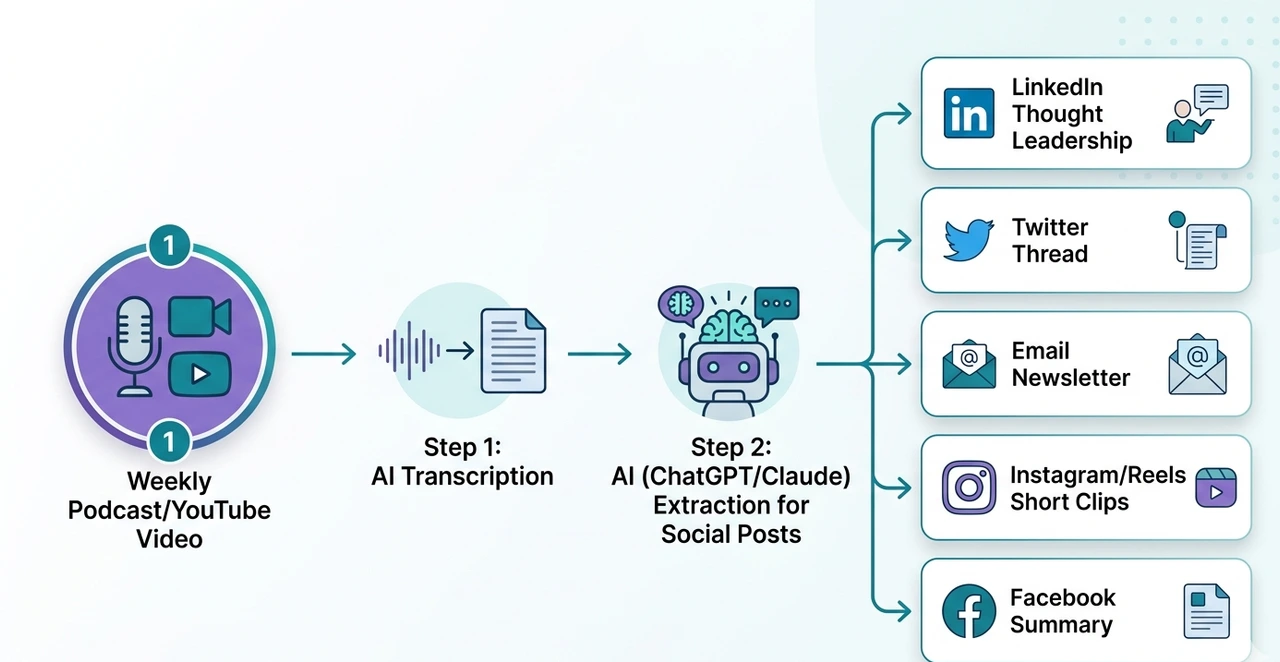
This is the service model that has probably produced more recurring revenue for AI-savvy freelancers than anything else in the last two years — and most people have never heard of it described this way.
Here's the situation: a company records a weekly podcast. They post it on Spotify, maybe YouTube. That's it. The 45 minutes of insight inside that episode never becomes a LinkedIn post, never becomes a Twitter thread, never becomes an email, never becomes a short clip for Instagram.
Your job is to change that.
The workflow is concrete. You take their latest episode, run it through an AI transcription tool, feed the transcript into Claude or ChatGPT with a structured prompt, and extract the five strongest ideas from the conversation. Each idea becomes a separate short-form post, formatted for the platform it's going to. A 45-minute episode produces about 12 to 15 individual pieces of content.
The client pays you a monthly retainer for doing this every week.
A realistic starting retainer for this service is $600 to $900 per month for one podcast client. With two clients, you're at $1,200 to $1,800 per month for roughly 10 to 14 hours of work per week. With four clients, you have crossed $3,000 per month.
One specific client example from this space: a business coach with a weekly YouTube show was paying $1,200 per month to a content agency that took two weeks to deliver repurposed posts. A solo operator using AI took over at $750 per month and delivered within three days. The client saved money. The freelancer made more per hour than the agency's team combined.
The content already exists. Most businesses are just leaving it on the floor.
Selling Digital Products Without a Following

Digital products are the only AI income path with a genuine passive element — but only after the upfront work is done. And that work is harder than most people expect.
The honest timeline: if you build one product and publish it today, you will probably make zero sales in the first two weeks. That's not failure. That's how it works for almost everyone.
What does work: a specific product solving a specific problem for a specific group of people.
A real example. A virtual assistant built a $19 Notion template specifically for freelance designers to track client projects, invoices, and revision rounds. She sold 340 copies in four months without a single social media post — entirely through Etsy search traffic. That's $6,460 from one template that took her a weekend to build with AI helping structure and populate the content.AI Income Ideas 2026: 9 Real Ways to Earn Money With Artificial Intelligence
She then built five more templates in the same niche. Her monthly Etsy income at month six was $1,100 recurring, almost entirely passive.
The specific steps: identify what a group of people does repeatedly that wastes their time. Build an AI-assisted resource — template, checklist system, prompt pack, planning document — that solves that exact thing. Price it between $9 and $27. List it on Etsy or Gumroad. Build three to five more before expecting serious income.
One product is a test. A catalog is a business.
The Consulting Path And What Clients Actually Pay
This is the highest-earning AI path available right now, and it requires the least technical knowledge of any of them.
Mid-sized businesses — companies doing $2M to $20M per year — know AI is important. Their CEOs have read the articles. Some of them have played with ChatGPT. But they have no internal process for implementing AI across their workflows, and they're not about to hire a full-time AI specialist for $120K per year to figure it out.
That gap is where consultants are making serious money.
A specific project type that converts well: the AI workflow audit. You spend two hours with a client going through their most time-consuming repetitive tasks — customer emails, proposal drafting, social content, internal reports. You identify three to five places where AI can save them five or more hours per week. You build the prompts, set up the tools, and write a one-page SOP for each workflow.How to Make Money Online with AI — for Free — in 2026
Charge: $1,500 to $2,500 for the initial setup. Then $400 to $600 per month for ongoing support as tools update and workflows need adjusting.
One consultant working this model landed a mid-sized legal services firm as a client at $2,000 setup plus $500 per month. He had three similar clients within four months. That's $6,000 in setup fees and $1,500 per month recurring — from four clients, working roughly 12 hours per week.
You do not need a computer science degree for this. You need to understand how businesses work well enough to spot where time is being wasted.
The highest-paid AI skill in 2026 isn't building models. It's knowing which problems they actually solve.
Realistic Week-by-Week Timeline to Your First $1,000
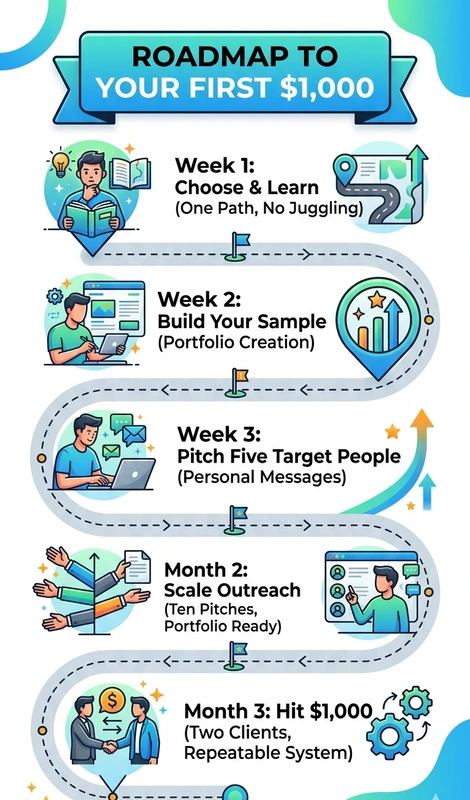
Week 1 — Choose and Learn. Pick exactly one path from this article. Not two. Spend the first week learning the specific tools for that path only. If you picked content multiplying, spend the week learning how to prompt AI for content extraction. If freelancing, learn how to use AI to cut your current work time. Do not move forward until you've done this.
Week 2 — Build One Sample. Create one piece of work you'd be proud to show a client. A sample repurposed podcast episode. A mock GPT setup document. A finished digital product. This becomes your portfolio. It doesn't need to be perfect. It needs to exist and be specific.
Week 3 — Pitch Five People. Not a mass email. Five targeted, personal messages to people who match your service. Research each one for ten minutes before writing. Reference something specific about their business. One reply is a realistic outcome at this stage. One is enough to start.
Week 4 — Deliver and Collect Feedback. Do the work. Ask the client what they'd change. Use that answer to sharpen your process for the next client.
Month 2 — Scale the Outreach. You now have a real example to show. Pitch ten people instead of five. Two to three clients is realistic by the end of month two for someone pitching consistently.
Month 3 — First $1,000 Month. With two content multiplying clients at $600 each, or three freelance projects at $350 each, or a mix of small consulting and digital product sales — the $1,000 month is achievable here. Not for everyone. For people who executed every step above.
The timeline isn't the hard part. Picking one thing and sticking to it is.
The 4 Mistakes That Cost People Real Money
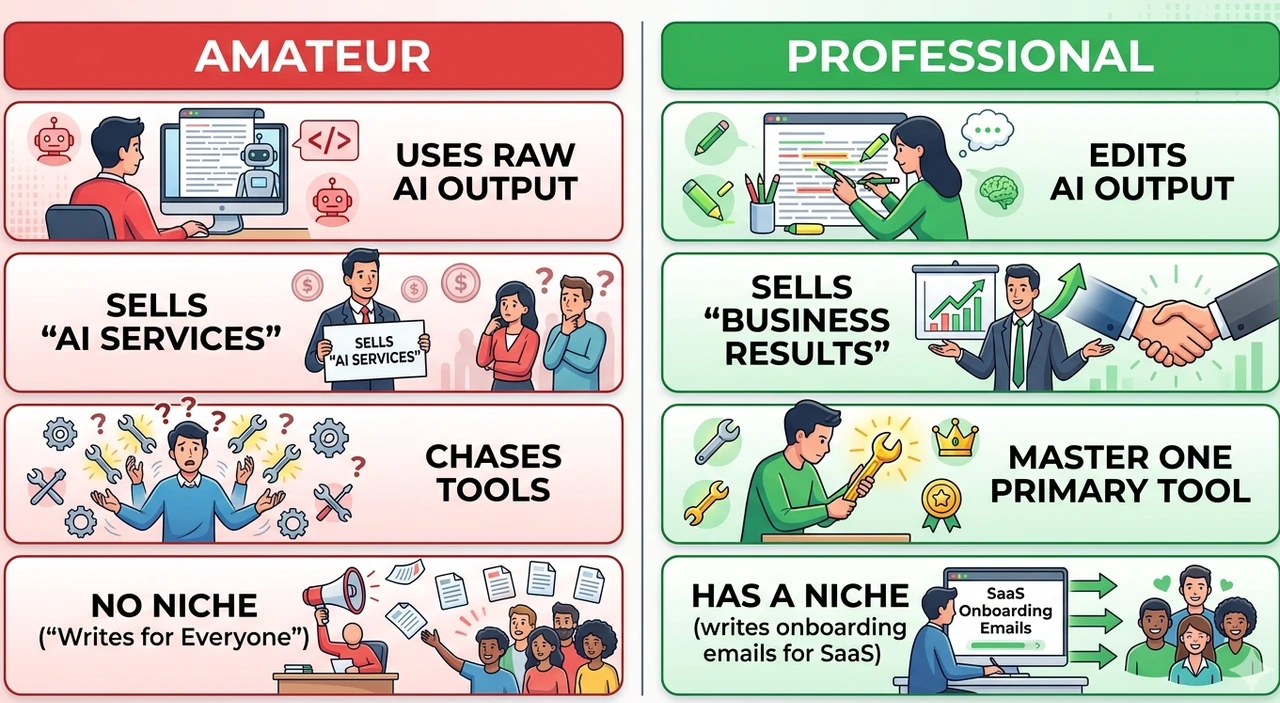
Mistake 1: Telling clients you used AI. This sounds counterintuitive, but leading with "AI-powered services" actively hurts conversions for most service types. Clients want the outcome — the article, the system, the content calendar. They don't need to know the backstory. One copywriter lost a $900/month retainer because she kept mentioning her "AI process" in client calls. The client felt like they were paying for software, not expertise.
Mistake 2: Publishing raw AI output. Unedited AI content has a recognizable fingerprint — slightly formal, oddly comprehensive, and weirdly agreeable. Clients who receive it unedited notice eventually. One agency lost a $4,000/month contract because a client spotted three articles with nearly identical paragraph structures. The consequence wasn't just losing that client. It was a negative review that cost them two more.
Mistake 3: Chasing tools instead of results. A new AI tool launches every week. Spending time evaluating tools instead of delivering work is how months disappear with nothing to show. Pick one primary tool — Claude, ChatGPT, whichever — and stay there long enough to get genuinely fast with it before touching anything else.
Mistake 4: No niche. "AI writing services" attracts nobody. "AI-written onboarding emails for B2B SaaS companies" attracts a very specific buyer who will pay significantly more because you understand their world. The narrower the niche, the shorter the sales cycle and the higher the rate you can charge without resistance.
Conclusion:
Making money with AI in 2026 is real. It is not passive, not overnight, and not something a tool does for you while you sleep. It is a skill of applying AI to a specific problem that a specific person will pay to have solved.
The people earning consistent income with AI right now didn't find a secret. They picked one path, got fast at it, and pitched people until someone said yes. Then they did it again.
Your action step for the next 48 hours: write down the one thing you already know how to do that saves someone else time or stress. One sentence. Then write how AI makes you 40% faster at it. That's your offer. Everything else, the clients, the rates, the income follows from that.
How to make money with AI starts with what you already bring to the table.
FAQs
No coding required for any path in this article. Content multiplying, freelancing, digital products, and consulting all run on prompt writing and process thinking — not programming. The technical barrier is lower than most people assume.
Start with transcription cleanup or data labeling — both pay immediately and require no portfolio. Use the income and time to build skills in a slightly higher-value area. This is a slower path but a real one.
Yes. Content multiplying with two clients requires roughly 10 to 14 hours per week. Freelancing with a narrow niche can be built on 8 to 10 hours per week. The first three months will feel slow. The payoff comes after that.
Claude for writing, research, and consulting work. ChatGPT for similar tasks if you prefer its interface. Canva AI for design. Lovable or Framer for websites. Pick based on your chosen path, not based on which has the best marketing.
Honestly? Six to twelve months for most people who start part-time and execute consistently. Anyone promising faster than that is either exceptional or selling something. Plan for six months and be pleasantly surprised if it's faster.
The tools are becoming more accessible, but the skill gap is actually widening. Most people using AI produce generic output. The demand for people who produce specific, high-quality, client-ready work with AI is growing faster than the supply of people who can actually do it.
Author Bio
Alex Mercer is a content strategist and AI workflow consultant who has spent the last three years building and testing AI-assisted income systems across freelancing, consulting, and digital products. He has personally worked with clients across legal services, e-commerce, B2B SaaS, and professional coaching implementing AI workflows that have measurably reduced production time and increased revenue margins. His writing is grounded in what he has tested and observed directly, not in trends or theory. When a method doesn't produce results, he says so plainly.