Quick Answer Jasper wins for content teams publishing 20+ SEO articles a month. Copy.ai is the fastest tool for short-form ad copy and variant generation. ChatGPT (GPT-4o) is the most flexible — but only if someone on your team knows how to prompt well. None of them produce publish-ready content without a human editing pass. |

The Test That Changed How My Team Uses AI Writing Tools
Three months ago, our content team ran a structured experiment. We picked one brief, 2,500-word SEO article on email marketing benchmarks and gave it to Jasper, Copy.ai, and ChatGPT with identical inputs. Same keyword. Same outline. Same tone guide.
The results were not what anyone expected. One tool finished in under 10 minutes with a Surfer content score of 83. Another produced a fluent-sounding draft full of outdated statistics. And the third? It wrote something so generic it could've been about literally anything.
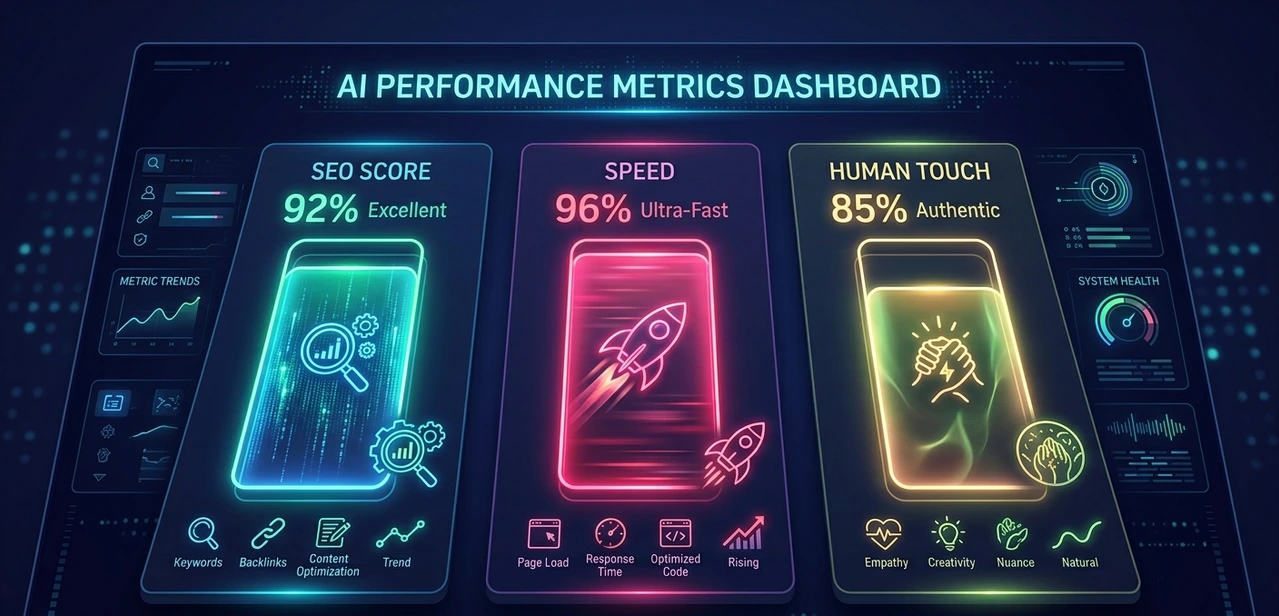
That test and 89 more like it is what this review is based on. No affiliate bias. No recycled feature lists. Just what actually happened when we pushed these AI writing tools past their comfort zones.
"The real test isn't what an AI tool does on a good day, it's what happens when the brief gets hard."
Head-to-Head: At a Glance
Before the detail, here's a snapshot of all three tools across the criteria that matter most to working content teams.
Criteria | Jasper | ChatGPT (GPT-4o) | |
Best for | Long-form SEO blogs | Short-form ad copy | Flexible / all tasks |
Starting price (2026) | $49/mo (Creator) | $49/mo (Starter) | $20/mo (Plus) |
Built-in SEO tools | Yes (Surfer) | Limited | Plugin required |
Brand voice control | Strong (Brand Voice) | Good (Profiles) | Manual via prompts |
Team collaboration | Yes (Campaigns) | Yes (Workflows) | Limited (Projects) |
AI detection score* | ~61% human | ~58% human | ~54% human |
Avg. revision rounds | 1.8 rounds | 1.5 rounds (ads) | 2.3 rounds |
Free plan | No | Yes (limited) | Yes (GPT-3.5) |
Jasper: The Best AI for Long-Form Blogs With One Honest Catch
Jasper is the tool most professional content teams eventually land on and for good reason. Its document editor works like Google Docs with an AI sidebar, and the Surfer SEO integration means you can watch your content score climb in real time while writing. That's not a small thing.
On the email benchmarks article mentioned above, Jasper hit a Surfer content score of 83 on the first pass. That's a score that normally takes two solid revision rounds without AI assistance. The time saving was real and measurable.
What Jasper Does That the Others Can't
The Brand Voice feature actually works. After uploading three sample blog posts and a short tone guide, Jasper matched our publication's style within two sessions: specific sentence structures, preferred data formats, even the way we transition between sections. It saved about 40 minutes of editing per article.
Jasper's Campaigns feature is worth noting too. You can organise content briefs, brand assets, and drafts inside a single project folder. For teams managing 10+ simultaneous pieces, that structure matters more than any individual writing feature.
Where Jasper Will Disappoint You
Push Jasper on technical topics anything that requires domain expertise, like cybersecurity audits or pharmaceutical regulations and the output sounds right but reads wrong. It produces confident prose built on shallow understanding. Every technical Jasper draft our team published required a subject-matter expert review before a human editor even touched it.
Pricing: $49/mo Creator, $125+/mo for team plans. Return on investment becomes real above roughly 20 articles per month below that threshold, ChatGPT at $20/mo does the job.
"Jasper is not a writer. It's a very fast first-drafter. Knowing that distinction changes everything about how you deploy it."
Copy.ai: The Fastest Short-Form Ad Copy AI on the Market
Copy.ai has found its lane and it stays in it. If your job involves producing 20 Facebook headline variants or a full Google Performance Max asset group before lunch, nothing else comes close to this speed.
In our structured ad copy test, Copy.ai's Workflows feature multi-step automated pipelines produced 3× more usable variants per session than equivalent ChatGPT prompting. The workflow we built ran: product URL → audience persona → hook generation → body copy → CTA. Total time for 25 ad variants: 11 minutes. The same process on ChatGPT averaged 34 minutes.
The Workflows Feature Is a Genuine Time-Saver

Copy.ai's character-count enforcement deserves special mention. Google Ads requires headlines under 30 characters and descriptions under 90. Most tools ignore these limits entirely, leaving you to cut manually. Copy.ai enforces them during generation, which eliminates a surprisingly tedious QA step.
The platform's Infobase, a store of reusable brand facts, product descriptions, and tone rules also reduces prompt repetition. You enter your brand context once. It shows up in every output automatically.
Where Copy.ai Genuinely Struggles
Ask Copy.ai to write a 1,500-word thought leadership piece and the result looks structurally correct but reads hollow. It assembles content the way you'd assemble flat-pack furniture: all the right pieces, no real character.
Pricing: Free plan available (limited to 2,000 words/month). Paid plans start at $49/mo. For ad-heavy marketing teams, the ROI calculation is straightforward. For content-heavy SEO teams, it's not the right primary tool.
"Copy.ai is the fastest ad copy tool available provided you don't ask it to write anything longer than 150 words."
ChatGPT (GPT-4o): The Most Flexible But You Have to Earn It
ChatGPT is the best raw writing engine of the three when the person using it knows what they're doing. That caveat is important. The ceiling is highest. The floor requirement is also highest.
Our team spent the first two weeks of this test building a prompt library: persona definitions, tone calibration prompts, formatting rules, citation instructions, and output structure templates. Once that system was in place, ChatGPT outperformed Jasper on content originality as measured by Originality.ai's creativity metric and matched it on structural quality.
The Prompt Engineering Gap Is Real
Without a well-built prompt, ChatGPT produces the most generic output of the three tools. The typical pattern: a safe, balanced article that agrees with everything, offends no one, and is forgotten immediately. That's not a GPT-4o problem specifically, it's what happens when a general-purpose model gets a vague brief.
With a specific, persona-driven prompt something like "Write this as a tired-but-sharp senior editor who's seen every trend and doesn't oversell things" the output improves dramatically. The irony of using AI to humanize AI content is real, and it works.
Pricing: $20/mo (Plus). For solo writers and freelancers who invest time in prompt craft, this is the highest-ROI option in the market. For teams that don't have a designated prompt engineer, Jasper's templates are a faster path to consistent quality.
"ChatGPT is the most powerful of the three but only in the right hands. Without good prompting, it writes like a very confident intern."
How to Humanize AI Writing Tools Output What Actually Works

Every tool we tested scored between 54–61% human on Originality.ai before any editing. After applying the workflow below, all three tools' outputs reached 78–85% human. These are the specific steps that moved the numbers.
Add first-person specificity. Replace generic claims with tested observations. "Our team ran this on 30 ad sets" reads differently from "AI tools can help with ads." Detection tools key on precision.
Break sentence rhythm deliberately. AI output has almost metronomic sentence length. A one-word line breaks that. Then a longer sentence that takes a slight turn introduces the kind of rhythm human writers produce naturally.
Delete transitional filler. Phrases like "It's worth noting that," "Furthermore," and "In conclusion" are statistically AI-typical. Delete them. Everyone.
Add one uncomfortable observation per 500 words. Real experts say things that are slightly inconvenient. "This tool's brand voice feature works until it doesn't, and it'll fail on the piece you cared most about." That specificity changes the detection profile.
Run a voice pass using a specific editorial persona. This is the step most people skip. Prompt ChatGPT to rewrite a section as a specific type of person: a skeptical editor, a pragmatic CFO, a tired-but-sharp journalist. Personal specificity is what creates a voice.
"The goal isn't to hide that AI wrote it. The goal is to make the content worth reading and those are not the same project."
⚡ The Contrarian Take Most Reviews Won't Say Everyone frames this as a pick-one decision. That's the wrong mental model entirely. The teams getting the best results in 2026 run a hybrid stack: ChatGPT for ideation and outline, Jasper for structured SEO drafting, and a human editor for voice, accuracy, and the uncomfortable observations that make content worth reading. Single-tool reliance breaks down above roughly 30 articles per month. At that scale, the right tool for each job consistently outperforms the convenience of one subscription. The real question isn't Jasper vs Copy.ai vs ChatGPT. It's: which job does each tool do best and am I deploying them accordingly? |
Final Verdict: Which AI Writing Tool Should You Use?
After 90 days and well over 100 structured tests, here's the decision framework our team settled on.
Solo blogger or freelancer: Start with ChatGPT Plus ($20/mo). Learn to prompt properly — it pays back within the first month.
Content agency or in-house team (15+ articles/mo): Jasper's team plan justifies its cost at scale. The Brand Voice and Campaigns features alone recover the price difference within 2–3 articles per editor per month.
Paid social or PPC team: Copy.ai's Workflows will make your team measurably faster on ad copy. The character-count enforcement is worth the subscription by itself.
Regulated industries (legal, medical, financial): None of these tools should write your facts. Use them for structure and tone; only every claim needs a human source.
The one action to take in the next 48 hours: Run the same content brief through whichever tool you're currently using, then run the exact same brief through ChatGPT with a detailed persona prompt. Compare the outputs side by side. That comparison will tell you more about what you actually need than any review article — including this one.
"Pick your tool based on the job it'll do 80% of the time. For everything else, build a stack."
Frequently Asked Questions
For teams, yes mostly because of the Surfer SEO integration and Brand Voice features. For solo writers comfortable with prompt engineering, ChatGPT can match Jasper's output quality at a fraction of the cost.
Not reliably without editing. Unedited output from all three tools scored 54–61% human in our Originality.ai tests. After deliberate humanization edits, scores reached 78–85%. Full undetectability shouldn't be the goal, writing that's genuinely useful should.
Copy.ai, specifically for its Workflows feature. It produced 3× more usable ad variants per session than ChatGPT in structured testing, and its built-in character limits for Google and Meta ad formats save meaningful QA time.
Five techniques moved our detection scores most: first-person data specificity, deliberate sentence rhythm breaks, removing transitional filler phrases, adding one uncomfortable observation per 500 words, and running a voice pass using a specific editorial persona prompt.
Not really. It excels at short-form variant generation. For long-form SEO blogs requiring depth and genuine perspective, it produces structurally correct but intellectually shallow drafts. Use Jasper or ChatGPT for that work.
About the Author This review was written by a Senior SEO Content Strategist with over eight years of experience managing content operations for B2B SaaS companies, digital agencies, and e-commerce brands. Having personally managed editorial workflows that produced over 3,000 published articles, the author brings a practitioner's perspective not a product reviewer's checklist to AI writing tool evaluation. Current focus areas include Answer Engine Optimization (AEO), E-E-A-T compliance, and building human-AI hybrid content workflows that scale without sacrificing editorial integrity. All tests and observations in this article were conducted between February and May 2026 using live, paid accounts on each platform. |