AI coding assistants now write a large share of the code that ends up in production. Estimates from late 2025 put AI-authored code at roughly 40% of shipped production code at teams with heavy adoption, and that share has only grown through 2026. The problem is that most testing workflows were built for a world where a human wrote every line, thought through the edge cases as they typed, and had some intuition about where the bugs were likely hiding. That intuition doesn't transfer to code you didn't write.
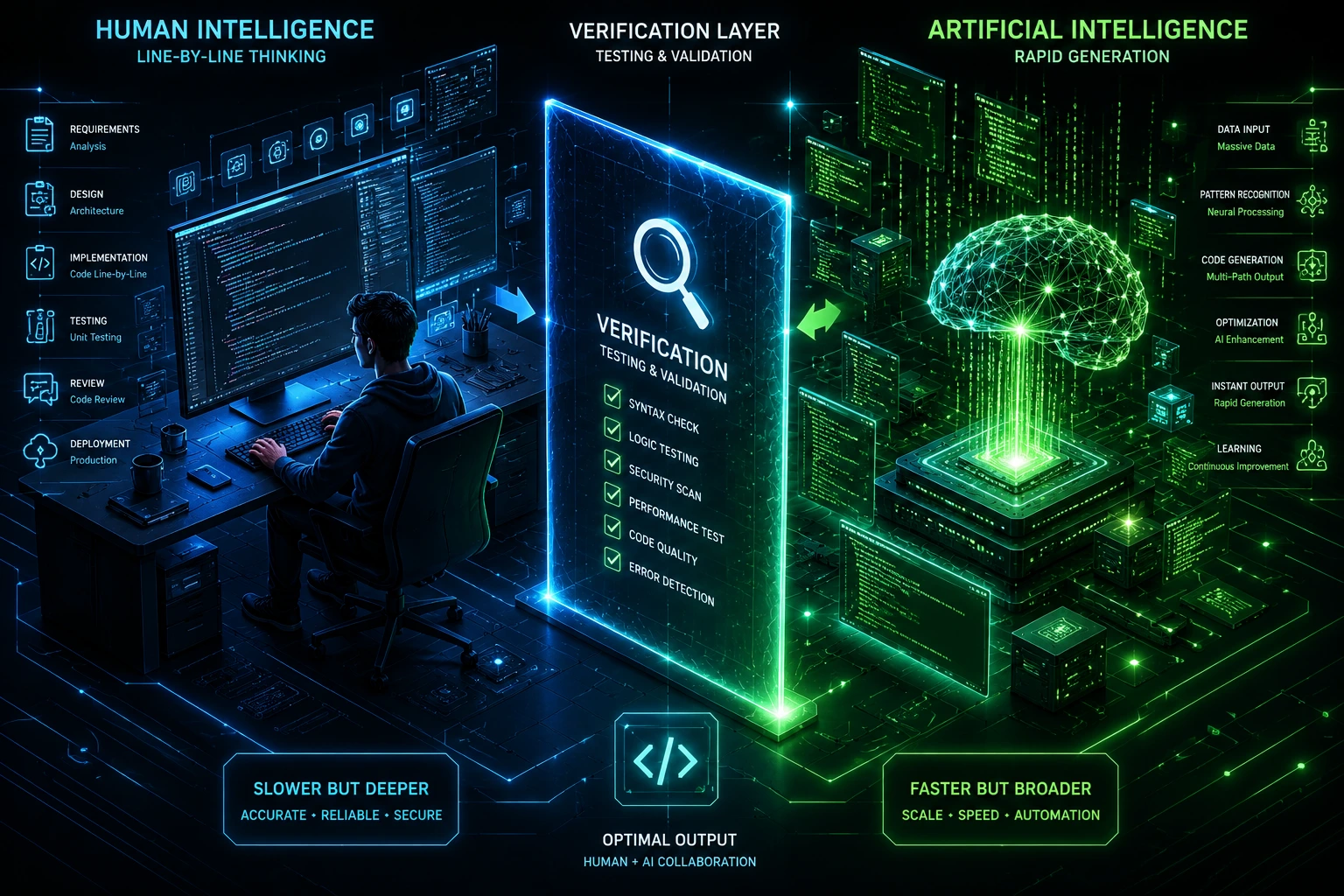
Testing AI generated code is a different discipline from testing human-written code, not because the syntax is different, but because the failure patterns are different. AI models tend to produce code that compiles cleanly, passes the obvious happy-path checks, and looks idiomatic while quietly mishandling error conditions, concurrency, authorization boundaries, and edge cases it was never explicitly told about. Stack Overflow's 2025 Developer Survey captured the tension well: the large majority of developers were using or planning to use AI coding tools, while roughly half said they distrust the accuracy of what those tools produce.
That gap between adoption and trust is exactly why testing practices matter more now, not less especially as "vibe coding," where an app is built almost entirely from natural-language prompts with little to no manual code review, becomes common even outside professional engineering teams. This article walks through how developers are actually testing AI-generated code in 2026: the workflows, the tools, the mistakes people make, and a concrete step-by-step process you can apply today.
What Does It Mean to Test AI-Generated Code?
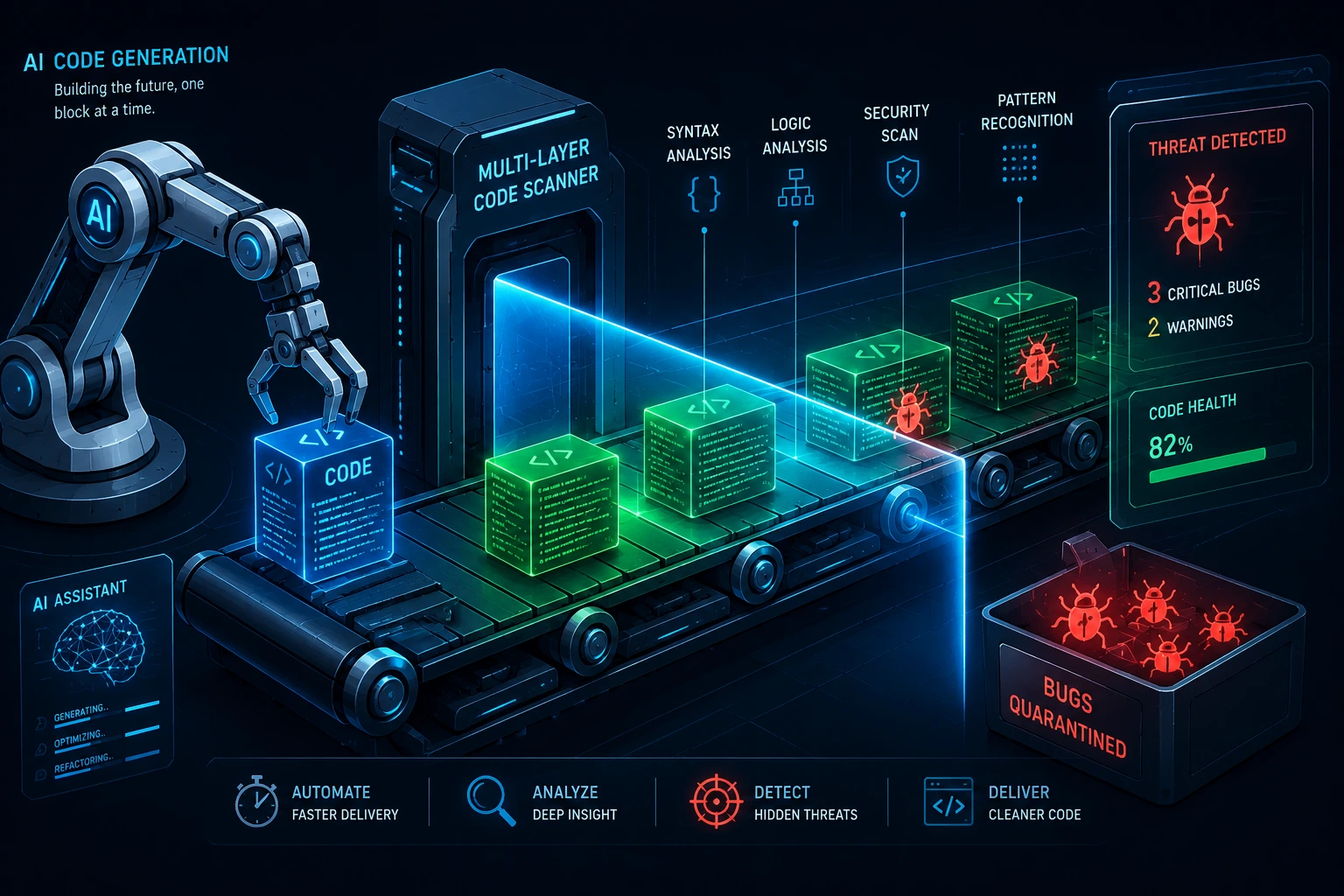
Testing AI generated code means independently verifying that code produced by an AI coding assistant or coding agent actually satisfies the intended specification, not just that it runs without errors. This includes unit testing, static analysis, security scanning, integration testing, and human code review, applied with more rigor than you'd typically use on code a trusted teammate wrote.
The key distinction: verification has to be independent of the generation process. If you ask the same model that wrote the code to also write the tests, you risk what's often called tautological testing. The tests validate what the code does, not what it was supposed to do, because both outputs share the same blind spots and misunderstandings of the spec.
Why This Matters More Than It Used To
A few years ago, AI-written code was mostly autocomplete suggestions and small snippets a developer read line by line before accepting. In 2026, coding agents write entire features, refactor whole modules, and open pull requests with minimal human involvement in the actual writing. That shift changes the risk profile in a few concrete ways:
Volume outpaces review capacity. Research from Faros AI covering more than 10,000 developers found that teams with high AI adoption merge nearly twice as many pull requests, but the time spent reviewing each PR increases by roughly 91%. More code is moving through the pipeline than humans can carefully read.
Acceptance rates tell the real story. LinearB's 2026 benchmark data, drawn from over 8 million pull requests across thousands of engineering teams, found AI-generated PRs get accepted on first review at a much lower rate than human-written PRs roughly a third of the time versus over 80% for human code. That gap is a direct signal that AI output needs more scrutiny, not less.
PRs are getting bigger. Greptile's internal data showed median pull request size grew by about a third between March and November 2025, as agents took on larger chunks of work in a single pass.
Defects cluster in predictable places, and unevenly so. AI models don't produce random bugs. Industry analysis of thousands of pull requests has found AI-generated code carries meaningfully more defects than human-written code overall, but the gap is far wider in specific categories: error-handling defects, edge-case handling bugs, null/undefined handling, and concurrent-access issues all show up multiple times more often in AI-generated code than in human-written code, while ordinary happy-path logic errors are close to parity. That pattern lines up with what these models were trained on public code and Q&A snippets skew heavily toward working, happy-path examples and are comparatively thin on error-handling code, so models learn to write confident code for the common case and under-handle the uncommon one.
Security flaws follow the same pattern. Independent research analyzing output from a large set of language models found a substantial share of AI-generated code contains security flaws, with elevated rates of cross-site scripting and authentication-handling mistakes compared with human-written code reinforcing why auth, session handling, and input validation deserve extra scrutiny in any AI-generated diff.
Review discipline changes the outcome. A 2025 production study across roughly 200 organizations with heavy AI coding adoption found that AI-generated code merged without mandatory human review had a noticeably higher defect rate than human-written code, while AI-generated code that went through mandatory human review actually had a lower defect rate than pure human-written code. In other words, the risk isn't inherent to AI-generated code; it's what happens when review and testing discipline don't scale with generation speed.
If your testing process hasn't changed since AI went from "suggests a line" to "writes the PR," it's very likely undertesting the code that's now shipping.
Traditional Testing vs. Testing AI-Generated Code
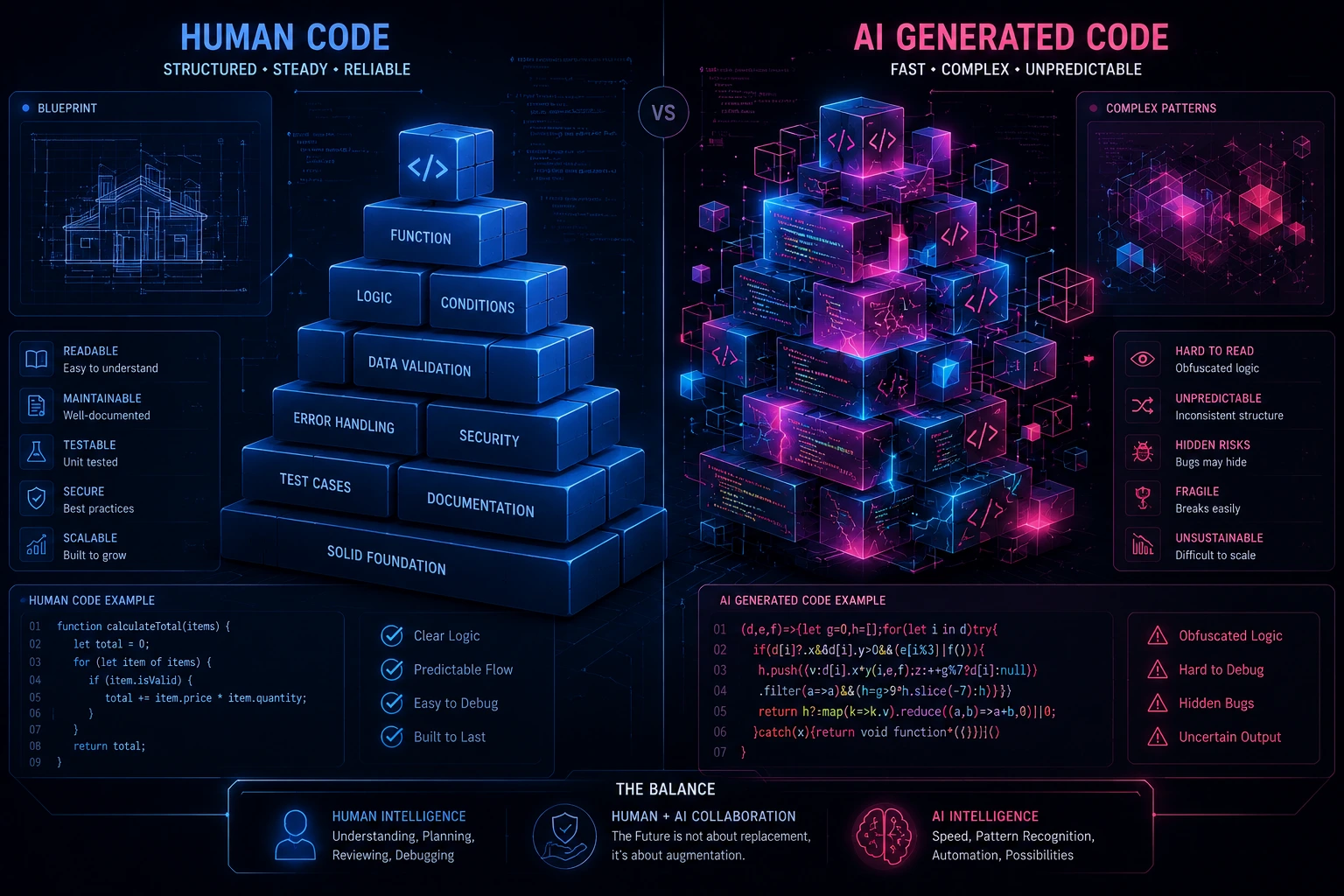
Aspect | Traditional (human-written) code | AI-generated code |
|---|---|---|
Author's mental model | Developer understands the intent behind the code | No guaranteed understanding — code can look correct while missing the actual intent |
Common defect types | Logic slips, typos, scope mistakes | Hallucinated APIs, silently swallowed errors, missed edge cases, subtle security gaps |
Test coverage expectation | 70–80% is a common standard | Often pushed higher (85%+) given the higher defect density in untested paths |
Who should write the tests | Often the same author, sometimes reviewed by peers | A different source than the one that generated the code (spec-first, human-written, or a second independent model) |
Review posture | Trust, verify selectively | Treat as untrusted by default until proven otherwise |
PR acceptance rate | High on first pass | Meaningfully lower on first pass, per 2026 industry benchmarks |
Common Problems When Testing AI-Generated Code
1. Tautological or self-validating tests. When you ask the same AI assistant to generate both the implementation and its tests, the tests tend to encode the same assumptions and gaps as the code. They'll pass, but they're not actually checking correctness against the real requirement. A July 2026 ISSTA research paper on what its authors call the "misguidance effect" put a number on this failure mode: when a model is shown buggy implementation code and asked to write tests for it, it doesn't just miss the bug it can become more likely to write tests that validate the broken behavior as correct, because it treats the flawed implementation as evidence of intent.
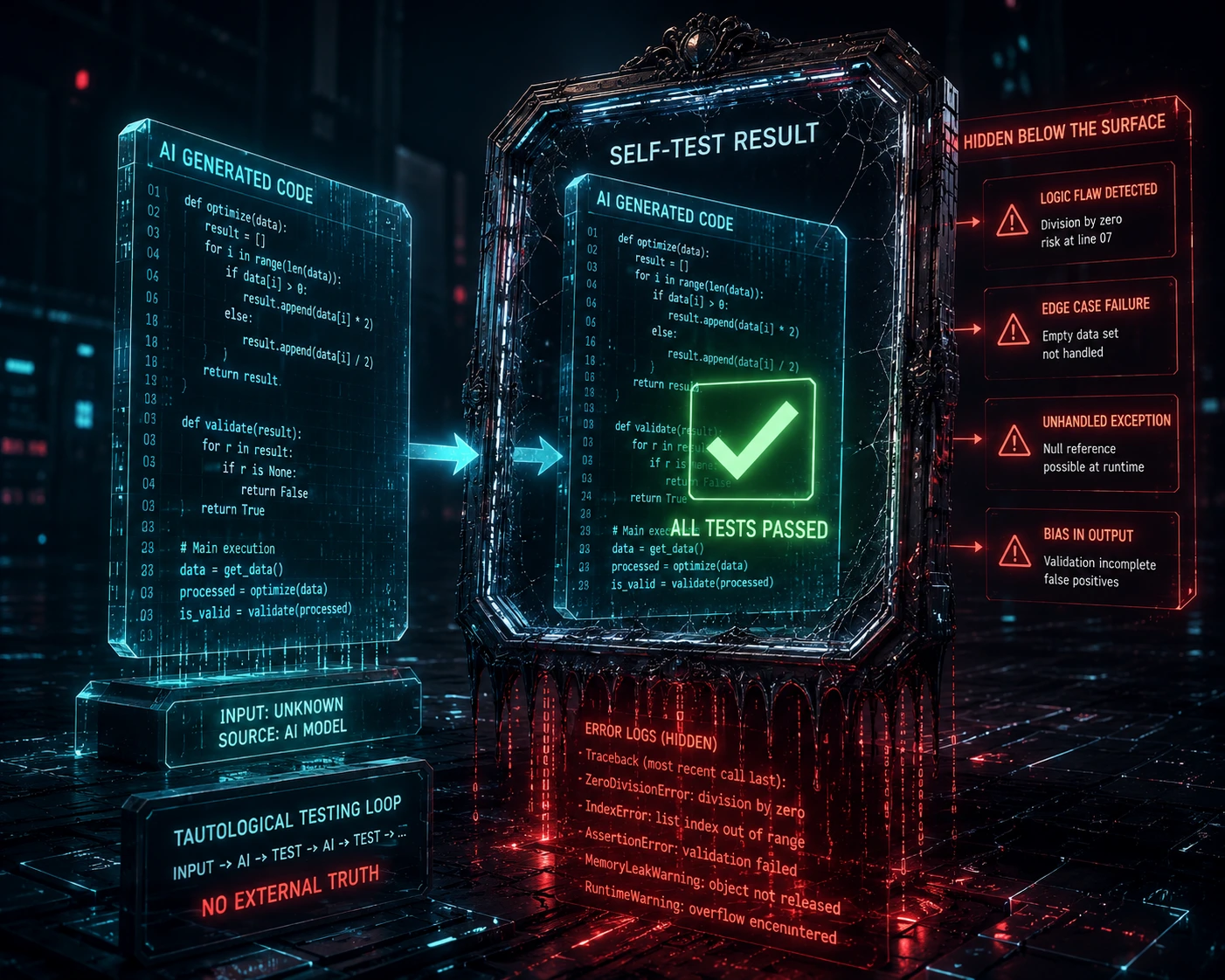
The paper's fix, and the practical lesson for teams, is to separate the two questions: have one pass (a human or a first agent) state what the code is supposed to do, independent of what it currently does, and only then generate tests against that specification.
2. Hallucinated APIs and libraries. AI models occasionally reference functions, parameters, or packages that don't exist, or that existed in an older version of a library. These often slip past a quick read because the code "looks" plausible. Static analysis and an actual build/install step catch this reliably; a visual code review often doesn't.
3. Missing error handling. AI-generated code frequently handles the success path correctly and either omits or under-handles failure paths network timeouts, null values, malformed input, permission denials.
4. False confidence from passing tests. A green test suite is not proof of correctness if the tests only cover the paths the AI thought to cover. Coverage percentage without coverage of the right things is a false signal.
5. Security regressions in areas the model wasn't told to think about. Authentication, authorization, and state-handling code is where AI-introduced vulnerabilities cluster most heavily, according to multiple 2026 industry reviews of AI-assisted pull requests.
6. Reviewer fatigue from PR volume. As agents produce more code faster, human reviewers face more pull requests, larger diffs, and less time per line which is exactly the condition under which subtle defects get merged.
How Developers Are Testing AI-Generated Code: A Practical Workflow
The pattern that's emerged across engineering teams in 2026 follows a spec-first, independently-verified loop. Here's the step-by-step version.
Step 1: Write the specification and failing tests first
Before prompting the AI assistant for an implementation, write out what the code needs to do and create tests that encode that expectation. These tests should fail against a stub or empty implementation. That's the point. You're defining correctness independently of whatever the model produces.
python
# test_discount_calculator.py
import pytest
from discount import calculate_discount

def test_no_discount_for_small_order():
    assert calculate_discount(order_total=20, is_member=False) == 0

def test_member_discount_applied():
    assert calculate_discount(order_total=100, is_member=True) == 10

def test_negative_total_raises_value_error():
    with pytest.raises(ValueError):
        calculate_discount(order_total=-5, is_member=True)

def test_discount_never_exceeds_total():
    # Edge case a model commonly misses
    assert calculate_discount(order_total=5, is_member=True) <= 5
This test file exists before discount.py does. It defines the contract, including the edge cases (negative input, discount exceeding total) that AI-generated implementations commonly overlook.
Step 2: Generate the implementation against the spec
Pass the specification and, if useful, the failing test file itself as context to the coding assistant. Constrain the prompt to the behavior you defined rather than leaving it open-ended.
Step 3: Run the test suite immediately and record every failure
Don't skim the code first run the tests. The first-pass failure list tells you exactly where the model's implementation diverges from spec, which is more reliable than trying to spot the gap by reading.
Step 4: Run static analysis and a build/install step on every commit
This catches hallucinated APIs, deprecated library calls, and syntax issues that a code read can miss. For Python, tools like ruff or mypy; for JavaScript/TypeScript, eslint and the TypeScript compiler itself act as a first filter, since a hallucinated import or wrong function signature will fail to type-check or fail to install.
bash
# Example CI step that would catch a hallucinated import
pip install -r requirements.txt   # fails fast if a package doesn't exist
mypy src/                          # fails if types/signatures don't match
pytest --cov=src --cov-report=term-missing
Step 5: Add property-based tests to surface edge cases you didn't think of
Example-based unit tests only check the cases you wrote. Property-based testing generates a wide range of inputs automatically and checks that an invariant holds across all of them, useful precisely because AI-generated code tends to fail on inputs nobody explicitly considered.
javascript
// Using fast-check with a JS/TS test runner
const fc = require('fast-check');
const { calculateDiscount } = require('./discount');

test('discount never exceeds order total', () => {
  fc.assert(
    fc.property(fc.float({ min: 0, max: 100000 }), fc.boolean(), (total, isMember) => {
      const discount = calculateDiscount(total, isMember);
      return discount <= total && discount >= 0;
    })
  );
});
This single property test can generate thousands of input combinations and will flag the class of edge-case bugs (discount exceeding total, negative discount) that a handful of hand-written examples might miss entirely.
Step 6: Push coverage higher than your human-code baseline
Many teams treat 70–80% line coverage as acceptable for human-written code. For AI-generated code, a stricter bar often 85% or higher, with explicit attention to branch coverage on error-handling paths is becoming standard practice, precisely because defect density is higher in the paths nobody wrote a test for.
Step 6b: Check test strength with mutation testing, not just coverage
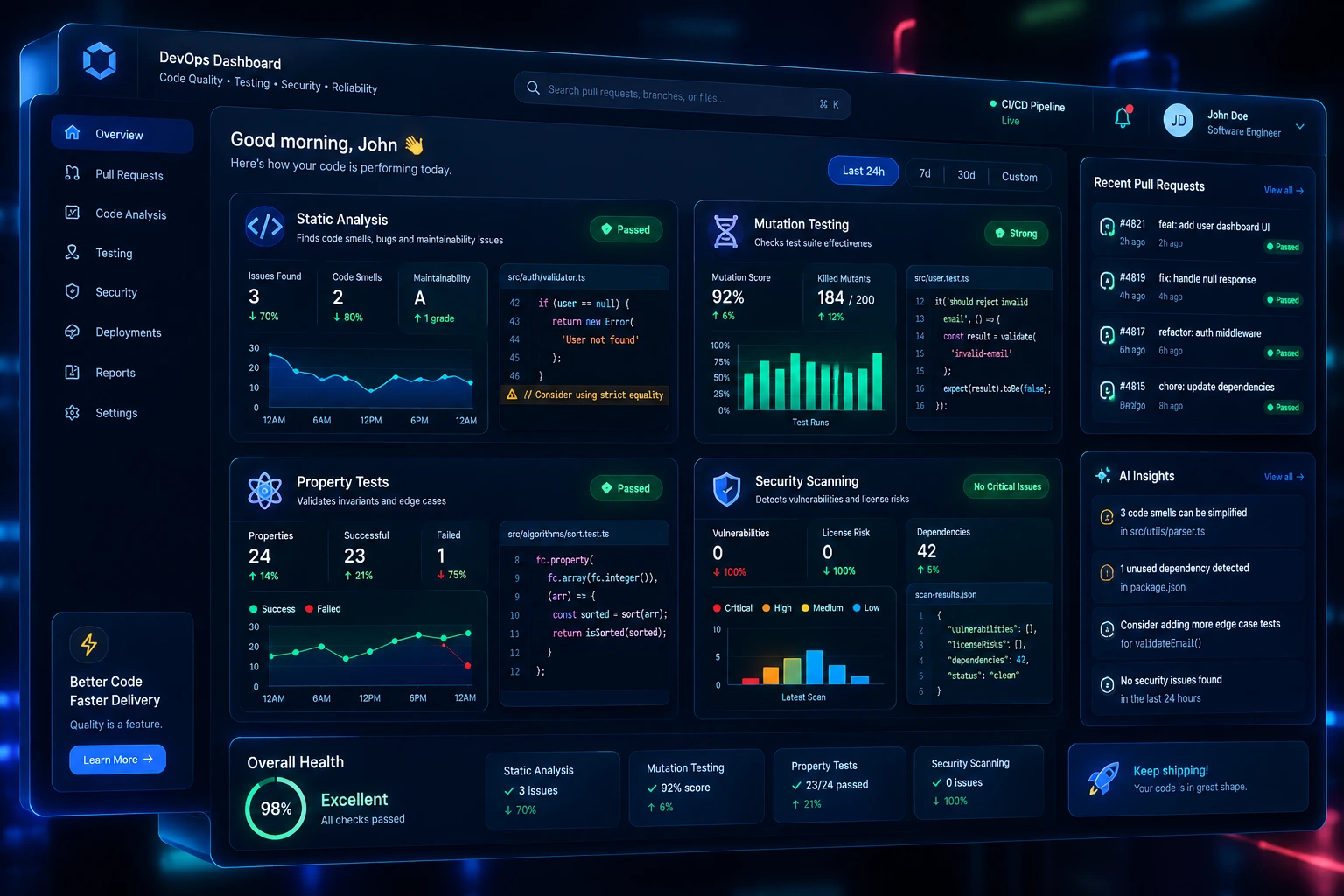
Coverage percentage tells you which lines executed during a test run; it says nothing about whether the test would actually fail if the code were wrong. Mutation testing closes that gap: a tool deliberately introduces small, deliberate bugs ("mutants") into your code flipping a comparison operator, changing a boundary value, removing a null check and reruns your suite against each mutant. If the tests still pass with the bug injected, that's a "surviving mutant," and it means the coverage on that line is cosmetic rather than real.
This matters more for AI-generated test suites than hand-written ones, because a suite that was itself AI-generated is exactly the kind of suite most likely to pad coverage numbers without catching real regressions, the same self-validation problem showing up one layer down. Stryker is a common choice for JavaScript/TypeScript codebases, and PIT (PITest) is the standard for JVM languages; both plug into CI and report a mutation score alongside your normal coverage number.
bash
# Example: running Stryker against a JS/TS project in CI
npx stryker run
# Output includes a mutation score — the percentage of injected
# bugs the test suite actually caught, separate from line coverage
A low mutation score on an AI-generated test file is a strong, concrete signal that the suite needs a human or an independent model pass, not just more tests.
Step 7: Run an adversarial review pass with a separate prompt or reviewer
Have a different model instance, or a human reviewer, specifically look for hallucinated APIs, off-by-one errors, and security issues framed as an adversarial check rather than a general "does this look okay" review. Asking a reviewer (human or AI) to specifically hunt for a category of bug produces better results than a general read-through.
Step 8: Run integration and end-to-end tests before merge
Unit tests validate components in isolation; AI-generated code frequently gets the component right but the integration wrong, a function that works alone but breaks when it's wired into the actual request/response cycle, database transaction, or UI state. Tools like Playwright for browser-based E2E checks or your existing integration test harness fill this gap.
Step 9: Gate the merge with security and static scanning
Run SAST (static application security testing), dependency/license scanning, and secrets detection as blocking checks not advisory ones on AI-generated pull requests specifically. Several code review platforms built for this (CodeRabbit, Greptile, CodeAnt AI, among others) bundle static analysis, security scanning, and AI-assisted review into the pull request workflow itself, so issues surface before a human even opens the diff.
Step 10: Monitor in production, segmented by code origin
Passing every pre-merge check doesn't guarantee correct behavior under real production load, real data, and real user behavior. Where possible, tag or track which code paths originated from AI-assisted PRs so you can correlate production incidents back to generation source and refine your process over time.
Unit Testing AI-Generated Code: What to Emphasize
Unit testing AI generated code follows the same fundamentals as unit testing any code, with a shifted emphasis:
Test the specification, not the implementation. Write tests from what the function is supposed to do, not by reading the generated code and confirming it does what it does.
Prioritize error paths. Explicitly test invalid input, boundary values, timeouts, and permission failures the categories where AI-generated code is statistically weaker.
Avoid mock-heavy tests that mirror the AI's own assumptions. If a test mocks a dependency the same way the AI assumed it would behave, and that assumption is wrong, the test won't catch it.
Keep tests independent of the code's internal structure. Testing implementation details makes tests brittle and can hide the fact that behavior is wrong.
Automated Testing Pipelines for AI Code
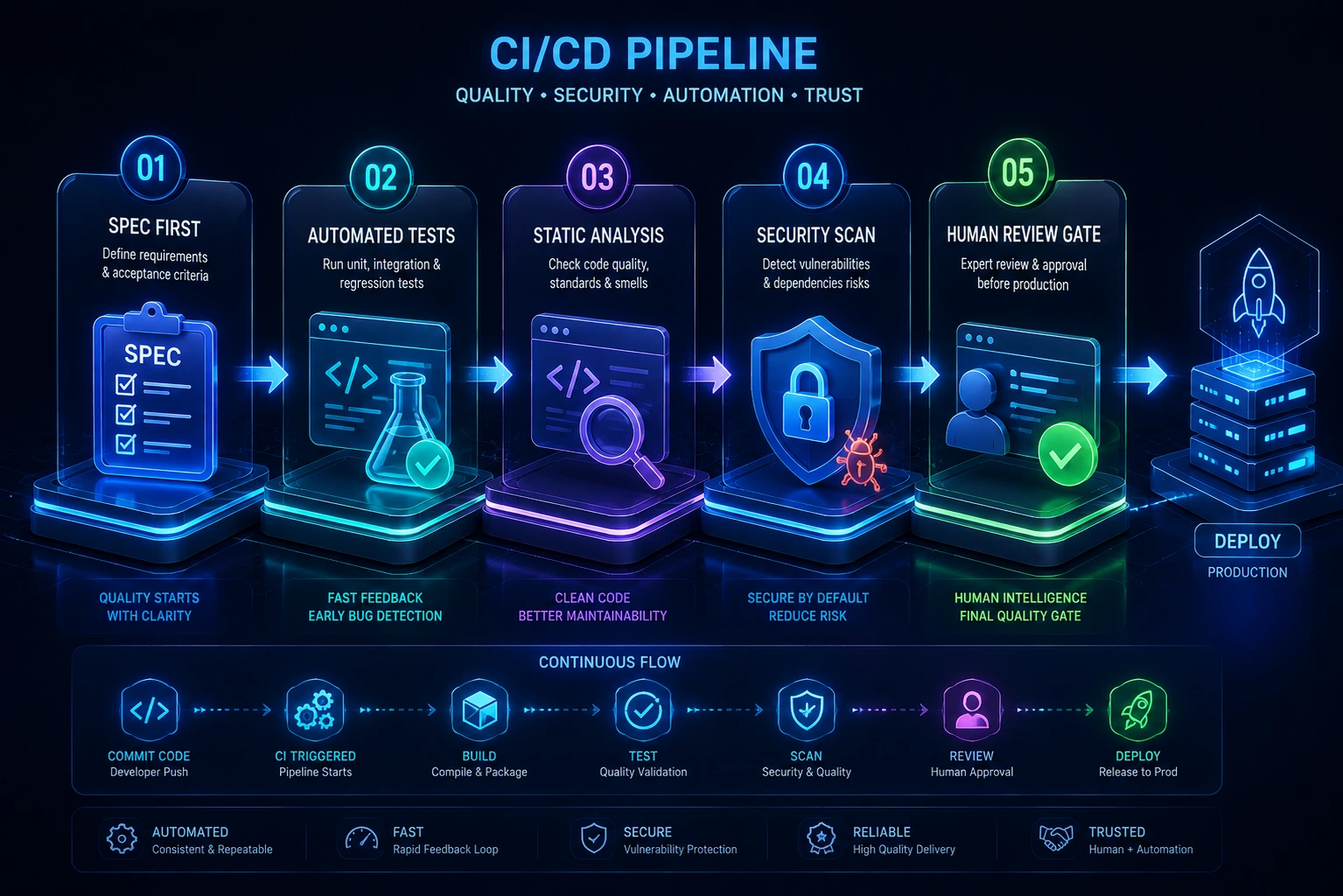
A typical CI pipeline for AI-generated code in 2026 looks like this, in order, with each stage able to block the merge:
Build/install step (catches hallucinated dependencies and syntax errors)
Static analysis and linting
Unit test suite with coverage threshold
Property-based tests on core logic
Security scanning (SAST, secrets detection, dependency/license scan)
Adversarial AI or human code review
Integration and end-to-end tests
Manual approval gate for anything touching auth, payments, or data access
Automated testing AI code doesn't replace human review, it filters what reaches the human reviewer, so the time they do spend is on the things automated tools genuinely can't catch, like whether the implementation matches business intent.
AI Code Review: What It Catches and What It Misses
AI code review tools (CodeRabbit, GitHub Copilot Code Review, Greptile, Qodo, and similar products) work in three stages: they ingest the pull request diff and gather surrounding context (related tests, called functions, recent commits to the same files), evaluate that diff against learned patterns and a system prompt encoding the team's priorities, then generate filtered, deduplicated comments on the PR itself. Understanding what this pipeline is structurally good at and where it breaks down determines whether it's a productivity multiplier or a false sense of security.
Where it's strong: bounded, locally-determinable problems. Naming consistency, missing test coverage on a new code path, undocumented public functions, unused variables, and common OWASP-style vulnerability patterns like SQL injection or hardcoded secrets are well-defined problems with well-defined fixes, and AI review tools catch a meaningful share of them.
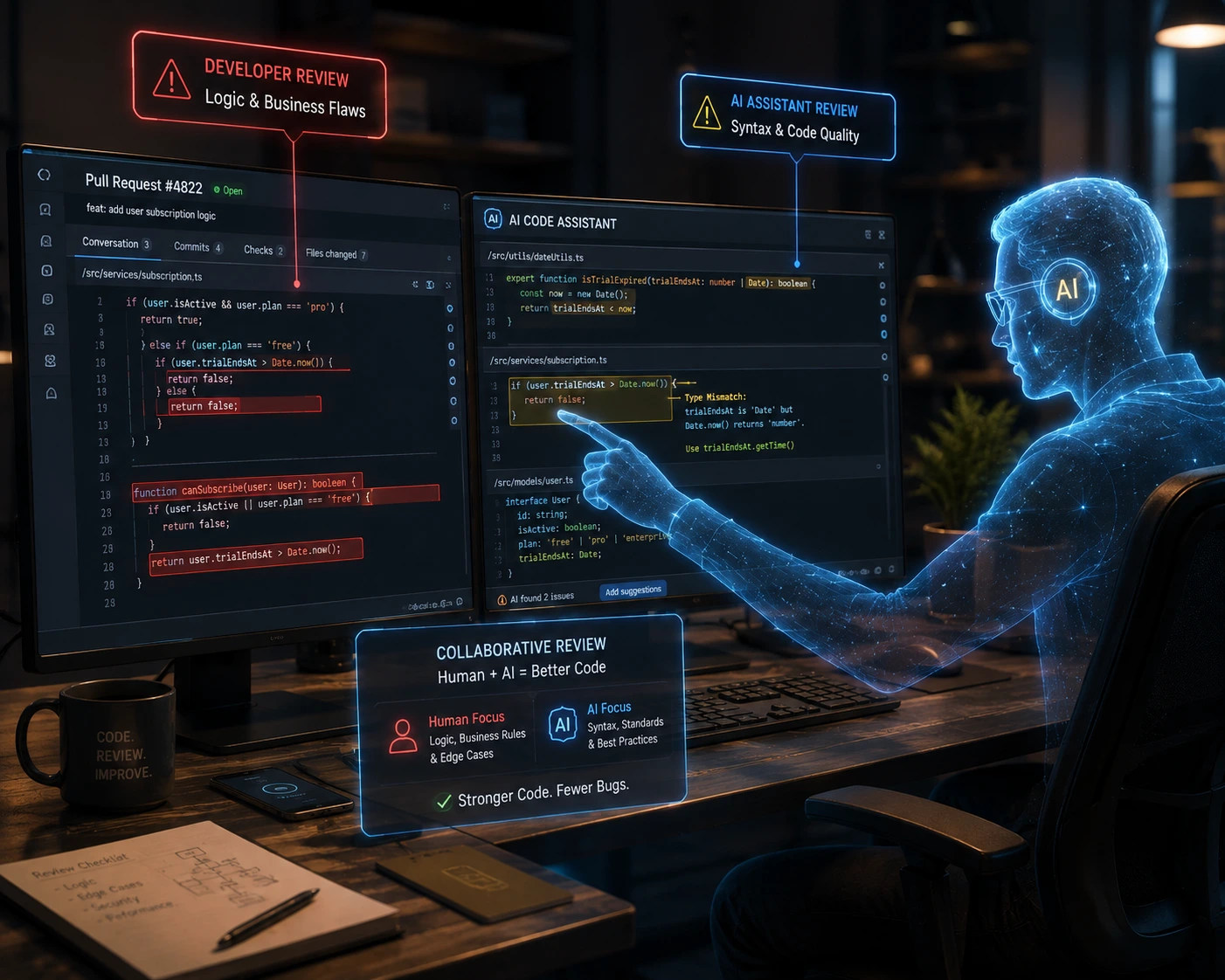
Where it's weak: cross-cutting changes and business-logic correctness. A tool reviewing a 40-line diff to an authentication middleware may call it clean while missing that a downstream API contract now drops a required field, that audit logging no longer fires on a bypassed code path, or that a frontend route still assumes the old response shape because those effects live outside the diff it can see. The tool also can't tell you that a function is well-written but shouldn't exist because the team already decided to move that responsibility elsewhere; that context lives in design docs and conversations, not in the code.
Practical adoption guidance:
Turn AI review on for style, missing tests, and documentation gaps first categories where "did this comment help?" is easy to judge before trusting it with security or architectural feedback.
Tune for low false positives before tuning for recall. A tool that posts noisy, wrong comments trains developers to ignore all of its comments, including the useful ones.
Track outcome metrics median review time and the rate of bugs that still escape to production or later-stage CI rather than vanity metrics like number of comments posted per week.
Treat AI review as one layer alongside static analysis and human review, not a replacement for either. The human reviewer remains the layer that catches "this is technically correct but the wrong thing to build."
Regression Testing AI-Generated Code at Agent Velocity
Regression testing gets harder, not easier, once coding agents are merging pull requests at a pace no human team could sustain manually. Two problems compound:
Blast radius per pull request is wider. A human developer asked to improve a sorting function typically makes a surgical change. An agent given the same task often refactors the surrounding component, adjusts a shared utility it calls, and updates downstream type definitions in the same pass — which means a hand-maintained regression suite scoped around human-sized changes can miss the interaction effects between what an agent touched and what it didn't.
Selector drift becomes constant instead of occasional. Traditional UI regression suites (Playwright, Cypress, Selenium) anchor tests to specific selectors, element IDs, CSS classes, data-testid attributes. Agents restructure markup routinely as part of ordinary refactors, which means selectors that a human-written codebase would rarely touch get renamed or moved every time an agent revisits a component.
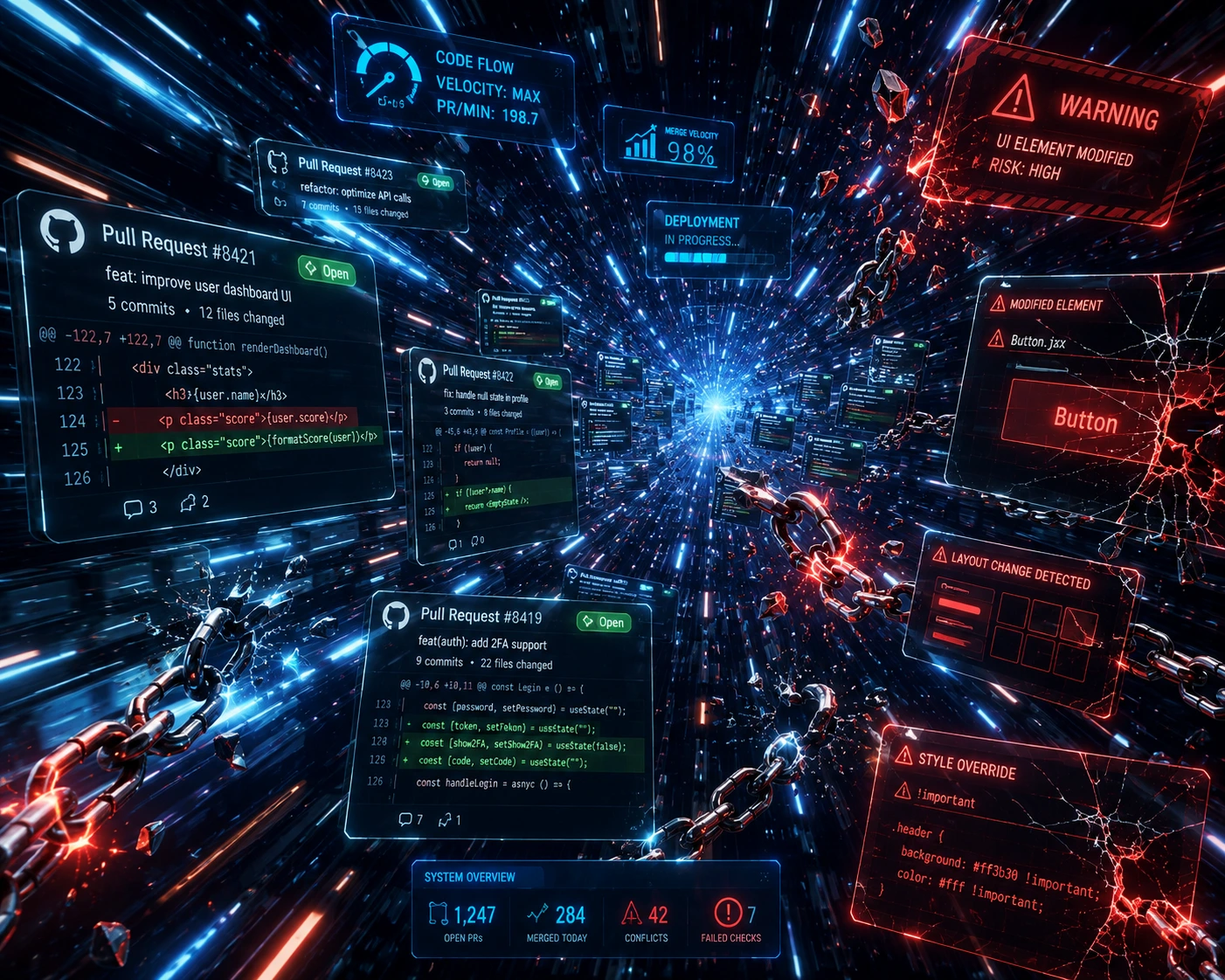
A test suite that requires a human to manually chase every selector change accumulates maintenance debt faster than any team can realistically keep up with, and a red CI run caused by a renamed selector is functionally indistinguishable from a real regression unless someone investigates it which costs time the team doesn't have at agent-generated PR volume.
Two practical responses have emerged:
Prioritize critical-path end-to-end coverage over broad UI coverage. Checkout, login, and other revenue-critical flows are both the most damaging to break and, not coincidentally, the flows agents touch most often because they're the most connected parts of the codebase. Cover these first and treat coverage here as non-negotiable.
Prefer intent-based or codebase-aware regression tooling over purely selector-based scripts where possible, since tests that re-derive what a flow is supposed to do from the current code (rather than replaying a recorded interaction against a fixed selector) are structurally more resistant to the kind of routine restructuring agents produce. Where you're still maintaining selector-based suites, budget explicit engineering time for selector maintenance as a known, recurring cost of agent-generated development rather than an occasional fire drill.
Security Considerations
Authentication, authorization, and state management are consistently where AI-introduced vulnerabilities show up most in 2026 industry reviews of AI-assisted pull requests. Practical steps:
Treat any AI-generated code touching auth, session handling, or access control as requiring mandatory senior or security-team review, regardless of how confident the diff looks.
Run dependency and secrets scanning on every AI-generated PR, since models can introduce outdated packages with known CVEs or accidentally hardcode credentials pulled from training patterns.
Set stricter merge-blocking thresholds for AI-generated code than for human code — for example, blocking on any critical (CVSS 7.0+) finding rather than allowing a "fix later" ticket.
Performance Considerations
AI-generated code can pass functional tests while introducing performance regressions N+1 database queries, unnecessary re-renders, unbounded loops, or naive algorithms where an efficient one was expected. Load and performance testing shouldn't be skipped just because functional tests pass; add profiling or load tests to the pipeline for code paths that are performance-sensitive (hot loops, database access layers, high-traffic endpoints).
Code Quality Metrics Worth Tracking Beyond Test Pass Rate
A green CI run and a coverage percentage don't tell the full story for AI-generated code. Teams that track quality over time generally watch four categories:
Defect rate bugs found per unit of shipped code, ideally segmented by whether the code was AI-generated and whether it went through mandatory human review, since review discipline changes the outcome substantially.
Security vulnerability rate the share of AI-generated diffs that introduce exploitable patterns, tracked separately from general defects because the categories (auth, injection, XSS) and the fixes differ.
Revert/rollback rate how often AI-generated changes get reverted or significantly reworked within the following months, which is a better long-term signal than initial test pass rate.
Maintainability indicators code complexity, duplicate logic, and churn (how often the same file changes across releases), since AI-generated code can pass every functional test while quietly making the codebase harder to work with over time.
Best Practices Summary
Write tests and specifications before generating the implementation.
Never let the same model that wrote the code be the sole author of its tests.
Run static analysis and a real build step on every AI-generated commit.
Use property-based testing to catch edge cases outside your example set.
Push AI-generated code coverage above your normal human-code baseline.
Run an adversarial review pass specifically hunting for hallucinations and security gaps.
Gate merges on security scanning with stricter thresholds than human code.
Monitor production behavior segmented by code origin, not just pre-merge checks.
Tools Developers Are Using
Test frameworks: pytest, Jest, JUnit unchanged fundamentals, applied more rigorously.
Property-based testing: fast-check (JS/TS), Hypothesis (Python).
Mutation testing (test-strength verification): Stryker for JavaScript/TypeScript, PIT (PITest) for JVM languages both report a mutation score showing whether a suite actually catches injected bugs, not just which lines it executed.
AI-assisted test generation: Qodo Cover, which generates tests against existing code and keeps only the ones that measurably raise coverage; Diffblue Cover, which uses search-based (non-LLM) generation for JVM unit tests specifically to avoid hallucination risk; and general-purpose coding agents like Claude Code and Codex CLI, which write tests as part of agentic feature work when explicitly asked for spec-driven coverage and edge cases.
End-to-end testing: Playwright, Cypress.
Static analysis/type checking: mypy, ruff, ESLint, TypeScript compiler.
AI-native code review and security scanning platforms: CodeRabbit, Greptile, CodeAnt AI, GitHub Copilot Code Review these integrate SAST, secrets detection, dependency scanning, and AI-assisted review directly into GitHub/GitLab/Bitbucket pull request workflows.
Codebase-context layers for review and agents: platforms like Sourcegraph expose repo-wide code search and navigation to AI review tools and coding agents via MCP, which materially improves how well those tools catch cross-cutting effects outside the immediate diff.
Engineering analytics: platforms like LinearB and Faros AI, used by some teams to track PR acceptance rates and review time as a health signal for AI-assisted development.
Frequently Asked Questions
Yes. Automated tests and static analysis catch a large share of defects, but they can't reliably judge whether code matches business intent, and AI-generated pull requests are accepted on first review far less often than human-written ones a strong signal that human review remains necessary, especially for logic tied to business rules, auth, or payments.
It can generate a useful starting point, but tests written by the same model that wrote the implementation tend to validate the code's own assumptions rather than the actual requirement. It's safer to write test specifications first, or have a separate model or human author for the tests.
Many teams target 85% or higher for AI-generated code, above the 70–80% commonly used for human-written code, with particular attention to branch coverage on error-handling and edge-case paths where AI-generated defects cluster.
Treating a passing test suite as proof of correctness. If the AI wrote both the code and the tests, a green suite can still be validating the wrong behavior. The fix is independent verification specs and tests written before or separately from the implementation.
No. They filter and prioritize what needs manual attention flagging hallucinated APIs, security issues, and missing error handling automatically so human reviewers can focus their limited time on business logic and intent, which automated tools still can't fully judge.
The mechanics are the same; the emphasis shifts. Tests should be written from the specification rather than from reading the generated code, with extra weight on error handling, edge cases, and boundary conditions, the categories where AI-generated code most often falls short.
It's a documented failure pattern where a model shown buggy code writes tests that validate the bug as correct behavior, rather than catching it because the model infers intent from the implementation it can see instead of an independent specification. The fix is structural: generate or state the expected behavior separately from the code under test, then write tests against that specification.
Yes. Agents restructure UI markup and refactor shared code more routinely than human developers typically do, which causes selector-based end-to-end tests to break far more often than in a human-maintained codebase. Prioritizing critical-path coverage, budgeting real time for selector maintenance, and favoring tests that re-derive intent from current code over ones that replay a fixed recording all help regression suites keep pace with agent-generated pull request volume.
Final Recommendations
Testing AI generated code isn't a matter of running your existing test suite and hoping it's thorough enough. It requires an independent verification step specifications and tests defined before or separately from the AI's output combined with static analysis, security scanning, property-based testing, and human review focused on the categories where AI-generated defects actually cluster: error handling, edge cases, concurrency, and security boundaries. Teams that have adapted their process this way are catching the defects that a quick read-through and a green checkmark would otherwise let through.