In 2020, you could walk into a system design interview, sketch a load balancer, fan it out to a handful of stateless app servers, drop a cache in front of a relational database, and call it a day. Memorize the "design Twitter" template, swap in the right nouns for "design Uber" or "design a URL shortener," and you had a repeatable script that got senior engineers through FAANG-style loops.
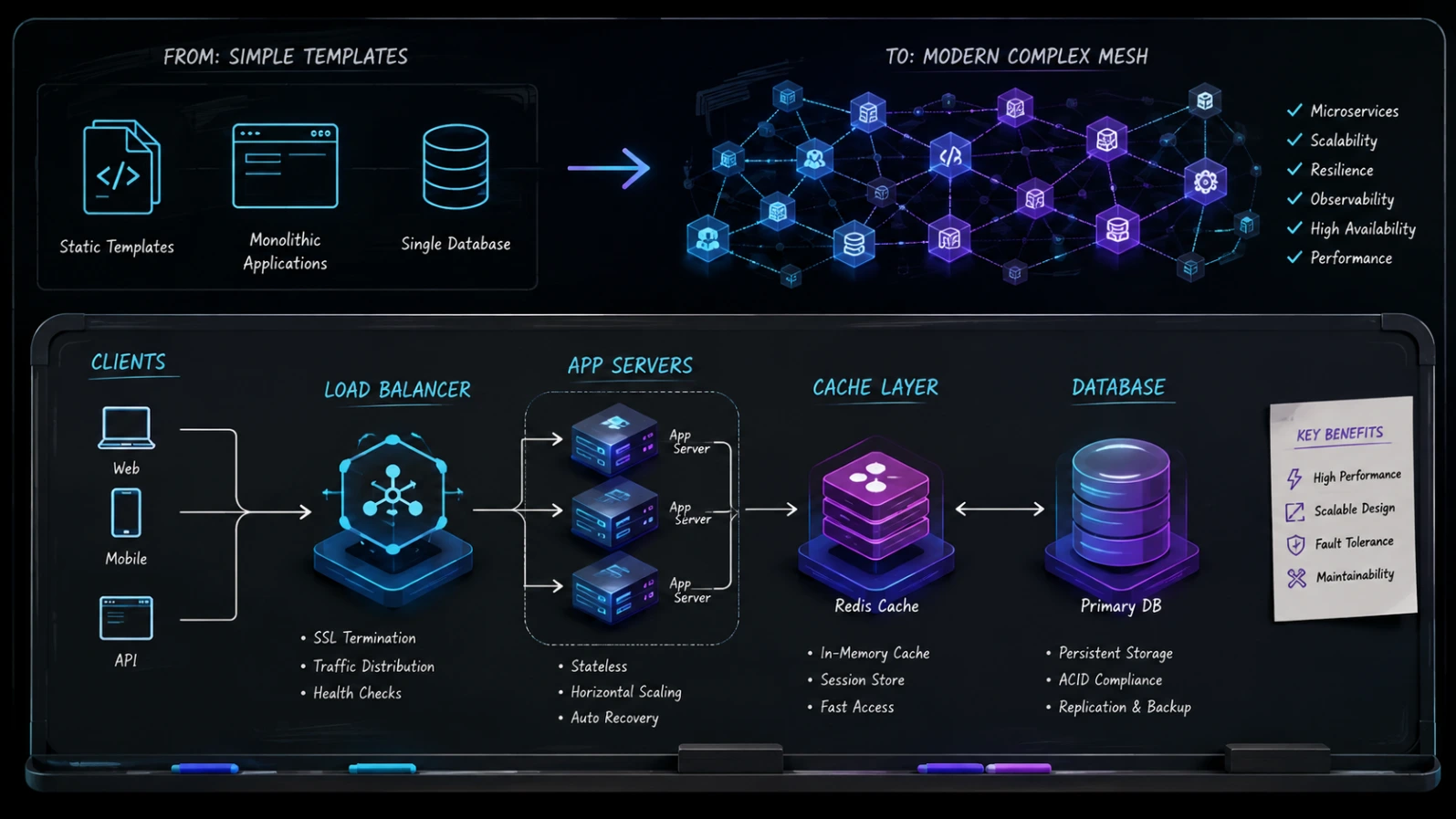
That script is dead. Not because the underlying concepts sharding, caching, load balancing, CAP theorem—stopped mattering, but because every candidate now walks in with the same YouTube playlist memorized. Interviewers have seen the Twitter diagram five hundred times. They know the score before you've finished drawing the third box. So they've adapted, and if your system design interview prep 2026 strategy hasn't adapted with them, you're going to get outpaced by people who understand the same concepts but can actually reason with them.
This is the uncomfortable truth senior engineers need to hear: the bar hasn't just moved up, it's moved sideways. Interviewers today aren't grading your diagram. They're grading your judgment. And the numbers back this up: one Airbnb interviewer with over a decade of experience building distributed systems has observed that candidates with the same strong technical scores that used to earn offers two years ago are now getting turned down, simply because more strong candidates are clearing the bar than there are open roles. A "Strong Hire" from two years ago might only rate as a plain "Hire" today. Passing isn't enough anymore; you need to stand out within the pool of people who already pass.
The Shift in Interviewer Expectations
The old rubric rewarded coverage did you mention caching, did you mention sharding, did you mention a message queue. The new rubric rewards depth under pressure. Interviewers have quietly shifted from "can you draw the boxes" to "can you defend the boxes when I start poking holes in them."
This shows up in a few concrete ways. You'll get interrupted mid-design with a constraint change traffic just 10x'd, or the read pattern flipped from read-heavy to write-heavy, or a compliance requirement just appeared that forces data residency in three regions. You'll get asked what happens when your "highly available" cache layer goes down at 2 AM during a traffic spike. You'll get asked to justify a decision purely on cost, not just feasibility.

None of this is really about system design concepts anymore everyone in the room already knows what a consistent hashing ring is. It's about whether you can operate that knowledge like a practicing architect instead of reciting it like a textbook. Interviewers have started treating the whiteboard less like an exam and more like a design review with a skeptical staff engineer in the room, because that's genuinely closer to the job.
It's also worth knowing that the format itself is shifting at several companies. The single open-ended whiteboard prompt is still the default almost everywhere, but it's no longer the only shape you'll meet. At Stripe and a handful of AI labs, a single problem now arrives broken into three to five sequential parts on a HackerRank-style platform, where each part only unlocks once the previous one runs cleanly which rewards candidates who can ship a working first version fast rather than over-engineering it before the interviewer even sees it.
At Amazon, some GenAI Architect screens skip the whiteboard entirely and ask you to reason through the design out loud, with the interviewer pressing you to revise requirements on the spot. Netflix rounds regularly happen with no shared diagramming tool as all candidates just talk. The lesson underneath all of these variations is the same: rehearse explaining your design out loud, not just drawing it.
Five (or Seven) Steps That Structure a Strong Answer
Interviewers aren't grading a single "right" architecture; they're watching how you move through the problem. Most strong answers, regardless of company, pass through the same handful of stages, and knowing the shape of them in advance frees up mental bandwidth for the actual reasoning.
Clarify requirements (5–8 minutes). Don't touch the whiteboard yet. Pin down functional requirements (what does the system actually need to do for "Design TikTok," does that mean upload, feed generation, search, live streaming, all of it?) and non-functional requirements (scale, latency targets, consistency vs. availability, durability). State explicitly what you're leaving out of scope. Strong candidates propose the scope themselves instead of waiting for the interviewer to narrow it.
Back-of-the-envelope estimation (3–5 minutes, often skipped by weaker candidates). Turn the vague prompt into real numbers daily active users, requests per second, storage growth per year. The precision doesn't matter; the habit of reasoning in orders of magnitude does. If you work out that a feed system needs to handle roughly 15,000 queries per second at peak, that number is what justifies bringing in a cache or reading replicas later instead of just declaring "we'll add caching" because it sounds right.
Define the API (3–5 minutes). Before designing internals, define the external contract: what endpoints exist, what goes in, what comes out. This forces you to think about the data flowing through the system and gives the interviewer concrete surface area to probe pagination, auth, versioning, rate limits.
High-level design (8–10 minutes). Sketch the broad flow client, CDN, load balancer, application services, cache, database and confirm it satisfies every functional requirement before drilling into any one piece.
Deep dive into one or two components (10–20 minutes). This is the highest-signal part of the interview. Go deep on the pieces that matter most for this specific system, usually the data layer, the caching strategy, or one domain-specific challenge and reason about how each one behaves under normal load, how it fails, and what happens when it does fail.
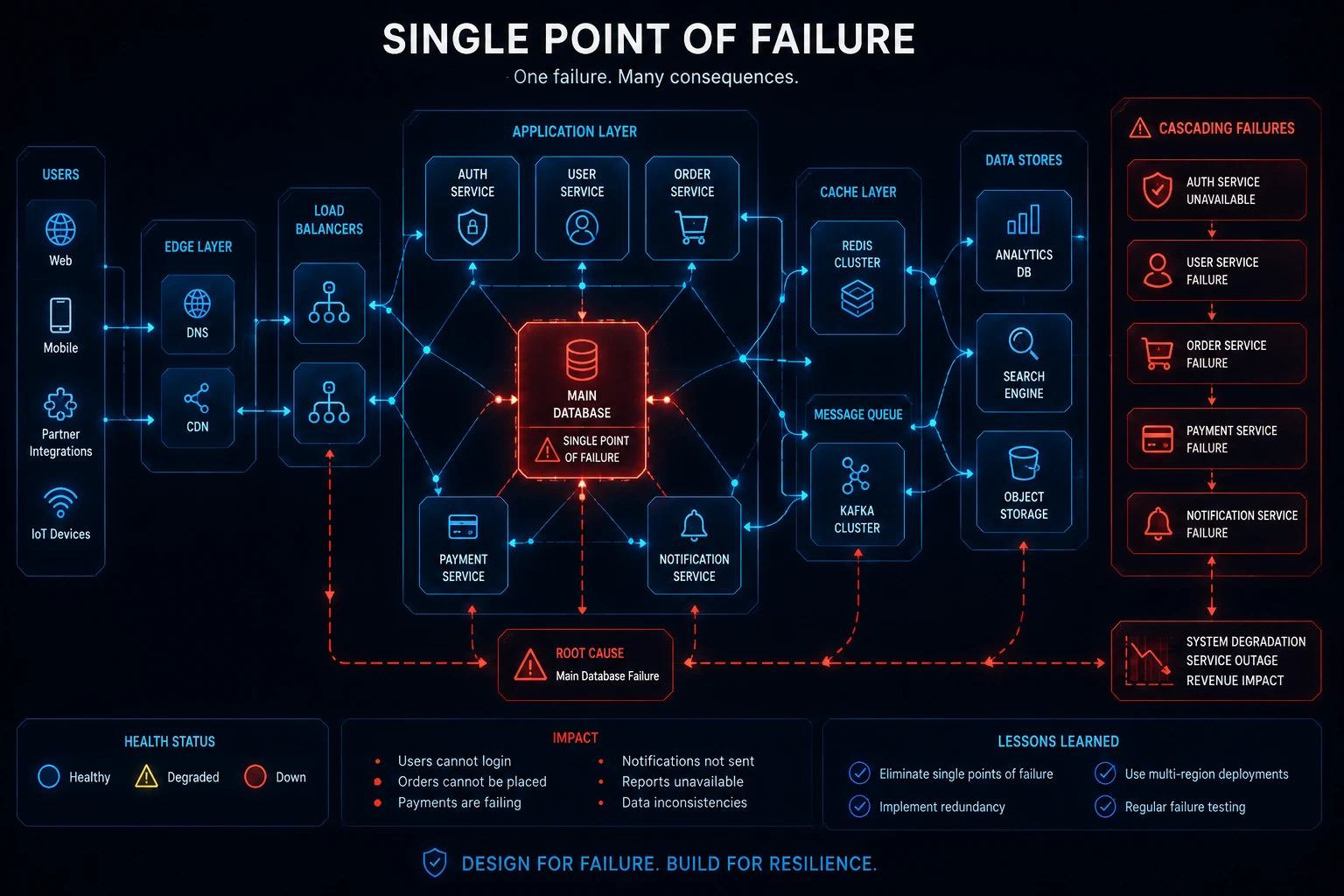
Address bottlenecks, cost, and operations (5–8 minutes). What breaks at 10x scale? Where's the single point of failure? What would you do differently to cut infrastructure spend in half without breaking the SLA? Mentioning monitoring, logging, and alerting before being asked signals real production experience.
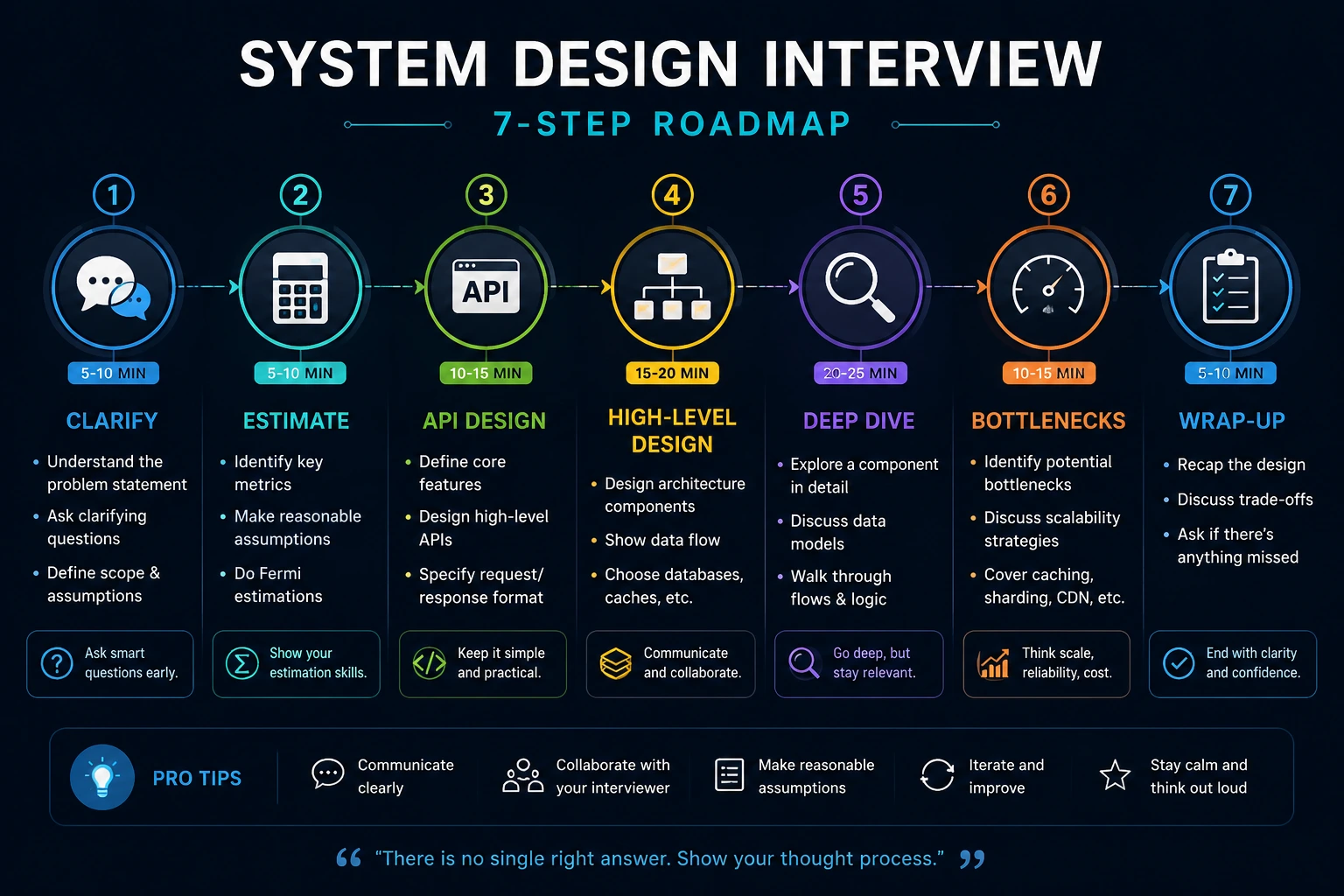
7. Wrap up (2–5 minutes). Summarize the design, name the trade-offs you made, and say what you'd tackle next with more time data migration, CI/CD, geographic failover. Showing you know what you deliberately left out is itself a signal of judgment.
Not every company follows this shape exactly. Netflix rounds are often unstructured, open-ended conversations, and Amazon's GenAI screens skip the diagram altogether but the underlying moves (scope, estimate, design, defend, extend) hold up almost everywhere.
Four Pillars Beyond the Basics
If you strip away the theater, four capabilities separate candidates who pass from candidates who merely know the material.
1. Trade-off Analysis: Latency vs. Consistency vs. Cost
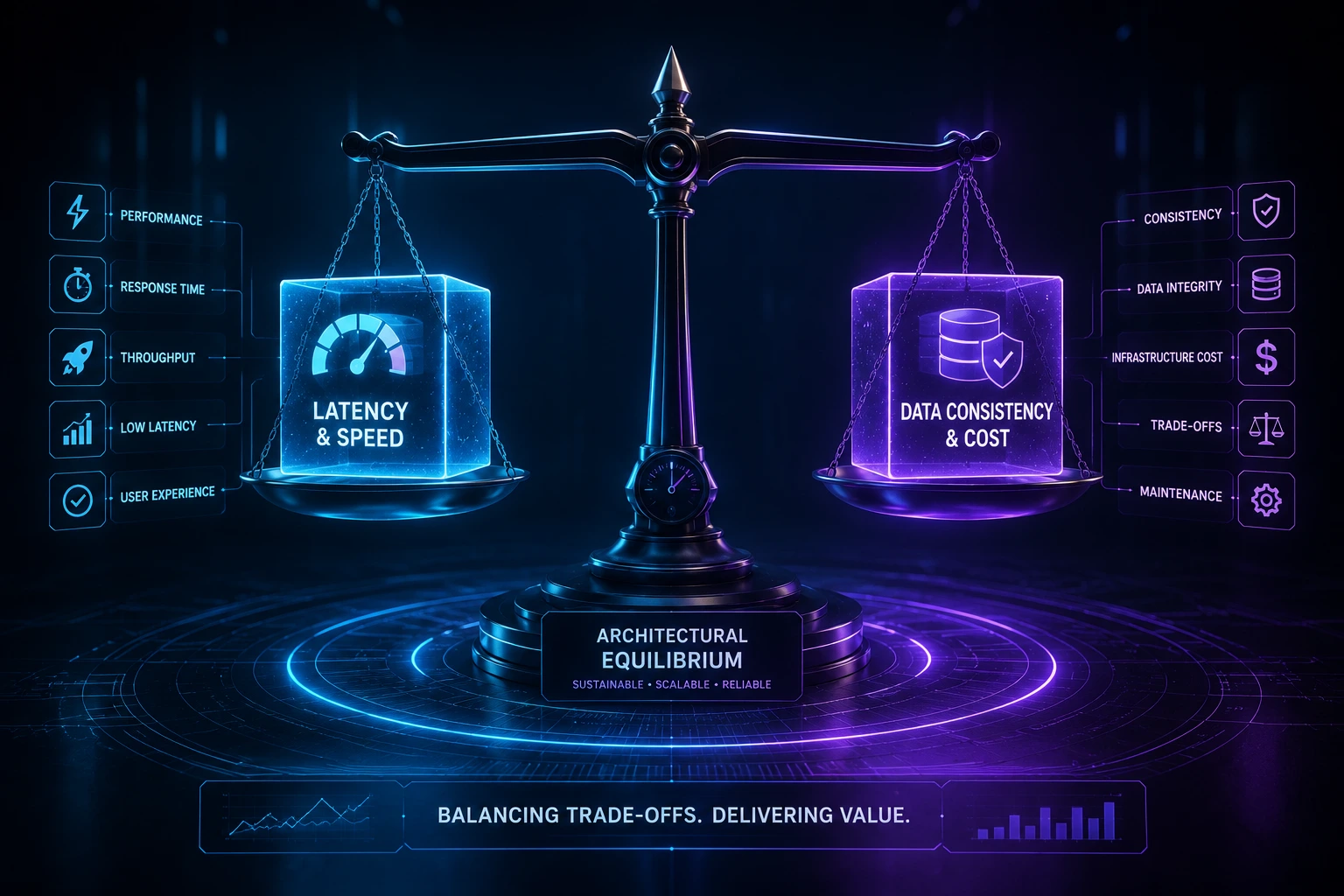
Every system design concept you learned CAP theorem, eventual consistency, and read replicas exists to be traded against something else. The interviewers of 2026 aren't interested in whether you know that strong consistency costs latency. They're interested in whether you can say, specifically, "for this feature, users tolerate 200ms of staleness because it's a social feed, not a bank ledger, so I'll take eventual consistency and save myself cross-region write latency."
This is the essence of practical system design trade-offs: naming the actual constraint that matters for this specific product, not reciting the general theorem. Cost has become a first-class citizen in this conversation too. It's no longer enough to say "we'll add more replicas." A senior candidate is expected to reason about the cost delta between over-provisioning for a rare spike versus building elastic autoscaling with acceptable cold-start latency, and to say which one they'd actually ship and why. Interviewers increasingly ask directly: "This design works, but it triples infrastructure spending. How would you cut that in half without breaking the SLA?" If you don't have an answer, the interview is effectively over.
One habit worth building deliberately here: reasoning quantitatively before you reason architecturally. Saying out loud, "we're talking a hundred million daily active users, roughly ten requests each, call it a billion requests a day, about twelve thousand RPS average and maybe forty thousand at peak" doesn't need to be precise but it reframes the whole conversation. You're no longer designing in the abstract; you're defending every choice against a budget you set yourself.
2. Real-World Failure Modes and Resilience
Anyone can design the happy path. What separates senior engineers is designing for the 3 AM page. Interviewers now routinely probe for cascading failures: what happens when your recommendation service slows down and every upstream caller starts timing out and retrying simultaneously, doubling the load on an already struggling system? Do you know what a retry storm looks like, and do you reach for exponential backoff with jitter, circuit breakers, and bulkheading without being prompted?
Rate limiting has become a near-mandatory topic, not as a bullet point but as a design decision with its own trade-offs: token bucket versus sliding window, per-user versus per-tenant limits, and what you degrade gracefully versus what you reject outright. The best candidates talk about partial degradation: if the personalization service is down, do you serve a generic feed instead of a blank page? That instinct to design for graceful failure rather than assuming everything stays up is exactly what separates textbook knowledge from operational maturity, and it's a huge part of learning how to pass system design interview loops at the senior and staff level in 2026.
An Airbnb interviewer summed up what he's actually screening for in this part of the round: how candidates think about systems and failure modes, not whether they can name the components. That's the whole pillar in one sentence.
3. Modern Infrastructure Shifts
The reference architectures written in 2018 didn't have to account for AI inference sitting in the critical path of a product, and that's no longer true. Interviewers are increasingly layering AI-adjacent constraints into classic problems: design a content moderation pipeline that calls an LLM, and now you have to reason about GPU-bound latency variance, batching for throughput versus per-request latency, model fallback strategies, and caching embeddings instead of re-computing them on every request. This isn't a niche add-on anymore; it's showing up in mainstream system design loops because it's showing up in mainstream production systems.
This shift is now measurable, not anecdotal. LLM infrastructure prompts have moved out of ML-specific interview loops and into general software engineering rounds a year ago, "design a system that serves an LLM" was reserved for ML roles; now it shows up broadly. Recently reported 2026 prompts include designing the high-level system behind an LLM answering user queries, building a customer-support chatbot on top of a third-party LLM platform (with rate limits, fallback, and state to reason about), distributing model weights to thousands of machines over a constrained network link, and designing safeguards for an AI system that can take actions on a user's behalf.
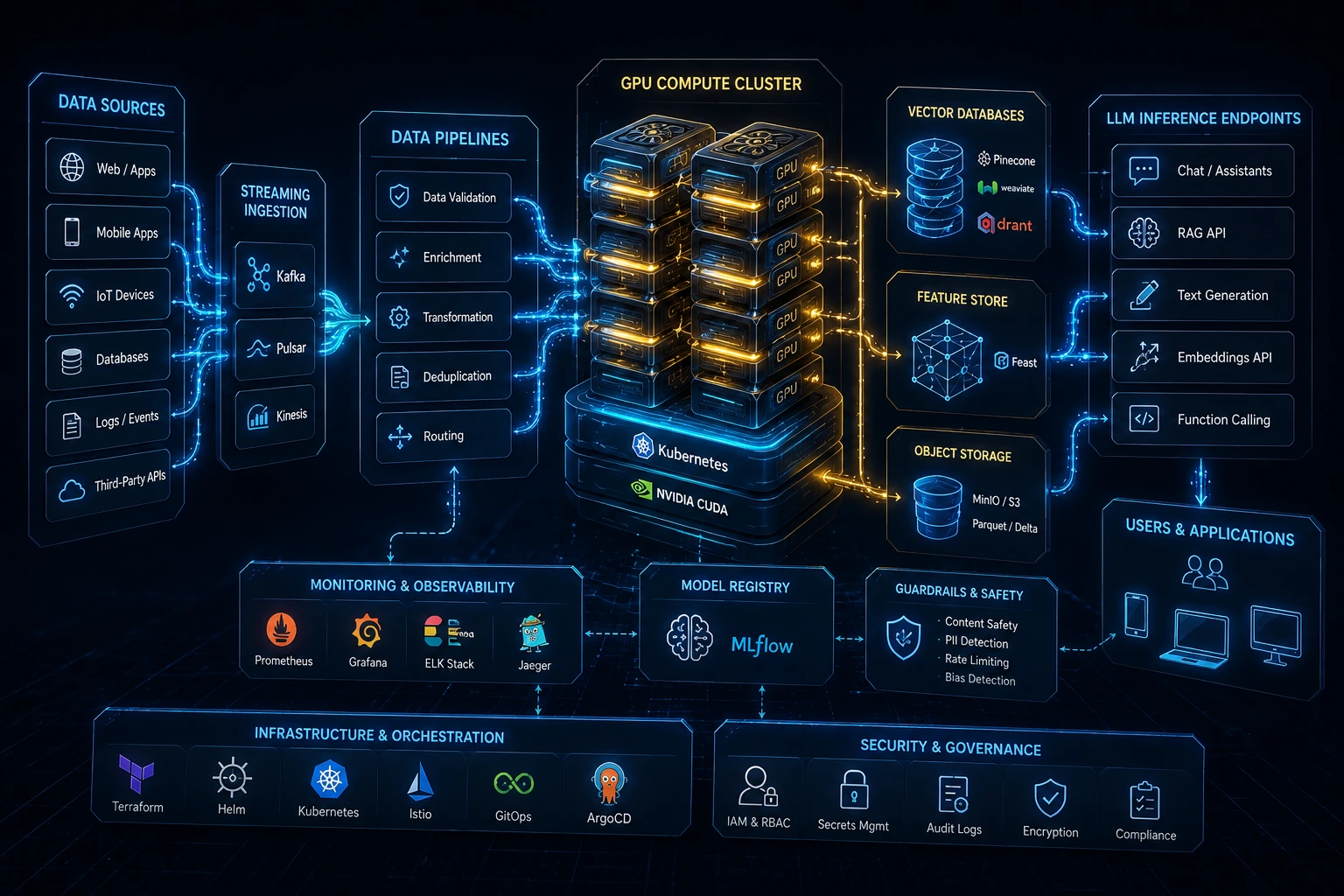
At Anthropic specifically, the most commonly reported prompt is a batch inference API for a GPU cluster and interviewers there explicitly want candidates to abstract the AI framing away, turning "batch inference on a GPU" into "batched processing on a constrained compute resource," since the underlying patterns (queuing, batching under constraints, async-to-sync mapping) are the same distributed-systems patterns you already know. If you're interviewing anywhere that ships AI features, expect at least one prompt touching LLM serving, embedding pipelines, or GPU resource management, even outside ML-specific roles.
Edge architecture is another area where the old templates fall flat. Candidates who still default to "central data center, single region" get pushed on why they didn't consider pushing compute to the edge for latency-sensitive read paths, or how they'd handle data consistency across edge nodes during a regional outage. And the database layer itself has diversified well past "SQL versus NoSQL." Interviewers expect familiarity with modern engines vector databases for retrieval-augmented systems, NewSQL options that blend horizontal scalability with transactional guarantees, and columnar stores for analytical workloads and, more importantly, judgment about when each one is actually the right tool rather than the trendy one.
That last point deserves its own emphasis: knowing when the boring choice beats the trendy one is itself a senior signal. A candidate who says "I'd start with a monolith here the team is small, the load is low, and the operational overhead of microservices isn't worth it for the first eighteen months" reads as someone who has actually shipped software, not someone reaching for jargon to sound impressive.
4. Communication and Steering the Interview
This is the pillar most senior engineers underrate, and it's often the one that decides the outcome. A 45-minute system design interview is not enough time to design a fully correct system everyone in the room knows. What it is enough time for is watching how you allocate your own attention. Do you spend fifteen minutes gold-plating the API schema while ignoring the one requirement that actually matters? Or do you clarify scope early, propose a rough plan, and explicitly negotiate where you'll go deep versus where you'll hand-wave?
The strongest candidates treat the interviewer as a collaborator, not a judge. They narrate their reasoning out loud, flag assumptions explicitly ("I'm assuming write volume dominates reads correct me if that's wrong"), and actively steer toward the parts of the problem that showcase judgment rather than passively waiting to be asked. This single skill steering rather than being steered is disproportionately responsible for the gap between "strong hire" and "no hire" among candidates with nearly identical technical knowledge.
Precise vocabulary is part of this signal, and it's more automatic than it looks. Saying "eventual consistency" instead of "the data syncs eventually," or "read replicas" instead of "copies of the database for reads," reveals precise thinking, not pedantry when a candidate fumbles for the right term, interviewers correctly read it as fumbling for the underlying idea.
At senior and staff level specifically, the bar for this pillar is different in kind, not just degree. Senior candidates are expected to show depth in their own domain reasoning about scalability, reliability, and how a decision affects the product's future. Staff candidates are expected to drive the interview: propose scope instead of waiting to be asked, raise cross-team concerns (data migration paths, backward compatibility, organizational boundaries) unprompted, and pick the two components most worth going deep on rather than being told which ones matter.
Common Mistakes That Sink Otherwise-Strong Candidates
A few failure patterns show up again and again in interviewer debriefs, independent of how technically strong the candidate is on paper:
Jumping into components before clarifying requirements. Drawing databases before you know if the system is read-heavy or write-heavy is guessing, and interviewers notice immediately.
Treating the interview as a monologue. System design is a conversation. Speaking uninterrupted for ten minutes usually means you're going deep on something the interviewer doesn't care about, pause and check in.
Ignoring non-functional requirements. A design that covers every feature but collapses at 10x traffic is an incomplete answer, not a creative one.
Naming products instead of patterns. Saying "we'll use Kafka here" without explaining why a message queue is needed async processing, decoupling, backpressure signals shallow understanding. Name the pattern before the product.
Skipping trade-offs. Every architectural decision costs something. Proposing a cache without acknowledging invalidation challenges, or eventual consistency without naming the staleness window, leaves the most gradeable part of the answer on the table.
How System Design Interviews Differ by Company
The core building blocks are the same everywhere, but what gets emphasized and how the round is even structured varies enough that generic prep leaves real points on the table.
Google runs a single 45-minute round with a strong emphasis on database selection, and tends to avoid asking candidates to design Google's own products directly.
Meta focuses on the products it actually builds social feeds, messaging, content delivery and expects candidates to proactively address scale across billions of users without being prompted.
Amazon weaves behavioral questions and its Leadership Principles directly into the technical round, and some GenAI-focused screens are entirely verbal with no whiteboard at all.
Netflix runs a 60-minute, open-ended discussion with no fixed framework; candidates frequently finish the round without ever opening a shared diagramming tool.
Anthropic frames prompts around AI workloads (most commonly a batch inference API for a GPU cluster), but is explicitly testing classic distributed-systems reasoning underneath the AI framing.
Stripe and several AI-first startups have moved toward multi-part sequential builds where each stage unlocks only after the previous one works.
If you know which company you're headed into, spending even an hour reading real interview experiences for that specific company tends to outperform another hour of generic practice.
How to Practice Effectively in 2026
Rote memorization of architecture diagrams is now actively counterproductive; it signals pattern-matching rather than reasoning, and experienced interviewers can tell the difference within minutes. Senior engineer interview prep in 2026 needs a different regimen.
Start with mock interviews where someone actively adversarial injects constraint changes mid-session a scaling curveball, a budget cut, a compliance requirement and forces you to adapt live rather than execute a memorized flow. This is a far better predictor of real interview performance than solo whiteboarding.
Study real post-mortems. Public incident reports from major engineering orgs are a goldmine because they show you actual cascading failures, actual root causes, and actual mitigations, grounded in systems that exist rather than idealized textbook diagrams. Reading five real post-mortems will teach you more about resilience design than reading twenty design blog templates.
Profile real systems where you can. If you have access to production metrics at your current job, spend an hour understanding why a particular service is provisioned the way it is and what trade-off produced that specific configuration. That grounded intuition transfers directly to interview reasoning in a way abstract study never does.
Practice explaining trade-offs out loud, alone, before you ever get in front of an interviewer. Pick any system and force yourself to argue both sides of a decision why you'd choose strong consistency here, why you'd choose eventual consistency there until justifying a trade-off feels as natural as naming one.
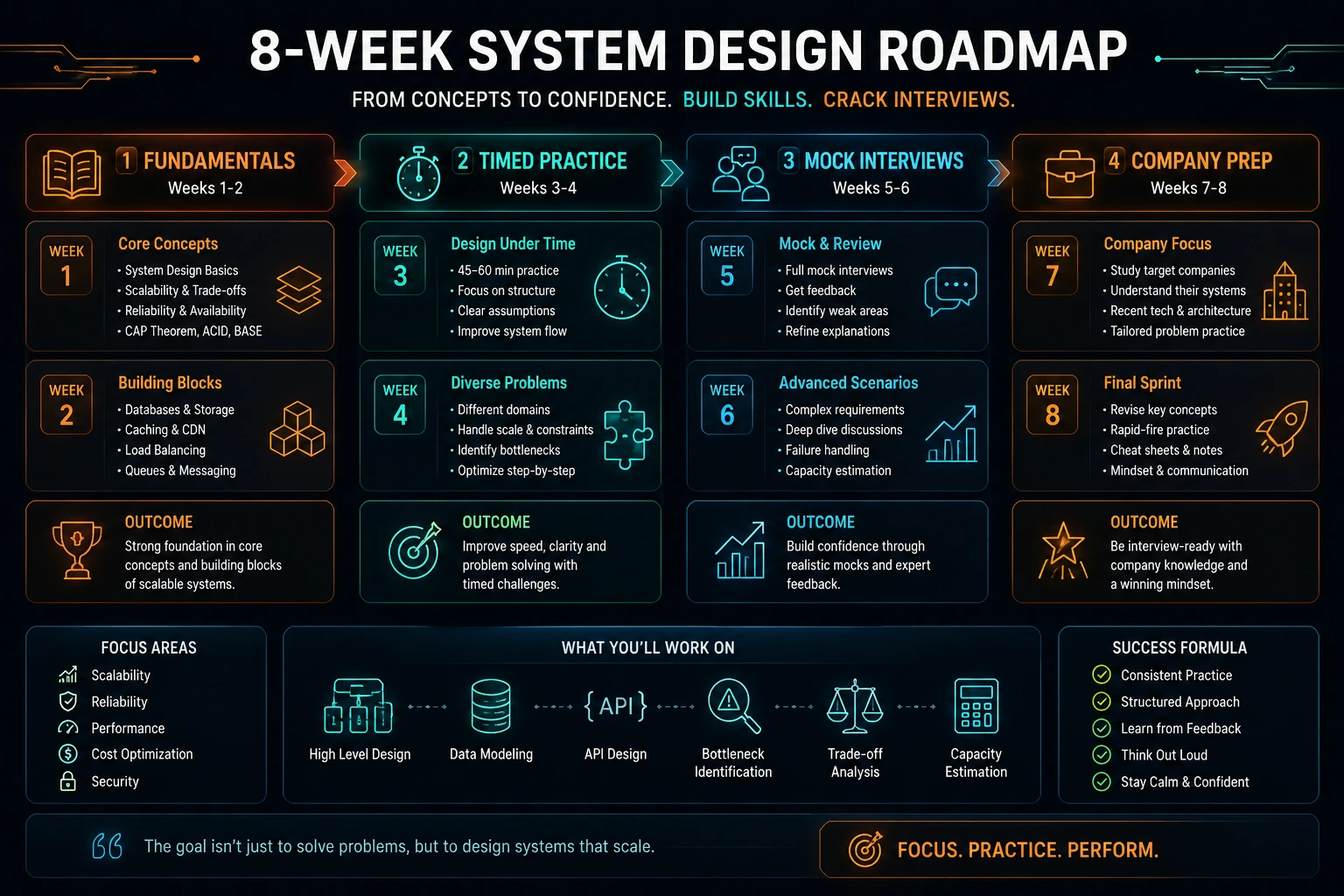
If you want a concrete timeline rather than an open-ended "practice more," an eight-week runway breaks down cleanly:
Weeks 1–2 — Fundamentals. Build the mental library: load balancing, caching, relational and non-relational databases, message queues, CDNs, consistent hashing, replication, sharding, CAP theorem. Focus on how the pieces compose, not on memorizing architectures for specific products.
Weeks 3–5 — Timed practice. Work through 8–10 classic prompts out loud in 45-minute timeboxes. Diagram polish doesn't matter; reasoning out loud does, even when you're practicing alone.
Weeks 6–7 — Mock interviews. Run mocks with another engineer or a peer-practice tool. This is the step people skip, and it's the one that matters most: a design explained to a rubber duck is not the same as one defended against a stranger who interrupts with "why not just cache everything?"
Week 8 — Company-specific prep. Review the target company's format and question style, and shore up whatever weak spot the mocks surfaced.
If time is short, a compressed two-week version squeezes fundamentals into three focused days and spends the rest on timed practice and at least two mock interviews aimed at your target company's most commonly reported questions. And if you're interviewing anywhere AI-first, add roughly a week specifically on batch inference, GPU resource management, retrieval-augmented generation, and rate limiting for LLM APIs you don't need to be an ML expert, but you do need the infrastructure vocabulary.
One more thing worth remembering: the system design round is one part of a multi-round loop, and it's possible to ace it and still not get the offer because a different round coding, behavioral, or a domain-specific screen was the weak link. Spend prep time in proportion to where your actual gaps are, not in proportion to which round feels the most "real."
Conclusion
The candidates who struggle in 2026 aren't the ones who don't know what a load balancer does. They're the ones who never learned to argue with themselves about when not to use one. System design interview concepts got you in the door in 2020; they'll barely get you past the first ten minutes now. What gets you hired is judgment under constraint the ability to trade off latency against cost against consistency in real time, to design for failure instead of assuming success, to speak fluently about AI-infused and edge-native infrastructure, and to steer a conversation like the staff-level engineer you're claiming to be. Master that, and the diagrams take care of themselves.