Introduction: The Most Audacious Deal in AI History

On June 16, 2026, the technology and aerospace landscapes collided in a historic restructuring of the global software industry. SpaceX, fresh off its blockbuster $75 billion IPO on the Nasdaq, formally confirmed the acquisition of Anysphere, the San Francisco-based startup behind the viral AI-native development environment, Cursor. Valued at a staggering $60 billion in an all-stock transaction, the merger represents the most expensive acquisition of an artificial intelligence startup to date fundamentally realigning the balance of power in developer tooling.
"AI will achieve Stockfish-level coding and generalized computer use." — Elon Musk, June 16, 2026 |
This wasn't an impulsive move. SpaceX had secured a strategic option in April 2026, giving it the right to either purchase Cursor for $60 billion or establish a $10 billion collaborative partnership. Days after the company's historic IPO closed, SpaceX exercised that option signalling absolute conviction. For years, software developers treated AI assistants as intelligent utilities glorified auto-complete engines or secondary sidecars configured to accelerate boilerplates. This deal changes that permanently.
Simultaneously with the acquisition, the Cursor team announced Cursor Origin a direct, agent-native GitHub competitor along with a completely unreleased, custom-built frontier model trained entirely from scratch on SpaceX's Colossus supercomputer cluster.
1. Inside the $60 Billion Deal: Structure, Finances & Leverage
The Initial Option (April 2026)
The road to this acquisition began in April 2026, when SpaceX locked in a strategic option agreement with Anysphere. Under those initial terms, SpaceX secured the right to either execute a full buyout for $60 billion or pay $10 billion for a formalized collaborative partnership. This was publicly acknowledged on SpaceX's X account, which stated it was working with Cursor to create "the world's best coding and knowledge work AI."
Cursor's Meteoric Revenue Growth
Financial data reveals a business experiencing hyper-exponential enterprise adoption. According to Forbes, Cursor's annualized recurring revenue (ARR) surpassed $4 billion as of early June 2026 — a staggering pace of growth:
November 2025: $1 billion ARR
February 2026: $2 billion ARR
Late April 2026: $3 billion ARR (Bloomberg)
Early June 2026: $4 billion ARR (Forbes)
Of this, 75% comes from enterprise customers. The company's enterprise business in Q1 2026 grew at three times the rate of Q4 2025 — driven by the launch of the "Cloud Agents" tool in February.
The Founders: From MIT Dorm to $60B
Cursor was founded in 2022 by four MIT students/alumni: Michael Truell (CEO), Sualeh Asif, Arvid Lunnemark, and Aman Sanger. They started Anysphere with a radical idea: what if your code editor understood your entire codebase the way a senior engineer does? They built Cursor as a fork of VS Code with deep, native AI integration. The product went viral almost immediately.
November 2024: Acquired AI code-completion startup Supermaven
2025: Massive funding rounds including a reported $2.3B round, minting founders as billionaires
April 2026: SpaceX/xAI secured the $60B call option
June 2026: SpaceX exercises the option — definitive agreement signed
The Compute Bottleneck & Colossus Engine
Despite staggering revenue growth, Anysphere's leadership explicitly noted that its long-term scaling trajectory was severely bottlenecked by a critical lack of raw, sovereign compute capacity. Renting third-party cloud infrastructure creates variable cost structures that compress software margins during continuous, long-running multi-file agent execution loops.
By merging into SpaceX, Cursor gains direct, unconstrained access to xAI's massive, million-H100-equivalent Colossus supercomputer cluster in Memphis, Tennessee. This effectively removes the structural scaling ceiling for Cursor's inference models. SpaceX also recently secured cloud-capacity rental deals with Google and Anthropic worth $26 billion annually — with 90-day termination clauses that give SpaceX flexibility to redirect that capacity toward Cursor's growth.
Termination Penalties & Risk Allocation
The regulatory filings reveal the aggressive terms SpaceX agreed to:
$10 billion termination fee if the deal fails to close under specific structural provisions
$4 billion regulatory break-up fee if federal antitrust bodies block the transaction
These immense penalty thresholds signal absolute corporate confidence that the deal will successfully navigate regulatory checkpoints to close in Q3 2026.
2. Wall Street Reacts: SpaceX Becomes World's 5th Most Valuable Company
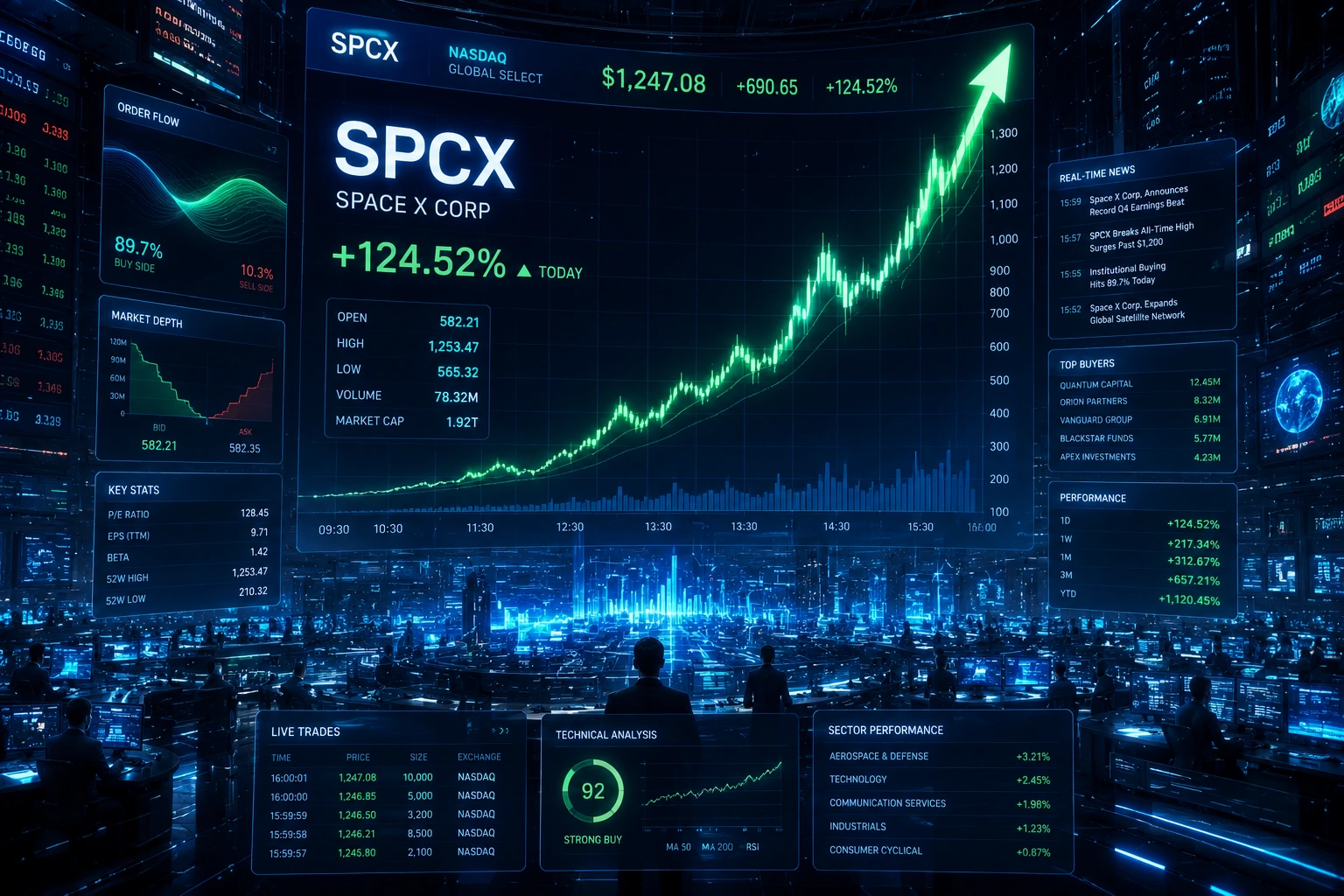
Wall Street responded with euphoria. SpaceX shares trading on the Nasdaq under the ticker SPCX.O surged nearly 10% in premarket trading to $211.27. The rally represents a 56% climb from the $135 IPO price set just days earlier, pushing SpaceX's market capitalization to a staggering $2.9 trillion.
With that jump, SpaceX overtook Amazon.com Inc. to become the world's fifth-most valuable public company — a milestone that officially makes Elon Musk the world's first trillionaire. |
However, analysts note the deal also underscores SpaceX's aggressive, high-burn strategy. Financial filings show the company is not yet profitable, posting over $9 billion in losses across 2025 and 2026 due to capital-intensive investments in rocket manufacturing, Starlink infrastructure, and AI data centers.
Vital Knowledge analyst Adam Crisafulli said in a note to investors: "SpaceX hopes the Cursor team/product will give a jolt to its Grok AI business (especially in coding), which has so far failed to make a dent in the frontier market (which is led by Anthropic, OpenAI, Google and Meta in the US, in that order)."
The $26 Trillion TAM Claim
In a detail flagged extensively on Hacker News, SpaceX told investors during the IPO process that it sees an addressable market for AI products worth $26 trillion — roughly equivalent to US GDP. The claim generated significant skepticism in developer circles, with some commenters noting that this figure implies an AI market 2.5x larger than the entire global food industry. Whether this reflects bold vision or aggressive investor marketing remains a subject of intense debate.
3. The Grand Vision: Unifying Cursor and xAI's Grok Ecosystem
The acquisition is not an isolated software play — it is a calculated effort to unify the application layer of Cursor with the foundational engineering pipelines of xAI, which SpaceX absorbed in February 2026. For the past several months, SpaceX and Cursor had already been jointly training a frontier model on SpaceX's massive computer infrastructure. That model is slated for release in both Cursor and Grok Build soon.
The Two Key Products Being Built
Grok Build: xAI's standalone, heavy-duty autonomous terminal and enterprise coding agent. Composer 2.5 (Cursor's current model, built on a Kimi K2.5 base with RL fine-tuning) currently serves as the default model in Grok Build. Community feedback suggests it is "comparable to Opus 4.7 but faster and cheaper."
A Co-Developed Frontier Model: A massive model integrated natively into the Cursor workspace — trained completely from scratch on Colossus, leveraging 10x to 20x more compute than the original Composer architectures.
Cursor's Unique Market Position
Cursor's AI-native code editor has already entered more than half of the Fortune 500 companies. Enterprise clients include Adobe, Stripe, and NVIDIA, whose CEO Jensen Huang publicly stated Cursor is not only his favorite enterprise AI service but also a tool used by NVIDIA's own engineers — with "an amazing boost in productivity."
The Data Flywheel Advantage

Foundational model creators like OpenAI and Anthropic have historically struggled with the "last mile" problem of developer adoption: their models are highly capable, but when wrapped in standard web-chat boxes, they lack real-time context regarding the local development state. Cursor completely solved this friction point by embedding the context scraping engine directly into the file system, text buffers, language server protocols (LSPs), and local terminal histories of the IDE.
By feeding this developer interaction data straight back into xAI's training loops, SpaceX can train a model that understands the precise habits, code structures, and refactoring choices of millions of active engineers — a data flywheel no competitor currently has.
"The acquisition of Cursor by SpaceX has the advantage that the companies have been working together already prior to the proposed outright acquisition. This mitigates to a degree one of the big challenges with any acquisition, namely integration risk. xAI has already hired a number of senior Cursor engineers and rents data center capacity to Cursor, so significant commercial ties are already in place."— Thad Bench, entrepreneur
4. Enterprise Analyst Warning: The Neutrality Problem
"An independent coding tool moving inside a frontier-model competitor's stack converts a model-agnostic layer into a captive one. Cursor's pull with enterprises rested on neutrality across models and clouds, and that neutrality is what the deal removes. Enterprise buyers now re-underwrite Cursor as a single-owner dependency. The procurement question moves from what the tool does to whether a newly public conglomerate with no enterprise software track record will steward a developer layer whose model partners it now competes against."— Mitch Ashley, VP & Practice Lead, Software Lifecycle Engineering, The Futurum Group
This concern resonates strongly in the Hacker News developer community. Multiple engineers have noted that Cursor's previous strength was its model-agnosticism — supporting Claude, GPT, and others simultaneously. Under SpaceX ownership, the question becomes whether Grok becomes the forced default, and whether enterprise procurement teams at companies like Tesla competitors or rival aerospace firms will trust their proprietary codebases to a Musk-controlled entity.
The Musk Brand Risk
Developers in enterprise environments have noted a clear bifurcation: larger enterprise buyers, particularly those in regulated industries, have shown preference for Anthropic's "safe enterprise bland vibe" over tools associated with Elon Musk's more volatile public profile. One Hacker News commenter noted bluntly that enterprises "abhor anything that might be seen as divisive and controversial" — and SpaceX's new ownership of Cursor creates exactly that perception risk.
5. Disruption: Cursor Announces 'Origin' (The GitHub Killer)
The most disruptive announcement accompanying the acquisition is the unveiling of Cursor Origin. With Origin, Cursor is formally transitioning from a local code-editing environment into a comprehensive cloud hosting, integration, and collaboration ecosystem designed to directly challenge Microsoft's dominance with GitHub.
Architected for the Agentic Era
Traditional code hosting platforms like GitHub and GitLab were built under the structural assumption that codebases are altered exclusively by human engineers writing structured commits linearly. Pull requests, manual code reviews, and CI/CD pipelines are designed as synchronous human checkpoints to prevent errors.
Cursor Origin upends this paradigm completely. It is explicitly architected as an agent-native, Git-compatible forge — assuming a modern reality where dozens of autonomous AI sub-agents are concurrently cloning repositories, spinning up temporary branch tracking architectures, generating commits, executing rebases, and attempting to merge code patches in parallel.
Traditional Git Flow (Human-Centric):
[Local Dev] --> [Git Commit] --> [Pull Request] --> [Human Review] --> [Merge to Main]
Agent-Native Git Flow (Cursor Origin):
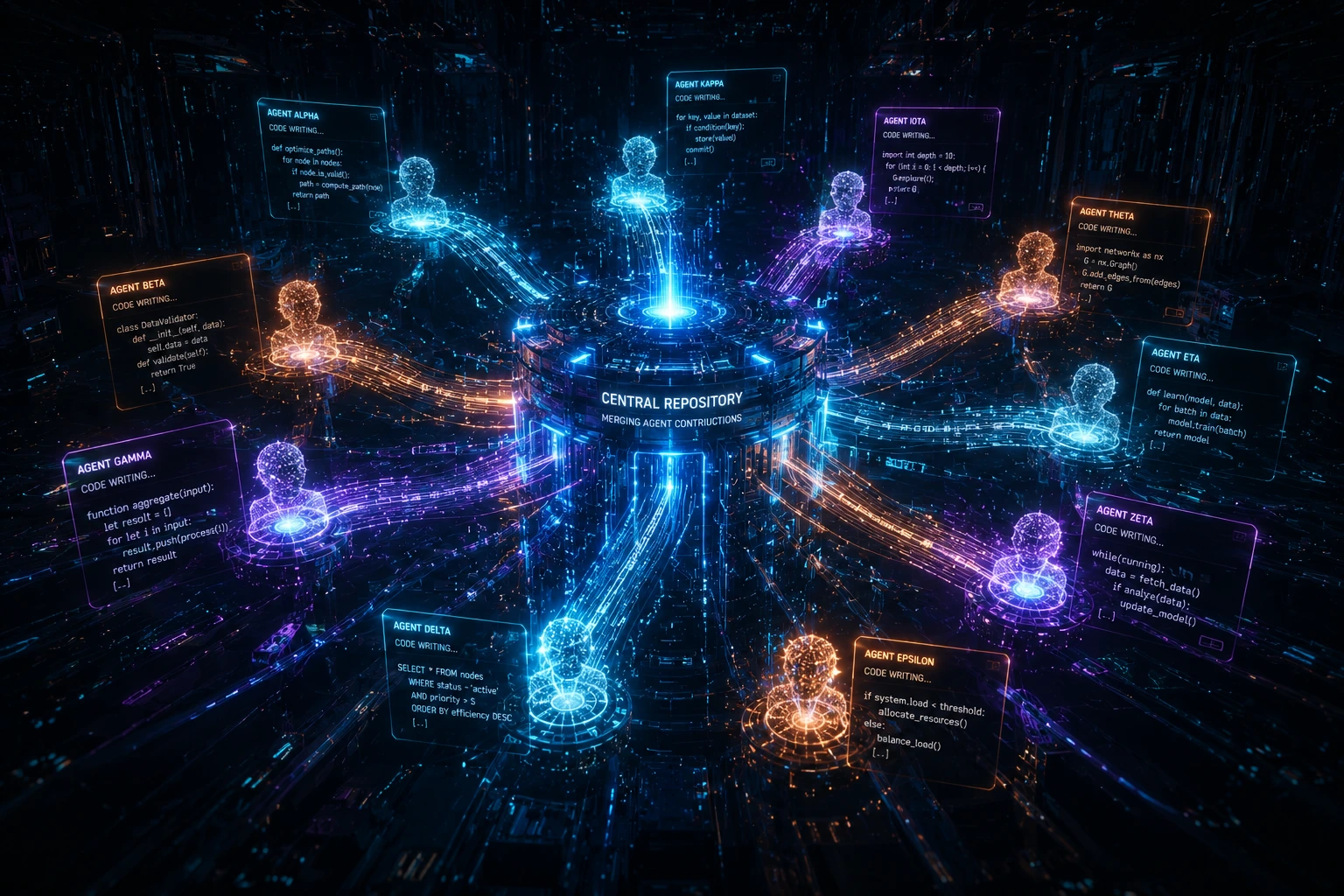
  +--> [Sub-Agent Alpha: Fix Bug]     -+
                 |                                    |
[Workspace] ---> +--> [Sub-Agent Beta: Write Test]   -+--> [Origin Merge Queue] --> [Autonomous Deploy]
                 |                                    |
                 +--> [Sub-Agent Gamma: Refactor]   -+
Instead of forcing a human developer to manually parse a massive multi-thousand-line git diff generated by an AI agent, Origin categorizes agent modifications into tightly insulated, logically ordered "Review Packets" — allowing engineers to operate strictly as high-level architectural gatekeepers. Origin also integrates deeply with Graphite's stacked PR models and automated merge queues.
6. What "Stockfish-Level Coding" Really Means
The Chess Engine Analogy

Stockfish is the world's strongest chess engine — an Elo ~3650 monster that makes grandmasters look like beginners. It doesn't just play good moves; it plays perfect chess relative to human capability, exploring millions of positions per second with flawless evaluation. Elon Musk's analogy is deliberate and profound: Stockfish-level coding means an AI that can:
Architect entire complex systems from high-level goals
Write, debug, optimize, and refactor production-grade code at superhuman speed and correctness
Handle massive codebases with perfect context across thousands of files
Iterate through design spaces that would take human teams months — in hours or minutes
We are not there yet. Today's best tools (Cursor Composer, Claude 4-class models, Grok Build, Devin-style agents) are already shockingly capable at many tasks — but they still hallucinate, struggle with novel architectures, and require significant human steering.
The New Frontier Model: Key Characteristics
Cursor has teased an unreleased, proprietary frontier model trained completely from scratch on internal compute clusters — moving beyond its previous approach of fine-tuning Moonshot's Kimi K2.5 with post-training and reinforcement learning:
Scale of Compute: 10x to 20x more compute than the original Composer architectures
General Intelligence: Broad, generalized technical reasoning — not just code-only syntax tokenization
Benchmark Capacity: Matches frontier architectures like Claude Opus and OpenAI's premium variants
Multi-Modal Systems Engineering: Native parsing of architectural diagrams, database schemas, hardware telemetry, and cross-language dependencies
Generalized Computer Use: The Real Unlock
The second half of Musk's statement — "generalized computer use" — may be even more important. This refers to AI agents that can control a full computer environment the way a human does: moving the mouse, clicking, typing, switching apps, reading screens, using the terminal, managing Git, deploying services. When combined with Stockfish-level coding ability, it creates something entirely new: autonomous software engineering agents that can take a product spec and ship working features end-to-end — including infrastructure, testing, monitoring, and iteration based on real usage data.
7. Developer Community Reaction: Mixed Signals
Hacker News: Skepticism & Concern
The developer community's reaction on Hacker News (129+ comments) reflects deep ambivalence. While the Cursor founders received congratulations — "arguably the first true AI-wrapper billionaires, 0 to multigenerational wealth in 4 years" — many engineers expressed concern or outright skepticism:
"$60B is a huge price, but buying Cursor gives Musk something xAI has struggled to build: a popular coding product with real developer and enterprise adoption. It may be the fastest way to catch up in AI coding. The real question is whether SpaceX ownership improves Cursor or drives its users away."— Hacker News commenter
A notable comment thread emerged around Cursor's actual technical moat. Critics pointed out that Composer 2.5 is essentially Kimi K2.5 with post-training RL — not a frontier model trained from scratch — and questioned whether $60 billion is justified. Defenders countered that Cursor's value lies in distribution: $4 billion ARR, Fortune 500 penetration, and real-world training data at scale.
The Subscription Cancellation Wave
Multiple developers publicly announced plans to cancel their Cursor subscriptions, citing concern about code privacy under Musk's conglomerate, the loss of model-agnosticism, and general distrust of the ownership change. Alternatives being discussed include: Claude Code, OpenAI Codex, Zed, Cline, Continue, and other open-source harnesses.
8. Developer Panic: The Privacy & Governance Trust Crisis
A code-generating editor demands a fundamentally distinct tier of trust compared to standard corporate software acquisitions. Cursor does not merely store static data — its active state engine continuously tracks:
In-flight, uncommitted corporate IP and proprietary algorithms
Internal product roadmaps, structural business dependencies, and architectural flaws
Granular system environmental variables, configuration templates, and cryptographic structures
Real-time developer behavior patterns and refactoring decisions
When the keys to this hyper-sensitive telemetry stream are handed to a conglomerate spanning aerospace engineering (SpaceX), autonomous robotics (Tesla), global telecommunications (Starlink), social media (X), and public neural networks (xAI), developers face a complex privacy equation. Engineers at rival aerospace firms, competing EV manufacturers, and alternative social media platforms are voicing severe alarm — with several organizations threatening to block network traffic to Cursor's servers unless a 100% air-gapped, verified Local On-Premise Enterprise Mode is contractually guaranteed.

9. Actionable Playbook: How Developers Should Pivot Now
Strategy 1: Hard-Enforce Local Context Boundaries
Implement an aggressive .cursorignore protocol at the root of your organizational repositories to prevent sensitive metadata, build caches, and private configuration environments from being bundled into cloud payload transfers:
# Heavy Git & System Tracking Insulators
.git/ | .hg/ | .svn/

# Restrict Build Caches & Production Artifacts
dist/ | build/ | .next/ | out/ | target/ | bin/

# Strict Environmental Security Filters
.env | .env.* | *.pem | *.key | secrets.json | config/private/

# Third-Party Dependencies
node_modules/ | vendor/ | .cargo/ | .pnpm-store/
Strategy 2: Prepare Code for Fluid Model Swapability
Do not couple your system's codebase patterns to the proprietary structural formatting of a single AI vendor's prompt hooks. Keep your code highly modular, strictly typed, and isolated behind clean interface boundaries. If corporate data policies require you to instantly switch your IDE from Cursor to alternative execution layers (VS Code with standalone API keys, Claude Code, or open-source local terminal systems like Aider), your engineering workflow should remain uninterrupted.
Strategy 3: Leverage Standard Tier for Cost-Efficiency
Explicitly switch your IDE configurations from the high-throughput Fast Tier over to the cost-optimized Standard Tier for long-running background tasks. The standard processing tier runs the same reasoning logic weights but strips away premium speed multipliers — allowing you to run continuous multi-file refactoring agents for hours at a fraction of your monthly token credit allocation.
Strategy 4: Evaluate Open-Source Alternatives
Given the ownership uncertainty, developers seeking model-agnostic, privacy-first alternatives should evaluate:
Claude Code (Anthropic) — Terminal-based, strong on large codebases
OpenAI Codex — Balanced quality/cost/speed, strong for personal projects
Zed — Open-source editor with native AI integration, highest GitHub stars
Cline / Continue / PearAI — YC-backed open-source harnesses
Aider — Terminal-based, fully open-source
10. What Happens Next: A Timeline
Next 6-12 Months
New jointly trained models will drop in Cursor and Grok Build. Expect rapid iteration. Cursor's agentic features will be supercharged with xAI's latest models and Colossus compute. Cloud Agents with Slack, Linear, and web integrations will expand significantly. The top 1% of developers using these tools already write 46x more lines of AI-generated code daily than the median active user — that gap will widen dramatically.
2-4 Years
Stockfish-level coding starts becoming visible in narrow domains — web apps, mobile, data pipelines, internal tools. Generalized computer use agents will handle large fractions of routine engineering work. Developer productivity metrics (features shipped per engineer) will begin looking unrecognizable by historical standards.
5-10 Years
AI systems may routinely architect and maintain complex, production-critical software with minimal human intervention. New software paradigms emerge that are designed for AI understanding and modification rather than human readability. The cost of creating sophisticated software drops dramatically.
Conclusion: The New Era of AI Production
The acquisition of Cursor by SpaceX for $60 billion — confirmed via SEC filing on June 16, 2026, with close expected in Q3 2026 — marks the definitive end of the experimental era for AI coding tools. Cursor went from four MIT kids with a vision in 2022 to a $60 billion strategic asset in just four years. That pace itself is a preview of what's coming.
Software engineering is no longer defined simply by a human typing lines of syntax into a local text editor. It is a highly automated, compute-heavy pipeline where foundational models, agent-native hosting forges, and planetary-scale supercomputing clusters operate in a continuous loop. |
For developers who learn to navigate this new paradigm — mastering context engineering, setting strict operational boundaries, and orchestrating parallel agentic codeflows — the capacity to ship robust, production-grade applications will scale exponentially. The future of software development belongs to the engineers who stop operating as line-by-line syntax writers and step into their new roles as master architects of autonomous AI software factories.
The universe is big. Understanding it — and expanding life throughout it — will require building extraordinary things at extraordinary speed. With this acquisition, SpaceX just bought itself (and the world) a powerful new engine for doing exactly that.