Quick Answer
Performance engineering is making a comeback because AI coding assistants generate working code fast, but rarely efficient code. As AI produces a growing share of production code, teams are seeing more memory bloat, redundant computation, and unoptimized data access patterns. Performance engineering profiling, benchmarking, and systematically tuning systems is the discipline catching what AI-generated code misses.
TL;DR
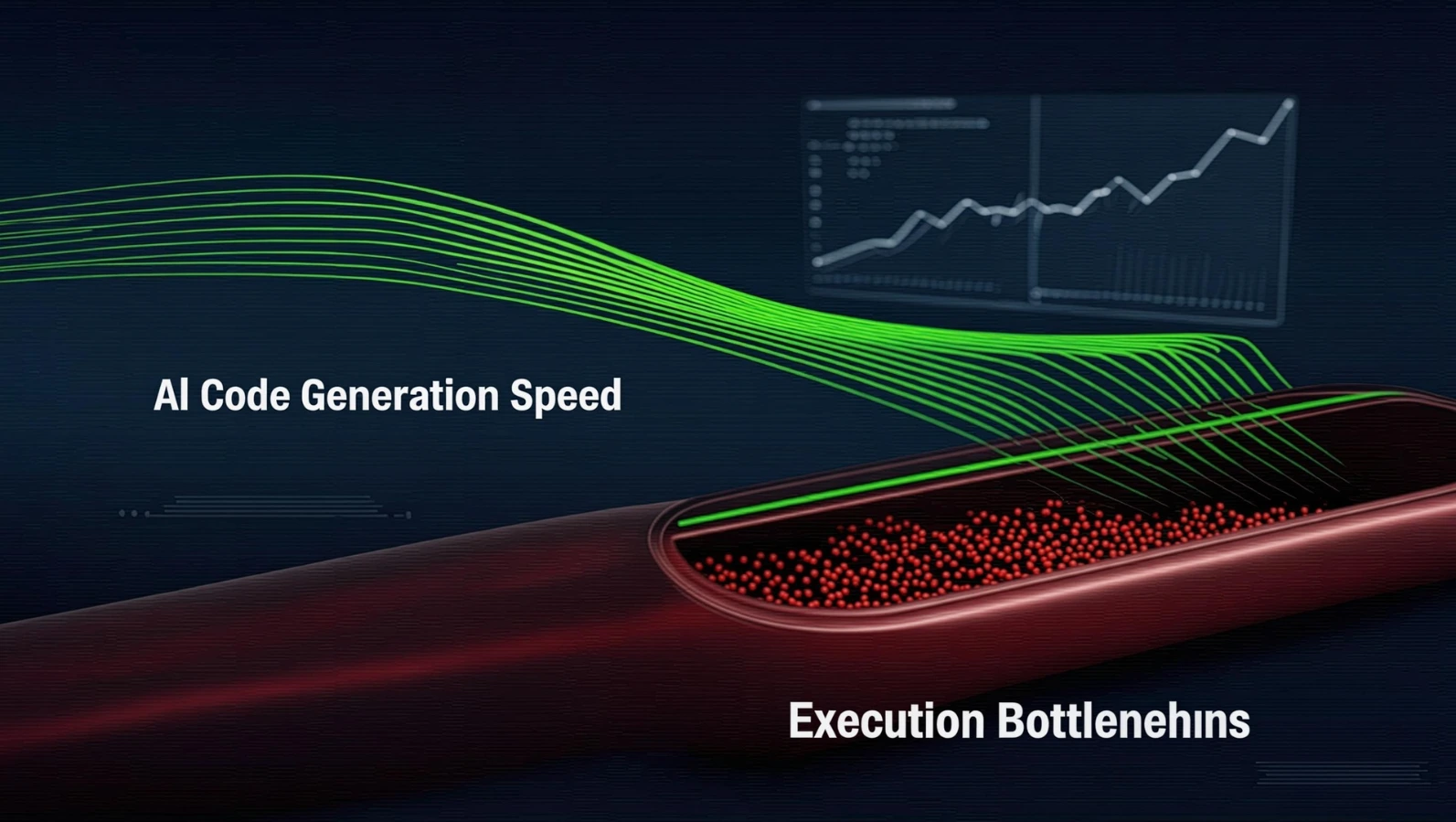
AI coding tools now generate a large share of new code at many companies, but speed of generation doesn't mean speed of execution.
AI models are trained to produce code that looks correct and passes tests, not code that's optimized for memory or latency.
"Memory shortage" and runaway cloud bills are becoming common side effects of AI-accelerated development.
Profiling-first workflows (measure before you optimize) matter more now, not less, because nobody fully reviews every line an AI writes.
Classic performance engineering skills Big O thinking, cache awareness, I/O batching, concurrency control are becoming differentiators for senior engineers.
New tooling categories are emerging specifically to measure AI-generated code's performance impact, separate from its correctness.
The fix isn't avoiding AI tools. It's pairing them with deliberate performance review steps, the same way code review caught bugs before AI existed.
Teams that treat performance as a one-time launch checklist item are getting burned by compounding inefficiencies at scale.
The productivity gains from AI are real and measurable — but they're unevenly distributed, and the gap between high- and low-adoption teams is widening, not narrowing.
Introduction
A senior engineer at a mid-sized fintech company told me something that stuck: their AI coding assistant had quietly increased their monthly cloud bill by 30% over two quarters. Nothing was broken. Every test passed. Every pull request got approved. The code just did more work than it needed to extra database round trips, unnecessary object allocations, a sorting algorithm that should have been a lookup.
This is the quiet story behind the AI coding boom. By early 2026, AI-generated code had reached close to half of all new code written, with adoption accelerating faster than most teams expected. That's a genuine productivity story. But generation speed and execution speed are not the same thing, and a lot of teams are learning that the hard way, one cloud invoice at a time.
This article is about why performance engineering, the discipline of measuring, profiling, and deliberately tuning how software uses CPU, memory, and I/O is having a comeback right now. Not because it ever went away in principle, but because it had quietly become an afterthought for a decade of "just scale the cluster" cloud-native thinking. AI-generated code is forcing it back into the spotlight, because nobody scales their way out of code that does ten times more work than necessary.
You'll get a working definition of modern performance engineering, the specific ways AI-generated code tends to underperform, hands-on code optimization techniques with before/after examples, a practical profiling workflow, real benchmark data, and a look at where this is heading. If you're a backend engineer, an AI engineer shipping LLM-powered features, or a technical lead trying to control cloud costs, this is written for you.
What Is Performance Engineering, Really?
Performance engineering isn't "making it faster." That's optimization. Performance engineering is the broader discipline of building performance into a system's lifecycle — from design decisions through monitoring in production — so that speed and resource efficiency are treated as requirements, not afterthoughts.
It covers:
Algorithmic efficiency — choosing data structures and algorithms with the right time and space complexity for the actual workload.
Memory management — controlling allocation patterns, avoiding leaks, and understanding garbage collection behavior.
I/O and concurrency — batching network calls, avoiding N+1 query patterns, and using concurrency primitives correctly instead of accidentally serializing work.
System-level tuning — caching strategy, connection pooling, indexing, and infrastructure sizing.
Continuous measurement — profiling and benchmarking as a routine part of development, not a pre-launch fire drill.
The reason this matters again right now is structural. For the last decade, a lot of teams substituted hardware for engineering discipline — "just add another instance" instead of fixing the slow query. Cloud elasticity made that substitution cheap enough to ignore. AI-generated code has changed the economics, because it multiplies the volume of code shipped without multiplying the number of engineers who deeply understand each line's performance characteristics.
Why AI-Generated Code Tends to Be Inefficient

This isn't a knock on the tools — it's how they're trained and how they're used in practice.
1. Models optimize for "looks correct," not "runs efficiently"
Large language models are trained on enormous amounts of code, weighted toward what's common and what compiles or passes tests. They're very good at producing idiomatic, working solutions. They're not inherently incentivized to minimize allocations, avoid redundant passes over data, or pick the asymptotically better algorithm unless the prompt specifically asks for it.
A documented example: a developer working through an Advent of Code problem found that the AI's first instinct was a recursive solution that worked perfectly on the small example case. Applying that recursive approach to the real dataset triggered stack overflow issues, and fixing it took longer than writing a dynamic-programming solution from scratch would have. The code was "textbook correct" in isolation and quietly wrong for the actual constraints of the problem.
2. Volume outpaces review depth
When a team moves from writing most code by hand to having AI generate a large share of it, code review capacity doesn't scale proportionally. Engineers are reviewing more surface area per hour, which means subtle performance issues — an extra database call buried in a loop, a cache that never gets invalidated, an object that gets cloned three times instead of once — slip through far more easily than outright bugs that fail tests.
3. The productivity paradox is real and measurable
Engineering analytics platforms tracking AI-assisted development have found that when AI-generated code exceeds roughly 40% of a team's output, rework rates climb 20–25% higher and bug rates increase, with a measurable gap between how productive teams feel and how productive they actually are. Performance regressions are a major, under-discussed component of that rework. They don't fail in CI. They show up three weeks later as a latency complaint or a cost spike.
4. The codebase changes faster than the team's mental model
Even senior engineers who deeply understand performance can fall behind when 2,000+ lines change in a sprint. One striking example from a recent industry survey: an engineer noticed an opportunity to optimize the slowest 1% of requests in their system, cut latency on those requests from 4 milliseconds to under half a millisecond, did it as a side project over a couple of days, and the work ended up spanning twelve pull requests and roughly 2,500 changed lines — work that became feasible specifically because AI agents could move fast enough to explore an optimization that wouldn't have been worth the time investment before.
That last example is the optimistic flip side: AI doesn't just create performance debt, it can also be directed at paying it down faster than ever, when someone with performance intuition is steering.
The "Memory Shortage" Problem
A recurring secondary keyword here for a reason: memory shortage is becoming a visible, recurring symptom in AI-accelerated codebases. It shows up as:
Containers getting OOM-killed in production despite "working fine" in staging.
Steadily climbing memory usage graphs that only show up after hours or days of uptime (classic slow leak signature).
Object allocation patterns where AI-suggested code creates intermediate copies of large data structures — common in data processing and LLM pipeline code where context windows and embeddings are large.
Caching layers added without eviction policies, because the AI suggestion solved the immediate latency problem without considering the memory ceiling.
The fix is rarely "buy more RAM." It's profiling allocation patterns with tools like heap profilers (py-spy, tracemalloc in Python; pprof in Go; Chrome DevTools heap snapshots in Node.js), and treating memory budgets as a design constraint the same way you'd treat a latency SLA.
Code Optimization Techniques That Actually Move the Needle
These are the techniques worth knowing cold, in rough order of how often they matter in real systems.
1. Fix the algorithm before you fix the implementation
A clever micro-optimization on an O(n²) algorithm is still O(n²). Before touching syntax, ask whether the underlying approach scales with your actual data size.

python
# Before: O(n^2) - checking membership in a list inside a loop
def find_duplicates(items):
    duplicates = []
    for i, item in enumerate(items):
        if item in items[i+1:]:   # O(n) lookup, done n times
            duplicates.append(item)
    return duplicates

# After: O(n) - using a set for O(1) average lookup
def find_duplicates(items):
    seen = set()
    duplicates = set()
    for item in items:
        if item in seen:
            duplicates.add(item)
        seen.add(item)
    return list(duplicates)
Why it matters: at 1,000 items the difference is barely noticeable. At 1,000,000 items, the first version can take minutes; the second takes well under a second. AI assistants will often produce the first version because it's the more "obvious" translation of the problem statement, unless you explicitly ask for an efficient solution.
2. Batch your I/O — kill the N+1 pattern
python
# Before: N+1 query problem - one query per user inside a loop
def get_user_orders(user_ids):
    results = {}
    for uid in user_ids:
        results[uid] = db.query(f"SELECT * FROM orders WHERE user_id = {uid}")
    return results

# After: one batched query
def get_user_orders(user_ids):
    rows = db.query(
        "SELECT * FROM orders WHERE user_id IN %s", (tuple(user_ids),)
    )
    results = {}
    for row in rows:
        results.setdefault(row.user_id, []).append(row)
    return results
Expected output: for 500 users, the first version issues 500 round trips to the database; the second issues one. On a database with 2ms average round-trip latency, that's the difference between roughly 1 second and a few milliseconds.
Common mistake: the original raw-string version above is also a SQL injection risk — another reason to never accept AI-generated query code without a security and performance pass.
3. Avoid unnecessary object copies in hot paths
python
# Before: copies the entire list on every call
def process(data):
    working_copy = data.copy()
    working_copy.sort()
    return working_copy[:10]

# After: avoid the copy when the caller doesn't need the original preserved,
# or use heapq when you only need the top-k
import heapq
def process(data):
    return heapq.nsmallest(10, data)
Why it matters: heapq.nsmallest avoids a full sort (O(n log n)) and a full copy, doing the work in roughly O(n log k) instead. For large datasets where you only need a handful of results, this is a meaningful win, not a micro-optimization.
4. Use connection pooling and caching deliberately, with eviction
python
# Before: cache with no bound — grows forever
cache = {}
def get_user(user_id):
    if user_id not in cache:
        cache[user_id] = db.fetch_user(user_id)
    return cache[user_id]

# After: bounded LRU cache
from functools import lru_cache

@lru_cache(maxsize=10_000)
def get_user(user_id):
    return db.fetch_user(user_id)
Common mistake: adding a cache to fix a latency problem and forgetting it now has no size limit — this is one of the most common sources of the "memory shortage" symptom described above.
5. Profile before you optimize, always
The single biggest waste of engineering time is optimizing code that isn't actually the bottleneck. Use a profiler — cProfile + snakeviz in Python, Chrome's Performance tab for JS, pprof for Go, async-profiler for JVM — and find the actual hot path before changing anything. AI assistants are good at suggesting plausible optimizations; they're not good at telling you whether you're optimizing the right 5% of your code.
A Practical Performance Engineering Workflow
- Establish a baseline. Benchmark the current behavior under realistic load before changing anything. Without a baseline, you can't prove improvement.
- Profile, don't guess. Use CPU and memory profilers on representative workloads, not toy inputs.
- Fix the biggest bottleneck first. Amdahl's Law is unforgiving — optimizing a function that's 2% of runtime will never give you a 10x speedup.
- Re-benchmark after every change. One change at a time, measured, so you know what actually helped.
- Add performance regression tests to CI. Treat a 2x latency regression the same way you'd treat a failing unit test — block the merge.
- Review AI-generated code for complexity, not just correctness. Ask explicitly: "what's the time and space complexity of this, and is there a more efficient approach?" Most coding assistants will give you a meaningfully better answer when asked directly than when left to their first instinct.
- Monitor in production continuously. Latency percentiles (p50, p95, p99), memory usage over time, and database query patterns should be dashboards you check weekly, not just during incidents.
What the Latest Industry Research Actually Shows
The points above match recent independent research, not just anecdotes. Four reports stand out.
The 2025 DORA report (covered by InfoQ in March 2026), based on survey responses from nearly 5,000 technology professionals, found that AI does not automatically improve software delivery performance — it acts as a multiplier of whatever engineering conditions already exist. Around ninety percent of developers now report using some form of AI assistance in their work, with roughly two-thirds relying heavily on it for coding, documentation, debugging, or exploring unfamiliar frameworks.
The report's key conclusion is that organizations with mature DevOps practices and strong platform capabilities convert AI productivity gains into real delivery improvements, while organizations with fragmented tooling or unclear processes can see AI accelerate technical debt and instability instead.
Faros AI's 2026 "Acceleration Whiplash" report is the most sobering data point available, and it's based on telemetry rather than survey opinion. Drawing on two years of data from 22,000 developers across more than 4,000 teams, it found genuine business value — epics completed per developer up 66%, task throughput up 33.7%, and PR merge rate up 16.2% — alongside a much rougher quality picture. Code churn rose 861%, the incidents-to-PR ratio rose 242.7%, and bugs per developer rose 54% as organizations moved from low to high AI adoption.
Perhaps most relevant to performance engineering specifically: pull requests merging with no review at all, human or automated, rose 31.3%, and median time in code review rose 441.5% as senior engineers tried to keep up with reviewing plausible-looking but subtly flawed AI output. Critically, the report found that strong existing engineering foundations did not protect organizations from this deterioration — high-DORA-maturity teams saw the same downstream quality decline as everyone else, which directly contradicts the more optimistic survey-based narrative and suggests the real-world performance and reliability cost of unreviewed AI code is larger than developer sentiment alone would suggest.
Jellyfish's 2026 State of Engineering Management report, based on survey responses from more than 600 engineering leaders, adds an important productivity-side counterweight to the Faros AI quality data. Nearly two-thirds of teams (64%) report at least a 25% increase in developer velocity from AI, and the gap between high- and low-adoption organizations is widening rather than closing: 92% of high-AI-adoption companies report an improved company growth outlook year over year, compared to 69% of low-adoption companies.
The report also surfaces a structural bottleneck relevant to performance work specifically — only about 10% of organizations report both strong AI enablement and high adoption across the org, meaning a small group of power users is driving most of the measured impact while the rest of the organization (and its review capacity) lags behind. The barriers cited — rising AI tool costs (42%), resistance from senior engineers (36%), and tool fragmentation (31%) — are the same structural gaps that let performance regressions slip through review.
A 20-year performance engineering veteran's take, published by Tricentis in May 2026, offers a useful ground-level counterpoint to the macro data: the fundamentals of performance work haven't changed. As one solution architect put it, you're still dealing with CPU, memory, disk I/O, and network — those principles haven't changed since the beginning of performance engineering. His view is that AI isn't replacing the discipline, it's raising the bar for how fast performance engineers need to validate increasingly large volumes of AI-generated code, making AI fluency a required addition to, not a replacement for, core performance skills.
The throughline across all four sources: AI is shipping more code, faster, and delivering real velocity gains — but the quality and performance safety net hasn't kept pace, adoption and review capacity are unevenly distributed across organizations, and that gap is exactly where performance engineering work is landing back on the priority list.
Benchmarks and Performance Analysis
A few data points worth internalizing:
Metric | Data Point | Source Context |
|---|---|---|
AI-generated code rate (early 2026) | Approaching 50% of new code at many companies | Industry adoption tracking |
"Safe" AI code share for mature teams | 25–40%, delivering 10–15% productivity gains | Engineering analytics benchmarking |
Rework rate increase above 40% AI code | 20–25% higher | Engineering analytics benchmarking |
Teams reporting 25%+ velocity gain from AI | 64% of teams | Jellyfish 2026 State of Engineering Management |
Orgs with strong AI enablement and high adoption | ~10% | Jellyfish 2026 State of Engineering Management |
Code churn in AI-assisted repos | Rising year over year across large-scale repo analysis | Repository-level research |
Example optimization win | A latency-critical path cut from 4ms to under 0.5ms via a focused, agent-assisted effort | Industry engineering survey |
Teams generating 25–40% of their code with AI tend to land in the safest zone, getting 10–15% productivity gains while keeping review overhead and quality manageable; pushing past 40% tends to create a measurable gap between perceived and actual performance. The practical takeaway: there's a real ceiling on how much AI-generated code a team can absorb before performance and quality problems start outpacing the speed gains.
That ceiling is a performance engineering problem as much as a process one — it's exactly the regime where unreviewed inefficiencies compound, and it's compounded further by the uneven enablement gap Jellyfish's data highlights: the teams with the least mature review and enablement practices are often the same ones pushing AI code share the highest.
Common Mistakes Teams Make
Treating performance as a launch-week checklist. Performance debt compounds. A system that's "fine" at 10,000 users can fall over at 200,000 because nobody revisited the assumptions.
Trusting AI suggestions for data-layer code without review. Database access patterns are where N+1 queries, missing indexes, and unbounded result sets hide, and they're the most expensive class of bug to fix after the fact.
Scaling infrastructure instead of fixing the bottleneck. Adding instance papers over an inefficient algorithm; it doesn't fix it, and the bill keeps growing.
No regression detection for performance. Functional tests catch broken features. Almost nothing catches a function that got 3x slower, unless you explicitly test for it.
Optimizing without measuring first. Guessing at bottlenecks wastes engineering time on changes that don't move the needle, while the real bottleneck stays untouched.
Advanced Tips
Ask your AI assistant for complexity analysis explicitly. Prompting for "the most memory-efficient approach" or "avoid O(n²) behavior here" produces measurably different code than a bare functional request.
Use sampling profilers in production, not just locally. Tools like py-spy (Python) or continuous profiling platforms can run with near-zero overhead and catch issues that only appear under real traffic patterns.
Set memory and latency budgets per service, the same way you'd set an error budget for reliability. A budget makes performance regressions visible immediately instead of accumulating silently.
Pair AI-generated PRs with a dedicated performance reviewer rotation on teams where AI code share is high — a second pass focused purely on resource usage, separate from the correctness review.
Re-profile after major dependency or model upgrades. Library updates and even LLM model swaps in AI-powered features can quietly shift memory and latency characteristics.
Community Insights
Developer communities are actively discussing this exact tension. On engineering forums and in industry surveys, two patterns keep surfacing:
Some experienced engineers report that with AI handling the typing, they're now able to explore optimization work that previously wasn't worth the time investment — describing it as suddenly being able to look at problems they'd never have contemplated tackling before, because an agent can iterate through a dozen pull requests in days instead of weeks.
At the same time, there's growing concern that what looks like a productivity boost is sometimes a "thinking decelerator" in disguise — teams have reported losing as much as 19% of velocity to the friction of debugging, verifying, and context-switching around AI-generated code for complex, thought-intensive tasks, even though the typing itself got faster.
Both things are true at once, which is exactly the nuance performance engineering is built to handle: AI is a force multiplier, and force multipliers amplify both good judgment and bad habits.
Latest Updates (2026)
A few developments worth tracking as of mid-2026:
AI coding tool adoption has continued accelerating, with one tool overtaking established competitors in usage rankings within about eight months according to a survey of over 900 engineers and leaders conducted in early 2026.
A new category of engineering analytics tooling has emerged specifically to measure AI code's real-world impact — tracking rework rates, churn, and quality separately from raw output volume, rather than assuming more generated code equals more progress.
Enterprise teams are increasingly required to use AI-assisted testing as a compliance and risk-management measure rather than purely a productivity tool, given research showing a 23.7% increase in security vulnerabilities in AI-assisted code — a closely related risk category to the performance issues covered in this article.
Jellyfish's 2026 survey of 600+ engineering leaders found that AI adoption gaps inside organizations — not just between organizations — are becoming a recognized risk: a small group of power users tends to drive most of the measured velocity gains while uneven enablement leaves the rest of the team, and its review capacity, behind.
Where the publicly available information is thin: there isn't yet broad, standardized benchmark data specifically isolating "performance regressions caused by AI-generated code" as its own measured category across the industry. Most current data bundles performance issues into broader quality and rework metrics. If you're building internal tooling, this is a gap worth filling with your own team's data rather than waiting for an industry standard.
Future Outlook
Performance engineering isn't going to fade back into the background this time, for a structural reason: the volume of code being shipped is growing faster than the number of engineers who can manually catch inefficiency, and cloud cost transparency is making the financial impact of inefficient code visible faster than it used to be. Expect three things over the next couple of years:

Performance-aware code review tooling becomes standard, the same way linters and security scanners became standard a decade ago — automated complexity and resource-usage analysis built into the PR pipeline.
"Efficiency per AI-generated line" becomes a tracked engineering metric, alongside the rework and churn metrics teams are already building tooling for.
Performance engineering becomes an explicit specialization again within teams, rather than something every senior engineer was simply expected to absorb through experience. The depth required to reason about algorithmic complexity, memory behavior, and system design at scale doesn't get automated away just because code generation does.
Yes — arguably more relevant, because AI optimizes for correctness and idiomatic style, not for resource efficiency, leaving a gap that someone needs to fill deliberately.
Performance testing is a verification activity, usually pre-launch. Performance engineering is a continuous discipline spanning design, implementation, and production monitoring.
This is a common symptom of unreviewed AI-generated code: extra database calls, unbounded caches, or inefficient algorithms that work correctly but consume more resources than necessary.
It refers to applications running out of available memory due to leaks, unbounded growth (like caches without eviction), or inefficient allocation patterns — increasingly common in fast-shipped, lightly-reviewed code.
No. The fix is adding an explicit performance review step, not removing the tool. Prompting assistants specifically for efficient, low-memory solutions also produces meaningfully better results.
Depends on the stack: cProfile/py-spy for Python, Chrome DevTools or clinic.js for Node.js, pprof for Go, async-profiler or JFR for the JVM, and continuous profiling platforms for production-scale visibility.
Industry data suggests roughly 25–40% is a sustainable range for most mature teams; beyond that, rework rates and quality issues climb faster than productivity gains.
Treating it as functionally equivalent to human-written code in review depth, when it actually needs a separate, explicit pass focused on complexity and resource usage.
Very common — it's one of the most frequent patterns AI assistants produce when asked for "simple" data-fetching logic, because the loop-based version is the more obvious translation of the request.
No — it masks them temporarily while increasing cost. The underlying inefficiency remains and tends to get worse as data volume grows.
Profiling before optimizing. It prevents wasted effort on changes that don't address the actual bottleneck.
Yes — when directed by someone with performance intuition, agents can explore and implement optimizations far faster than manual work would allow, as shown by real cases of multi-millisecond latency cuts achieved in days rather than weeks.
Both — frontend bundle size, render performance, and memory leaks in long-running single-page apps are equally susceptible to the same "looks correct, performs poorly" pattern from AI-generated code.
Tie it directly to cloud cost data. A concrete "this query pattern costs $X/month at current scale" argument is far more persuasive than an abstract code-quality argument.
Pick your three highest-traffic endpoints, profile them under realistic load, and fix the single biggest bottleneck in each. Small, measured wins build the case for a broader investment.
Both, and the inside-company gap is arguably more actionable. Recent survey data shows a small group of power users often drives most of an organization's measured AI-driven velocity gains, while uneven enablement leaves the rest of the team — and its review and performance-review capacity — lagging behind.
Performance engineering isn't coming back because anyone romanticizes the days of hand-tuning assembly. It's coming back because the math changed. When a growing share of production code is AI-generated, optimized for passing tests and looking idiomatic rather than for memory and latency, someone has to own the gap — and that someone needs the same skills performance engineers have always needed: profiling discipline, algorithmic judgment, and a habit of measuring before assuming.
The practical path forward is straightforward, even if it takes real effort: establish baselines, profile before optimizing, add performance-specific review to your AI-generated code, set explicit budgets for latency and memory, and watch your cloud cost data as closely as your test coverage. Teams that do this will keep the genuine productivity gains from AI coding tools without absorbing the quiet cost — the memory shortage problems, the runaway bills, the systems that work in staging and buckle at scale. That's what performance engineering, done well, has always been for.