
The Core Problem: Why Developers Are Rethinking Node.js
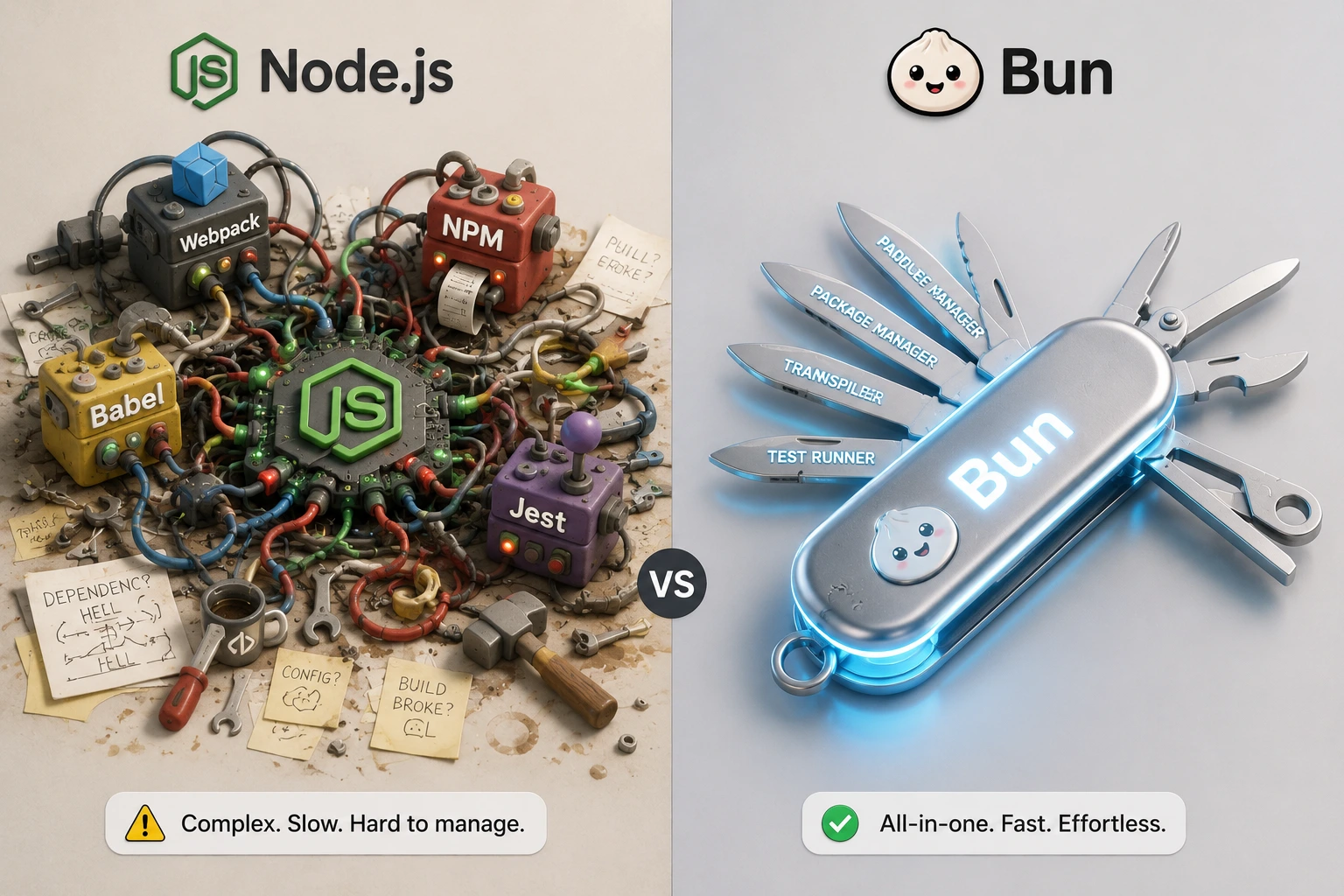
Node.js is great, but it carries legacy architectural baggage. Built on Google's V8 engine, Node.js requires external bundlers (like Webpack or Esbuild), package managers (like NPM or Yarn), and separate testing frameworks just to get a modern project running.
In high-concurrency environments, maximizing backend framework throughput while minimizing CPU and memory usage is a constant battle. This performance ceiling is exactly why switching to Bun has become a top priority for modern engineering teams.
But before we declare Node.js dead it isn't. Node.js is still the most widely adopted backend JavaScript runtime in the world, with more than 45% of backend developers actively using it in production. The real story in 2026 isn't about one replacing the other. It's about choosing the right tool for the right workload.
Is Node.js Still Relevant in 2026?
Yes and not in a "legacy" way.
Node's biggest advantage isn't raw performance. It's gravity. The NPM ecosystem contains over two million packages. Enterprises, frameworks, internal tooling, CI pipelines, and decades of community knowledge are all built around Node.js. That compatibility moat is nearly impossible to replace overnight.
Why Node.js still dominates:
Ecosystem: Every framework, SDK, observability agent, and library targets Node.js first.
Stability: Long-Term Support (LTS) releases provide predictable maintenance and security patches, governed by the OpenJS Foundation.
Enterprise trust: NASA, PayPal, Microsoft, LinkedIn, Walmart, and Netflix all rely on Node.js for mission-critical workloads. LinkedIn's migration from Ruby on Rails to Node.js cut servers from roughly 30 down to just 3 and delivered up to 20x faster performance in certain scenarios.
TypeScript momentum: TypeScript is rapidly becoming the default way to write Node.js. Large-scale projects benefit from clearer data shapes, better tooling, and safer refactoring making teams more productive over time.
Where Node.js still struggles:
Cold starts in serverless environments remain slow.
Toolchain sprawl: you still need a bundler, a test runner, and a package manager separately.
ESM/CJS compatibility issues continue to cause headaches.
Configuration fatigue is real bundlers, transpilers, linters, and test frameworks all need setup.
 x
x
What is Bun, and Why is it Faster?
Bun is not just a runtime it is an all-in-one toolkit. It replaces your runtime, package manager, bundler, and test runner simultaneously, attacking exactly the toolchain sprawl that frustrates Node.js developers.
There are two architectural reasons why Bun claims the title of the fastest JavaScript runtime:
The JavaScriptCore Engine: Instead of V8, Bun uses Apple's JavaScriptCore (JSC) engine. JSC is historically optimized for faster startup times and lower memory footprints.
Native Zig & C++ Optimization: Bun is written from scratch in Zig and C++, ensuring low-level memory control and zero-overhead system calls.
The Performance Breakdown: Bun vs Node.js
1. HTTP Requests Per Second Be Honest About Benchmarks
In standard HTTP server benchmarks, Bun handles roughly 52,000 requests/sec compared to Node's ~13,000 — a 4× difference in synthetic tests. However, when a production-grade app with routing, validation, and a real database was tested, Bun delivered 12,400 req/sec vs Node's 12,000 — only a 3% difference.
The takeaway: Benchmarks only tell half the story. In database-heavy apps, the performance gap narrows significantly. The biggest gains come in CPU-bound, stateless, or I/O-heavy workloads.
2. Package Installation Speed
Bun's built-in package manager uses aggressive caching and hard-linking. In a large monorepo test with 1,847 dependencies:
Package Manager | Install Time |
|---|---|
npm install | 28 minutes |
pnpm install | 4 minutes |
bun install | 47 seconds |

That's 35× faster than npm and 5× faster than pnpm — drastically reducing CI/CD pipeline wait times.
3. Startup Time and Cold Starts
Bun boots up almost instantly (often under 10 milliseconds). For serverless functions and edge computing, this eliminates the dreaded "cold start" problem entirely.
On AWS Lambda in production, Bun's cold start is 290ms vs Node's 940ms — 69% faster. One migration report documented a 35% reduction in Lambda costs after switching.
4. TypeScript Support
Bun runs TypeScript natively with zero config — enums, namespaces, decorators, all of it work out of the box. Node.js v25 added TypeScript type stripping, but it only supports "erasable syntax" by default. Enums and namespaces still require extra flags.
For large teams, TypeScript is not just about speed — it's about safety. Types catch errors during development instead of production, improve collaboration, clarify data shapes, and make refactoring far less risky. The real performance impact of TypeScript is organizational, not runtime.
Real-World Case Study: Trigger.dev Gets 5x Throughput
The best proof isn't synthetic benchmarks, it's production data.
Trigger.dev migrated their latency-sensitive service "Firestarter" from Node.js to Bun. The results were remarkable:
Metric | Node.js | Bun (Compiled Binary) |
|---|---|---|
Throughput | 2,099 req/s | 10,700 req/s |
Max Latency | 619ms | 17ms |
Container Image Size | 180MB | 68MB |

By using bun build --compile, they generated a self-contained executable with no runtime, no node_modules, no source files in the container. This alone gave them 14% more throughput and 24% better p95 latency.
Bun's New Built-in Features (2025–2026)
Bun 1.2 and 1.3 added native database support directly in the runtime — no npm packages needed:
Bun.SQL — built-in PostgreSQL client
Built-in MySQL, SQLite, and Redis support
This means smaller dependency lists and lower supply chain attack risk. Your stack gets simpler, not more complex.
Big News: Anthropic Acquired Bun (December 2025)
In December 2025, Anthropic acquired Bun and deployed it as the core infrastructure for Claude Code. The project remained MIT-licensed and open source, but corporate backing from one of the world's leading AI companies has significantly reduced any concern about Bun being abandoned.
This is a major credibility milestone for Bun's long-term viability.

The Runtime Landscape in 2026: Node.js, Bun, Deno, and Edge
The question is no longer "which runtime will kill Node?" The smarter question is: which runtime is right for this workload?
Most modern teams aren't picking one runtime for everything they're composing:
Edge runtimes (Cloudflare Workers, Vercel, Deno Deploy) handle fast, global, request-level routing and caching near users.
Node.js / Bun / Deno handle the heavy backend integrations, long-running processes, job queues, and database-heavy APIs.
Node.js is the compatibility baseline and safest enterprise default. Bun wins where speed and integrated tooling matter most. Deno wins where security posture and modern web-standard APIs matter. Edge runtimes win where latency and cold starts are the bottleneck.
The Future-Proof Architecture: Write for Web APIs
One emerging trend that crosses all runtimes: code built on Web Standard APIs fetch(), Request, Response, Web Streams, Web Crypto is portable across Node.js, Bun, Deno, and edge runtimes alike.
The runtime becomes an infrastructure choice, not a rewrite. If your core logic uses standard APIs, you can swap runtimes with minimal pain.
Should You Switch? The Migration Reality Check
Bun features native, drop-in compatibility with Node.js APIs and the NPM ecosystem. You can run your existing Express, NestJS, or Next.js applications directly using Bun with minimal configuration changes.
⚠️ One Thing to Watch: Memory Leaks
After migration, Trigger.dev discovered a memory leak. Bun's Bun.serve() HTTP model works differently if a Promise<Response> never resolves (e.g., on client disconnect), Bun holds the request context in memory indefinitely. Node.js doesn't have this issue because its response state is tied to the socket. The Bun team fixed this quickly, but the lesson is clear: always monitor memory carefully after migrating to Bun.
The Safest Migration Strategy
Don't migrate everything at once. The recommended approach:
Start with stateless workers and job processors, the simplest, most CPU-bound services.
Validate performance metrics in production.
Run both runtimes in parallel in CI and compare results.
Expand to other services only after confirmation.
When to Switch to Bun
You are building serverless or edge functions where milliseconds matter.
Your backend handles massive real-time data streaming or high-volume API requests.
You want to speed up your developer workflow and local build times.
You want to eliminate TypeScript config overhead.
You want a single binary deployment with zero dependencies in containers.
When to Stick with Node.js
You rely heavily on ultra-specific, low-level Node.js C++ add-ons not yet fully supported in Bun.
Your enterprise infrastructure demands conservative, highly mature ecosystem stability.
Your bottleneck is database queries, not the runtime itself.
You are building large-scale, long-term systems where TypeScript on Node.js provides the clarity and tooling your team needs.

Final Verdict: The Future is Plural
The Bun vs Node.js performance debate is no longer about theoretical benchmarks. Real companies like Trigger.dev are reporting massive drops in infrastructure bills and massive gains in application throughput after migrating.
With Anthropic's backing, native database support, true TypeScript compatibility, and a self-contained binary compiler, Bun is no longer just a "faster alternative" it's a fundamentally better developer experience for the right workloads.
Node.js will remain a powerhouse for years to come especially for enterprise applications, compatibility-sensitive projects, and teams that value ecosystem stability and TypeScript at scale.
The future isn't one runtime winning. The future is teams making smarter, workload-specific decisions. And in 2026, you finally have enough information to make that decision confidently.