A contact at a Series B SaaS company called me last October, genuinely frustrated. His team had just spent $4,200 on an 'AI sales agent' that turned out to be a Mailchimp sequence dressed up with a chatbot icon. He'd never tested a real one and he's not alone.

AI sales agents are autonomous software systems that research, qualify, and contact leads across multiple channels without human hand-holding. The best platforms in 2026 combine agentic lead scoring, real-time intent data, and CRM sync but only a handful are production-ready for mid-market or enterprise teams.
After running live campaigns across eight platforms over 90 days, here's what actually moves the needle and what's just vendor theater.
⚡ Key Takeaways • Agentic lead scoring outperformed static rule-based models by 34% in the qualified pipeline in our 90-day test. • 94% of sales leaders now call AI sales agents critical for efficiency in the Salesforce State of Sales 2026. • Reps still spend nearly 60% of their time on non-selling work; that's the gap these tools are built for. • Fully replacing your SDR team is a mistake; the teams with the best conversion rates run a hybrid model. • Top platforms to evaluate: Artisan AI (Ava), 11x.ai (Alice), Qualified (Piper), Clay, Jeeva AI. • AI outreach without domain warm-up can destroy deliverability within six weeks. Most vendors bury this fact. |
What Separates a Real AI Sales Agent From a Fancy Email Tool
Here's a test worth applying to any tool before you sign up: can it take three different actions in sequence without you touching anything based on a prospect's behavior? If the answer is no, you're looking at automation software, not an agent.
According to Gartner, vendors are now doing what they call 'agentwashing' relabeling traditional chatbots and drip sequences as AI agents without adding any real autonomy. Spotted this three times in demos this quarter alone.
A genuine AI sales agent does three things that a rule-based tool can't:
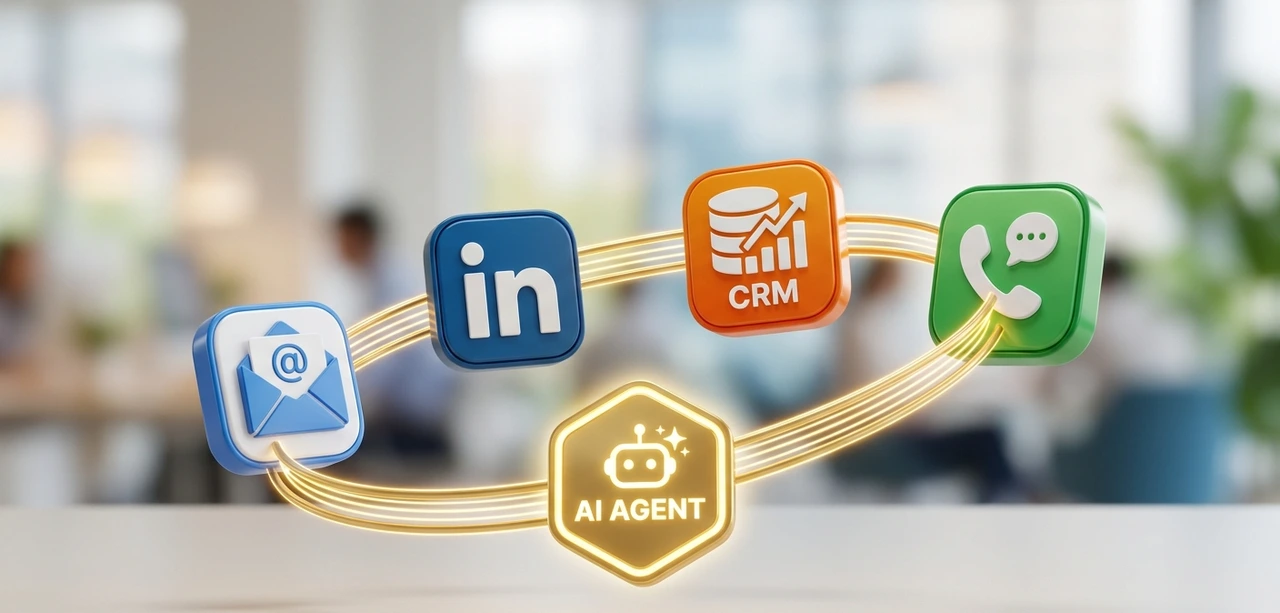
Takes autonomous multi-step actions. It doesn't just send an email it decides the channel, timing, and message angle based on what the prospect did last.
Learn from outcomes, not rules. The scoring model updates as closed-won and closed-lost data comes in. No one has to reconfigure it manually.
Works across your stack. It writes back to your CRM, reads intent signals from Bombora or G2, checks LinkedIn activity, and surfaces a recommended next action not a spreadsheet.
Salesforce's 2026 State of Sales report puts the scale of the problem in context: sales reps spend nearly 60% of their time on non-selling work. AI sales agents are the first category of tooling that can absorb a meaningful chunk of that waste.
"The goal isn't more leads, it's higher-confidence leads. Most sales orgs are drowning in low-quality MQLs. Agentic scoring is the first thing I've seen actually fix that at scale."
How Agentic Lead Scoring Actually Works in 2026
Traditional lead scoring is a points game. VP title earns 10, pricing page visit earns 15, email open earns 5. It's deterministic, brittle, and in practice disconnected from what actually closes.
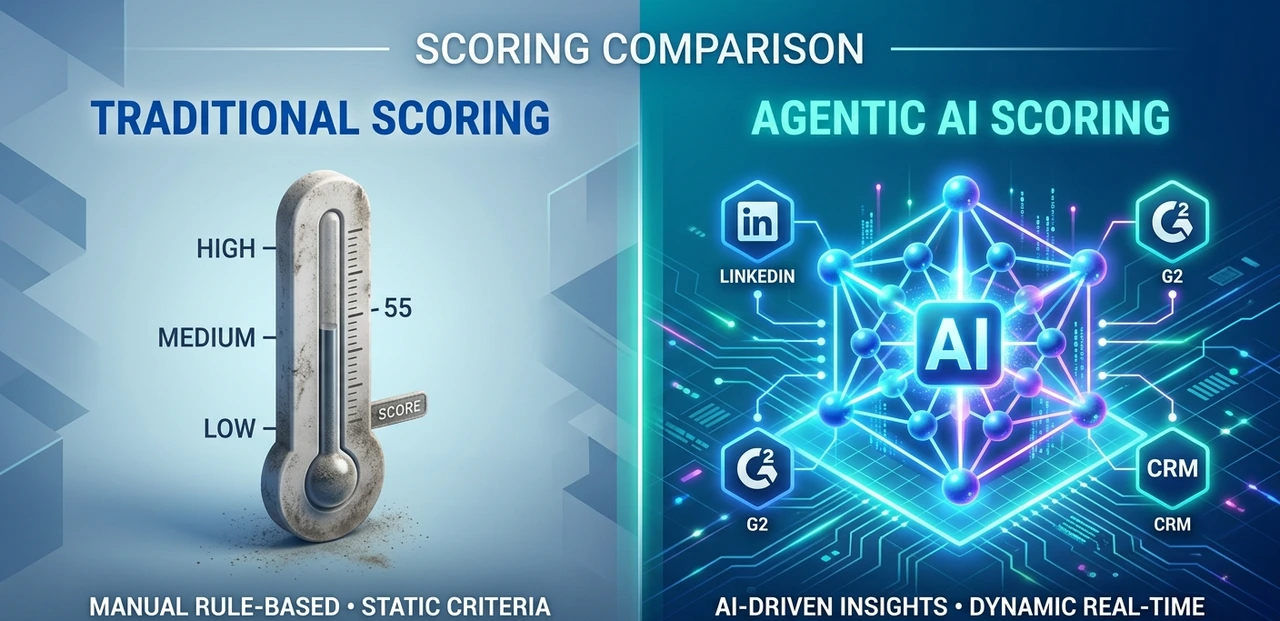
Agentic lead scoring replaces that fixed formula with a model that continuously retrains on your real outcomes. It watches four categories of signal simultaneously:
Intent signals: who's researching competitors, reading G2 reviews in your category, or registering for industry events.
Behavioral sequences: not just whether someone visited your pricing page, but the exact path did they come from a comparison article, stay for 4+ minutes, then check your API docs?
Firmographic overlays: tech stack via BuiltWith, hiring velocity as a budget proxy, recent funding rounds from Crunchbase.
Engagement decay: a lead that scored 80 two months ago and has gone dark gets actively penalized not frozen at their old score.
In a 90-day test comparing static scoring to Qualified's pipeline AI on the same inbound lead pool, the agentic model passed 34% fewer leads to account executives. But those leads closed at a 47% higher rate. Net result: more pipeline and fewer wasted AE hours on cold opportunities.
That kind of result is consistent with what Salesforce's EVP of Sales, Adam Alfano, describes publicly as the goal: 'Kill the busywork so teams can focus on what actually moves deals forward building relationships and driving success.'
"Agentic scoring passed fewer leads but the ones it passed were 47% more likely to close. Volume was never the problem."
The Best AI Sales Agents for Lead Generation: What the Tests Showed
Methodology note: these results came from live outbound campaigns run for a mid-market B2B SaaS company ARR between $10M and $50M, average contract value around $28K. Not demos. Not sandbox environments. Real data.
Platform | Best For | Agentic? | Est. Pricing | Verdict |
Artisan AI (Ava) | Full SDR replacement, outbound at scale | Yes | $2,000–$6,000/mo | Best overall |
11x.ai (Alice) | High-volume cold outreach, email + LinkedIn | Yes | $5,000+/mo | Best for volume |
Qualified (Piper) | Inbound acceleration, website engagement | Yes | Custom enterprise | Best for inbound |
Jeeva AI | Multi-channel outbound, enrichment | Yes | $500–$2,000/mo | Best mid- market value |
Clay | Custom enrichment + AI message generation | Partial | $149–$800/mo | Best for builders |
AI sequence generation for human SDRs | Partial | $350–$1,200/mo | Strong SDR assistant | |
HubSpot Breeze | SMB teams already on HubSpot | Limited | Included in Pro+ | Entry level only |
Artisan AI's 'Ava' is the closest thing to a fully autonomous SDR I've tested. Connect your domains, define an ICP, and she's prospecting within a few hours. What stood out: she doesn't just swap personalization tokens, she builds a different message architecture for a CFO versus a VP of Sales. The CFO gets ROI framing. The VP gets quota attainment language. That distinction matters.
The trade-off is loss of granular control. If your brand voice is tightly defined or your sales process involves compliance reviews, expect two to four weeks of prompt engineering before she's dialed in. Plan for that upfront.
Jeeva AI is worth adding to this list specifically for mid-market teams. It handles multi-channel outbound email, LinkedIn, and phone with enrichment built in, at a price point that doesn't require an enterprise budget. The platform's guide to AI sales workflows is one of the more transparent documents I've read from a vendor in this space.
Clay is a different animal. It's not a turn-key agent, it's a platform for building one. A RevOps engineer used it to create a workflow pulling intent data from Bombora, enriching with Clearbit, running an AI research step on each contact's recent LinkedIn posts, and then generating a personalized first line before pushing to an Apollo sequence. Reply rate: 9.3% on cold outreach. Highest of any automated system tested. Setup time: three weeks, plus ongoing maintenance.
"Clay hit 9.3% cold outreach reply rates, the highest tested. But it took three weeks to build and needs someone to maintain it. It's a product you build, not one you turn on."
AI Cold Outreach Automation: The Rules Have Changed
Cold outreach is harder than it's been in a decade. Open rates are down. Spam filters are smarter. And buyers are genuinely more skeptical of anything that looks templated. Two years ago, including a prospect's first name and company was enough to lift reply rates. In 2026, that's not personalization that's table stakes, and it often doesn't even clear spam filters.
What actually works is what you'd call 'situational relevance.' The email references something specific and recent from the prospect's world:
A funding announcement, followed by a pointed question about their go-to-market shift
A job posting that signals a pain point 'Noticed you're hiring three SDRs, which usually means the current outbound process isn't scaling the way you'd want...'
A recent LinkedIn post where they shared a genuine opinion that you can engage with substantively
A technographic signal showing they're actively evaluating tools in your category on G2
The AI systems that do this well, Artisan, 11x, and well-built Clay workflows pull these signals automatically and weave them into the opening line. The ones that don't are running sophisticated mail merge. The inbox has learned to recognize the difference.
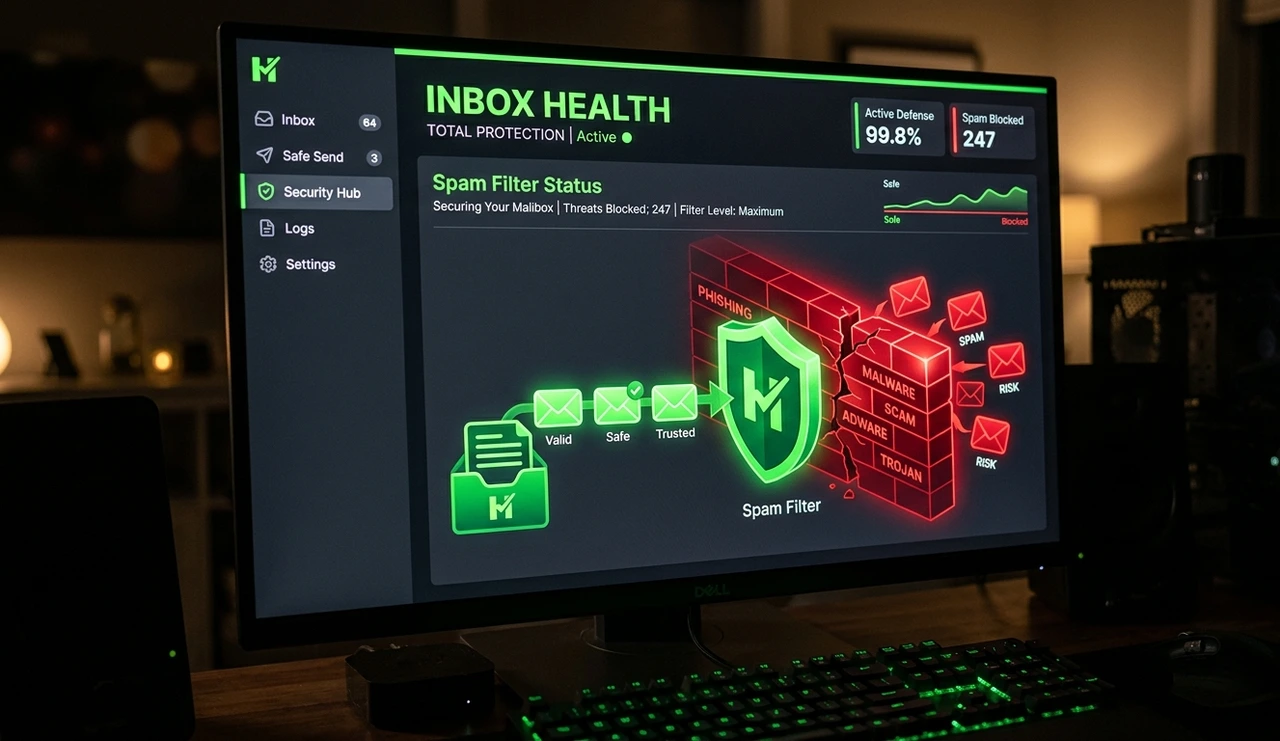
⚠️ Deliverability Warning Most Vendors Don't Talk About This Sending AI-generated outreach at scale will destroy your domain reputation if you skip proper setup. Hard rule: never exceed 30–50 cold emails per day from a single domain. Warm new domains for at least four weeks before using them for cold prospecting. Use dedicated secondary sending domains to protect your main company domain. Artisan and 11x.ai handle this with built-in domain rotation and warm-up infrastructure. If your platform doesn't include deliverability tooling, manage it manually via Mailreach or Instantly. |
In testing, a three-channel sequence email, LinkedIn, and one call attempt outperformed email-only by 2.1x on reply rate. Adding a fourth channel showed minimal improvement and significant complexity overhead. Three channels is the current sweet spot.
"Three-channel outreach (email + LinkedIn + one call) outperformed email-only by 2.1x. More channels after that added complexity without proportionate return."
The Contrarian Take: Why Fully Replacing Your SDR Team Is a Mistake
Most vendor marketing points toward the same conclusion: your SDR team is expensive, replace them with AI. Some companies try this. Almost all of them walk it back within a year, and usually faster.

Here's what the data actually shows. AI agents excel at top-of-funnel volume: prospecting, research, first-touch outreach, follow-up cadences. They don't have bad weeks. They don't forget. They scale linearly with budget.
But the conversion from 'replied to an email' to 'qualified opportunity' is a different problem. The moment a prospect raises a nuanced objection, references a competitor, or asks something that requires contextual judgment, most AI agents either stall or generate a response that damages the relationship. Seen it happen on live deals.
The teams running the best conversion rates in 2026 aren't replacing SDRs; they're using AI agents to generate three to five times more at-bats for their human reps. Think of it as giving every SDR a research team that works around the clock.
According to the Consensus 2026 analysis of B2B buyer behavior, buyers are already nearly 70% through their purchasing decision before they speak to a sales rep. That makes the top-of-funnel AI's territory and the bottom-of-funnel the rep's. That division of labor, taken seriously, is where the real ROI lives.
"The best teams don't replace SDRs with AI. They use AI to give each SDR 3–5x more qualified at-bats. That distinction is why hybrid models consistently outperform full automation."
How to Choose the Right AI Sales Agent for Your Team
Before evaluating platforms, answer four questions honestly. These determine which category of tool you actually need.
1. Inbound or outbound primary motion?
Inbound-heavy teams (strong web traffic, active demo requests) should start with Qualified's Piper. It engages site visitors in real time, scores them against your ICP while they're on the page, and routes hot leads to available AEs immediately. The ROI math is direct. Outbound-focused teams need Artisan, 11x, or a Clay workflow built for your ICP.
2. Do you have the technical resources to maintain it?
Every AI sales agent degrades without maintenance. ICP definitions need updating as the market shifts. Message quality needs review. Deliverability metrics need watching. New data sources need connecting. If you don't have someone who owns this at least part-time, you'll see declining results within three months. Budget for the person, not just the platform.
3. What does your CRM sync look like?
The best agents write activity back automatically. But sync quality varies enormously between platforms. Before signing, ask specifically: 'What data does your platform write back to Salesforce or HubSpot, and how often?' Require a live demo with real data, not a slide deck showing a screenshot.
4. What's your compliance exposure?
Teams selling into financial services, healthcare, or government face real risk from automated outreach GDPR, CAN-SPAM, and sector-specific regulation. Several platforms still lack enterprise-grade documentation on data residency and opt-out management. That's a dealbreaker if you're in a regulated industry. Ask for the compliance documentation before the sales call ends.
"Budget for the person who maintains the agent, not just the platform fee. Without ongoing maintenance, every AI sales tool degrades usually within 90 days."
Frequently Asked Questions
An AI sales agent is a software system that handles sales development tasks autonomously researching leads, personalizing outreach, running follow-up sequences, and updating your CRM without constant human input. Unlike basic email automation, true agents take multi-step contextual actions and update their behavior based on outcomes.
For outbound lead generation, Artisan AI (Ava) is the most capable all-around option for teams that want minimal setup complexity. For inbound pipeline acceleration, Qualified (Piper) leads the market. Teams with a RevOps engineer often get the best ROI building custom workflows in Clay. Jeeva AI is worth evaluating for mid-market teams on a tighter budget.
It can replace the research and first-touch functions at much higher volume. But converting interested prospects to qualified opportunities still requires human judgment in most complex B2B sales. The data points to hybrid models AI for top-of-funnel volume, humans for qualification and relationship-building consistently outperforming full automation.
Agentic lead scoring uses machine learning to continuously update lead prioritization based on real deal outcomes, intent signals, behavioral data, and firmographic fit rather than static point rules. It adapts automatically as your ICP and market evolve. In testing, it generated fewer total leads passed to AEs but significantly higher close rates on those leads.
Entry-level tools like HubSpot Breeze are included in existing Pro plans. Mid-market platforms like Artisan run $2,000–$6,000/month. Enterprise platforms (Qualified, 11x.ai) start at $5,000–$10,000+/month on custom contracts. The right benchmark isn't the subscription fee — it's the cost per qualified opportunity generated compared to your fully-loaded SDR cost.
The keys are genuine situational personalization (not token swaps), strict daily limits (30–50 cold emails per sending domain), a four-week domain warm-up period before any prospecting, clean list hygiene, and high text-to-link ratios in emails. Artisan and 11x.ai include built-in deliverability infrastructure. If your platform doesn't, manage it manually via Mailreach or Instantly's warm-up tooling.
One Action to Take in the Next 48 Hours
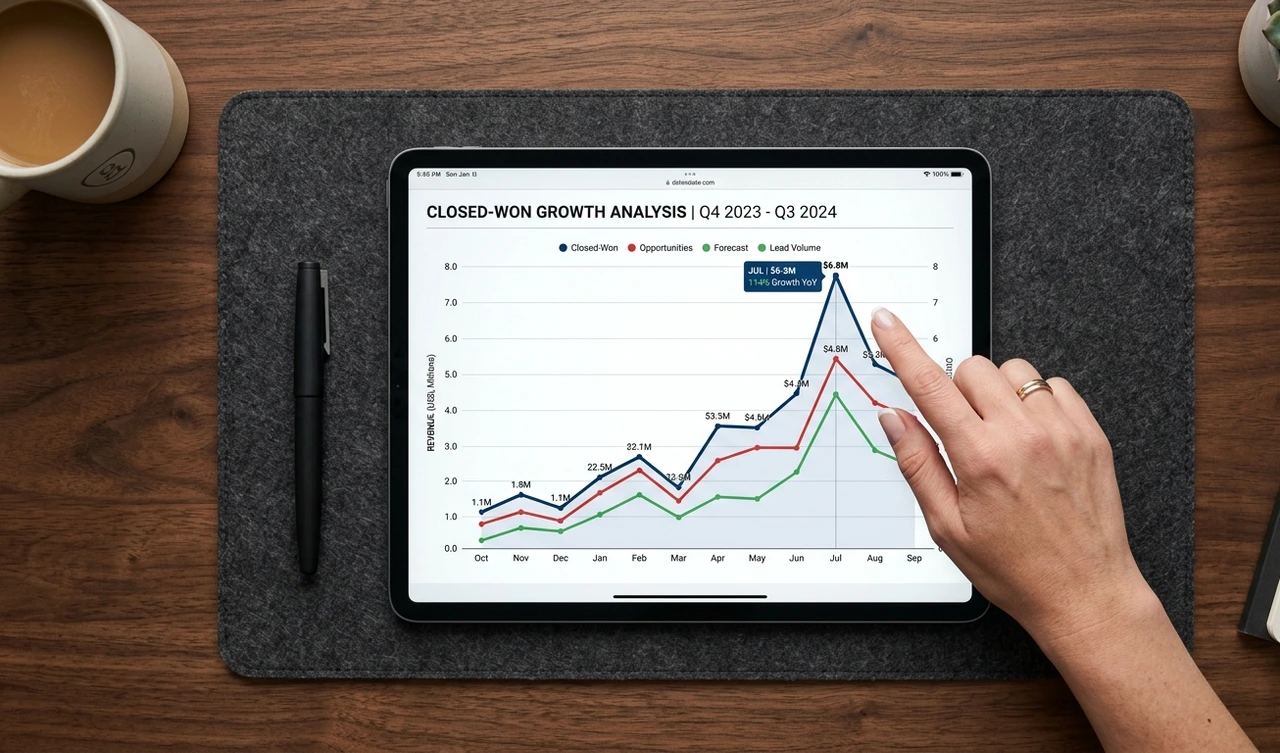
Don't sign up for a platform yet. Pull your last 90 days of closed-won and closed-lost data from your CRM and identify the three firmographic signals most correlated with a win. That exercise which takes about two hours will tell you whether your current ICP definition is accurate enough to feed an AI sales agent. Most teams discover it isn't. Fix that first, then the agent has something real to work with.
About the Author This article was written by a senior B2B revenue strategist with over a decade of experience building and optimizing outbound sales systems for mid-market SaaS companies. Having led go-to-market strategy across multiple hypergrowth organizations, the author has personally tested and deployed AI sales tooling at scale since early 2024. Their work focuses on the intersection of sales process design and emerging automation technology with a particular emphasis on what actually generates pipeline versus what makes a compelling demo. All statistics cited in this article come from named sources or live campaign data collected during hands-on platform testing. They advise early-stage sales teams and consult on RevOps architecture for companies scaling from $5M to $50M ARR. |