Quick Answer: Is Pair Programming Dead?
No. Pair programming is not dead, but AI coding agents are changing what developers need to pair on.
Traditional pair programming puts two developers together to solve a problem, write code, review decisions, and share knowledge in real time.
AI coding agents can now handle many of the mechanical parts of that workflow. They can inspect repositories, edit multiple files, run commands, execute tests, investigate failures, and iterate on their own work.
That makes AI a powerful coding partner.
But it does not automatically make AI a replacement for another human developer.
The bigger change is that pair programming is being unbundled.
AI increasingly handles execution, repetitive implementation, repository exploration, testing, and debugging.
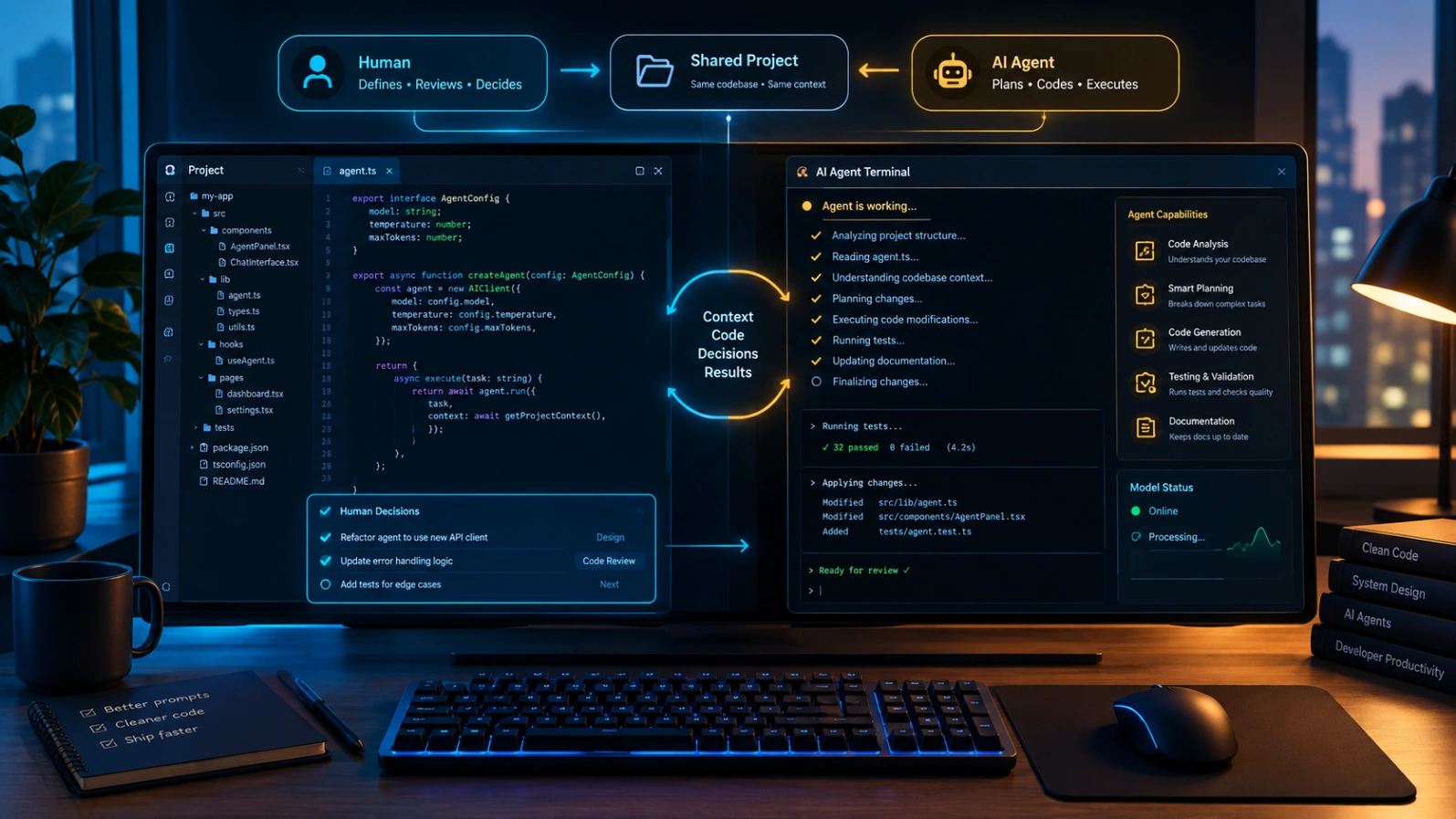
Humans remain especially valuable for:
- Architecture
- Product decisions
- Security
- Mentorship
- Ambiguous requirements
- Risk assessment
- Team communication
- Long-term technical decisions
And in 2026, there is an even bigger shift happening.
We are moving from AI pair programmers toward AI coding agents and agent teams that can take ownership of larger engineering tasks.
So the real question is no longer:
“Will AI kill pair programming?”
It is:
“Which parts of pair programming should developers delegate to AI, and which parts still require humans?”
What Is AI Pair Programming?
AI pair programming is the practice of working with an AI coding assistant or AI coding agent as part of software development.
It can happen at several levels.
1. Suggest: AI as a Coding Assistant
At the simplest level, AI suggests code while the developer remains fully in control.
Examples include:
- Inline autocomplete
- Function suggestions
- Code explanations
- Small refactors
- Documentation generation
- Error explanations
The developer decides what to write and whether to accept the suggestion.
This is the traditional AI-assistant model.
2. Drive: AI as an Implementation Partner
The developer can give the AI a larger task.
For example:
“Add authentication middleware to these API routes and update the tests.”
The AI may then:
- Inspect relevant files
- Modify multiple files
- Generate tests
- Run the test suite
- Investigate failures
- Suggest or apply fixes
The developer still directs the task, but the AI performs much more of the implementation.
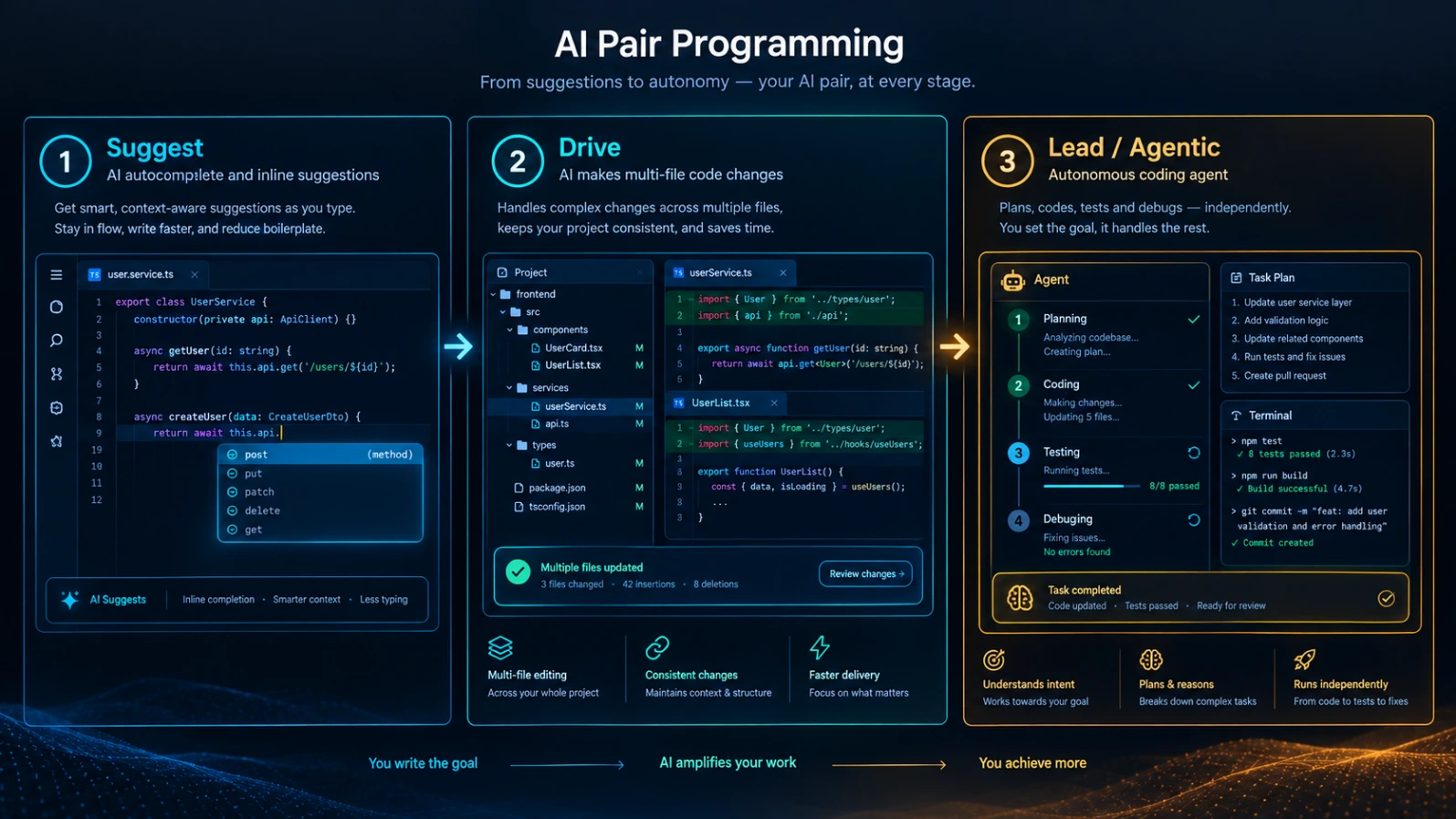
3. Lead: AI as a Coding Agent
This is where the definition of AI pair programming starts to change.
A developer might say:
“Add pagination to the users API, update the frontend table, add tests, and make sure the existing endpoints still work.”
A modern coding agent may:
- Explore the repository
- Create a plan
- Trace dependencies
- Edit multiple files
- Run commands
- Execute tests
- Investigate failures
- Modify the implementation
- Run tests again
- Return a summary
The AI is no longer simply suggesting code.
It is executing an engineering task.
AI Coding Agents Have Moved Beyond Traditional Pair Programming
One of the biggest developments in 2026 is that coding agents are beginning to converge around similar capabilities.
Dave Patten's analysis of the 2026 coding-agent landscape identifies a common architecture across tools such as Claude Code, Codex, Copilot, Gemini, Cursor, Devin, and Windsurf.
The common building blocks include:
- Repository awareness
- Memory files
- Tools and skills
- Long-running execution
- Background agents
- Sub-agent orchestration
- Codebase context
The interfaces differ, but the underlying direction is similar: agents are moving from answering prompts to operating on codebases over time.
That leads to three broad categories.
CLI-First Agents
These operate from the terminal.
Examples include:
- Claude Code
- Codex CLI
- Gemini CLI
- Copilot CLI
They can read repositories, run shell commands, edit files, and run tests.
IDE-Native Agents
These operate directly inside development environments.
Examples include:
- Cursor
- Windsurf
- GitHub Copilot
- Gemini Code Assist
They can navigate projects, make multi-file changes, execute commands, and iterate on errors.
Cloud Engineering Agents
These are further removed from the traditional pair-programming model.
A cloud agent can potentially receive an issue, investigate the repository, implement a solution, run tests, and open a pull request.
The workflow becomes:
Issue → Agent → Code → Tests → Review → Pull Request
At this point, the developer is not necessarily pairing with AI line by line.
The developer is delegating work to an AI system.
From AI Pair Programming to AI Engineering Teams
This may be the most important change in the 2026 landscape.
Instead of one AI doing everything, developers can increasingly organize specialized AI workflows around different tasks.
A conceptual workflow might look like:
Planner → Architect → Builder → Tester → Reviewer
Each stage has a different responsibility.
For example:
- Planner breaks down the requirement.
- Architect considers the design.
- Builder implements the changes.
- Tester runs and expands tests.
- Reviewer checks the resulting code.
This resembles a small software engineering team.
The important distinction is that this does not mean humans are no longer needed.
It changes the human role.
Instead of manually performing every implementation step, developers increasingly:
- Define requirements
- Set constraints
- Review plans
- Validate architecture
- Inspect output
- Resolve ambiguity
- Approve changes
In other words:
Coding is increasingly becoming the output. System design and judgment are becoming more important parts of the work.
Dave Patten describes this shift as moving from individual AI assistance toward systems that operate on codebases over longer periods of time.
What the Data Actually Says About AI Coding
AI adoption among developers is already high.
Stack Overflow's 2025 Developer Survey reported that 84% of developers use or plan to use AI tools, while only 29% said they trust AI output. Stack Overflow described this as a significant gap between adoption and trust.
That creates an important contradiction:
Developers are using AI more while remaining cautious about what AI produces.
And that makes sense.
Writing code faster is not the same as shipping reliable software faster.
An AI agent can generate a feature in minutes.
But someone still needs to determine:
- Is the implementation correct?
- Does it fit the architecture?
- Are edge cases handled?
- Is it secure?
- Will it scale?
- Did it break something else?
- Can the team maintain it?
This is why AI coding changes the bottleneck rather than simply eliminating it.
The bottleneck can move from:
Writing code
to:
Understanding, testing, reviewing, and validating code.
The Trust Gap Is More Important Than the Adoption Rate
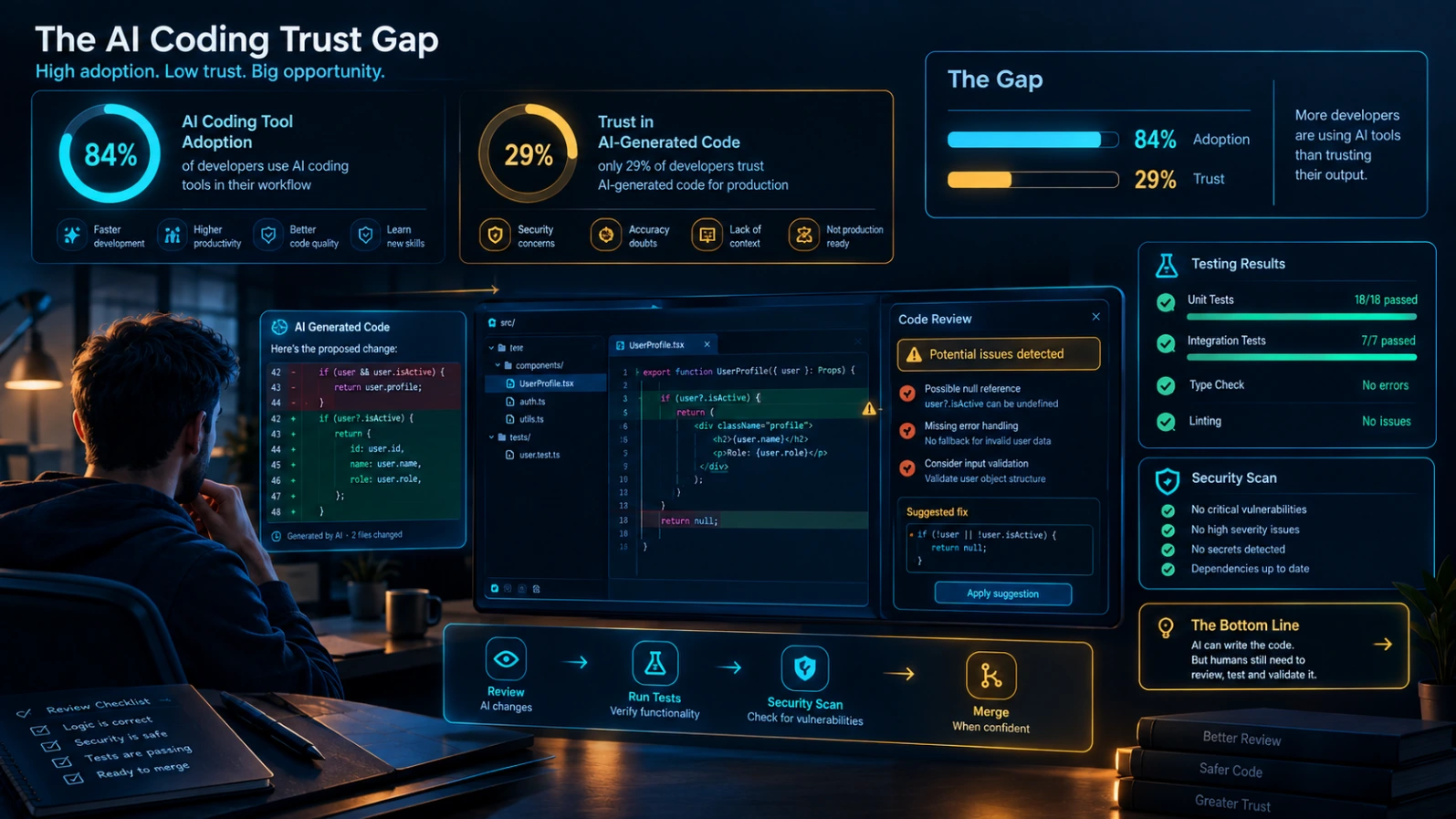
A useful way to think about 2026 AI coding is:
High adoption ≠ high trust.
Developers can use AI every day while still refusing to blindly ship its output.
That distinction matters because AI-generated code can look convincing even when it contains subtle problems.
One 2026 discussion about production AI coding highlighted a recurring pattern: agents can generate large amounts of working-looking code, but they may still misunderstand existing abstractions, introduce unnecessary complexity, or solve the wrong problem.
Another analysis of AI coding agents argues that the best agent is not necessarily the one that writes the most lines.
The better metric is whether it produces:
- Fewer regressions
- Fewer surprises
- Less cleanup
- Better alignment with the existing codebase
This is an important shift.
Lines of code are becoming a poor measure of AI productivity.
AI Coding Agents Are Becoming Better—but They Still Need Context
Modern agents can read repositories and inspect files.
But repository access is not the same as complete understanding.
An agent may know:
- Your source code
- Dependencies
- Configuration
- Tests
But it may not know:
- Why an architectural decision was made
- What a stakeholder actually wants
- Which technical debt is intentional
- What the team learned from a previous incident
- Which business constraint matters most
Vellum's 2026 analysis highlights this limitation: an agent can know your code without fully understanding the broader work surrounding that code. It also notes that security models vary between tools and that many systems still require significant guidance and review despite being called “agents.”
This is why context engineering is becoming increasingly important.
Memory Is Becoming More Important Than Prompting
Traditional AI coding often relied heavily on prompts.
You explained the task.
The model answered.
Then you repeated the context later.
Agentic coding is different.
Many modern coding systems use persistent project instructions or memory files such as:
- CLAUDE.md
- AGENTS.md
- GEMINI.md
These files can contain:
- Project conventions
- Architecture rules
- Testing instructions
- Coding standards
- Important constraints
- Development workflows
Instead of repeatedly explaining the same project rules, developers can define them once and let agents use them across tasks.
This creates a new skill:
Context engineering.
The developer's job increasingly includes designing the environment in which the AI works—not just writing better prompts.
The Biggest Change: AI Can Now Work in Loops
Traditional AI assistance often looked like:
Prompt → Answer
Agentic coding looks more like:
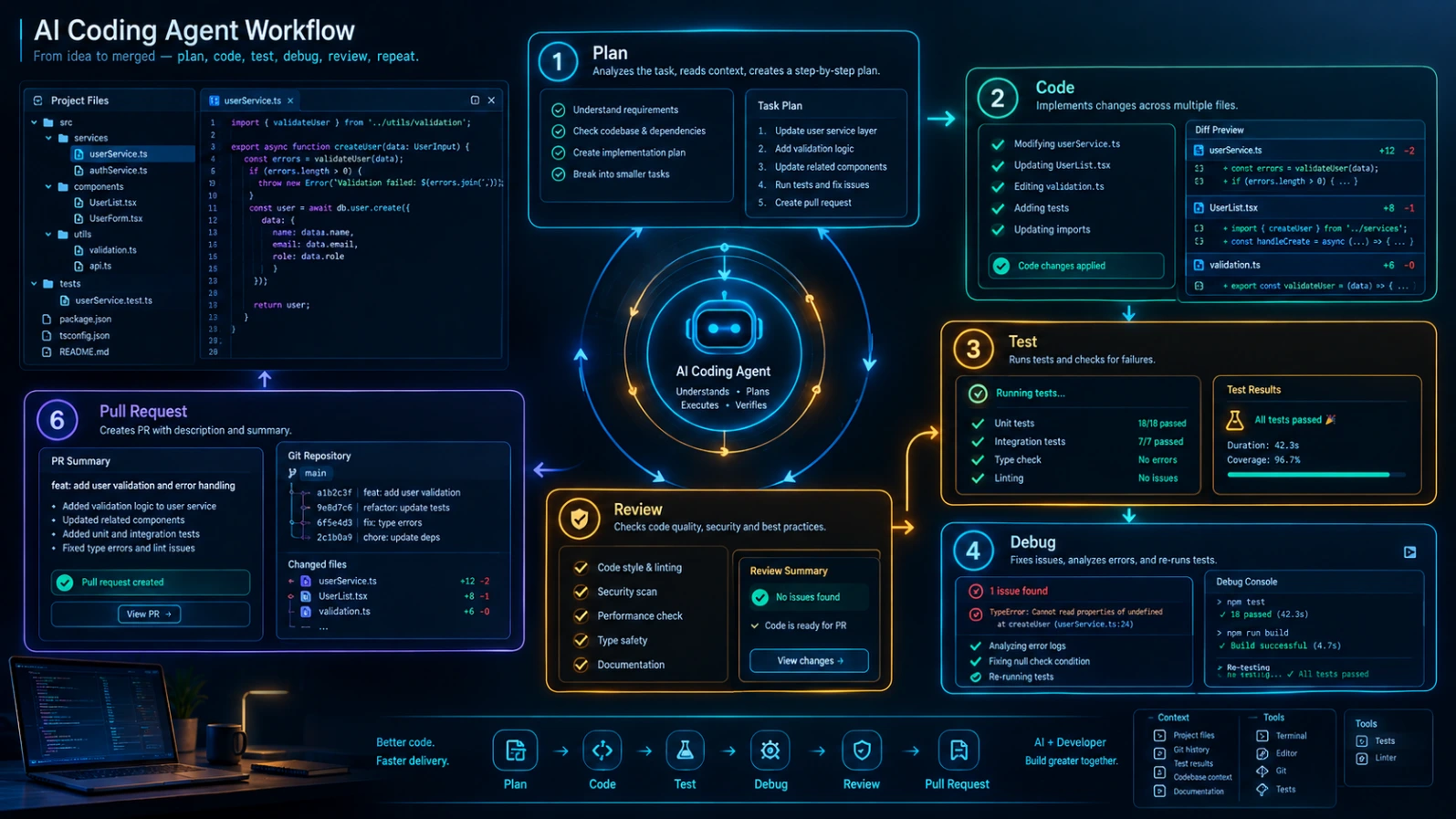
Understand → Explore → Implement → Test → Debug → Repeat
That loop is important.
An agent can:
- Inspect the repository
- Make a change
- Run a test
- Read the error
- Modify the implementation
- Run the test again
The AI therefore becomes part of an iterative development process.
This makes it much more useful than basic autocomplete.
But it also introduces a new risk:
The agent can make more decisions without asking you.
That is why good agents need boundaries.
A production coding agent should ideally know:
- What it can modify
- Which commands it can run
- When it should stop
- When it should ask for approval
- What requires human review
One 2026 developer-focused comparison specifically treats “does the agent know when to stop and ask?” as an important test of production usefulness.
The Unbundling of Pair Programming
Traditional pair programming provides several benefits simultaneously:
- Code execution
- Immediate review
- Problem solving
- Knowledge sharing
- Mentorship
- Shared decision-making
- Collective ownership
- Feedback
AI can increasingly handle some of these.
Others remain strongly human.
What AI Is Good At
AI coding agents are particularly useful for:
- Boilerplate
- Repetitive refactoring
- Test generation
- Documentation
- Repository exploration
- Known bugs
- API exploration
- Multi-file implementation
- Dependency upgrades
- Routine debugging
What Humans Are Still Better At
Humans remain particularly valuable for:
- Architecture
- Product judgment
- Security decisions
- Business context
- Mentorship
- Team communication
- Ambiguous requirements
- Risk assessment
- Long-term maintainability
So “AI replaces pair programming” is too simplistic.
A better description is:
AI is replacing pieces of the pair-programming workflow.
AI Pair Programming vs Human Pair Programming
| Area | AI Pair Programmer | Human Pair Programmer |
|---|---|---|
| Code generation | Excellent | Good |
| Boilerplate | Excellent | Slow |
| Repetitive refactoring | Excellent | Good |
| Repository exploration | Excellent | Good |
| Test generation | Excellent | Good |
| Debugging reproducible errors | Excellent | Excellent |
| Product judgment | Limited | Excellent |
| Architecture | Useful input | Excellent |
| Mentorship | Limited | Excellent |
| Team communication | Limited | Excellent |
| Business context | Limited | Excellent |
| Shared ownership | Limited | Excellent |
| High-risk decisions | Needs human oversight | Excellent |
| Knowledge transfer | Limited | Excellent |
The point is not that AI is “better” than a human.
The point is that AI and humans provide different forms of leverage.
What Developers Are Saying About AI Pair Programming
Community discussions show a more complicated picture than vendor marketing.
A Reddit discussion from a junior developer describes AI as being deeply integrated into their daily workflow for generating code, fixing bugs, refactoring, and learning new libraries.
But the same developer raised a major concern:
Could relying on AI too heavily prevent them from developing the fundamentals needed to become a senior engineer?
The discussion repeatedly returned to the same theme:
Use AI, but understand what it is doing.
Developers recommended reviewing generated code, writing tests, learning fundamentals, and treating AI as a tool rather than a replacement for engineering judgment.
One especially useful perspective from the discussion was that developers should think of themselves as the architects of the solution, while AI handles more of the repetitive implementation.
That distinction is highly relevant to pair programming in 2026.
The Junior Developer Problem Is Getting Bigger
AI can be incredibly useful for junior developers.
It can provide:
- Instant examples
- Explanations
- Debugging help
- Library guidance
- Code reviews
- Test generation
- Faster experimentation
But there is a dangerous version of this workflow.
The Bad Loop
Problem → Ask AI → Copy solution → Run it → Move on
The developer gets the task completed.
But they may not understand:
- Why the solution works
- Why another solution would be better
- What could break
- What tradeoffs were made
- How to debug it without AI
That can create dependency.
The Reddit discussion contains multiple developers warning that juniors should not approve or ship code they cannot explain, and that AI should be used to accelerate learning rather than eliminate the learning process.
The Better Loop
Problem → Think → Ask AI → Compare → Review → Test → Explain
For example:
- Try solving the problem yourself.
- Ask AI for an approach.
- Compare it with your solution.
- Ask why the AI chose its approach.
- Review every important change.
- Write or inspect the tests.
- Explain the final solution in your own words.
That turns AI into a learning partner instead of a crutch.
AI Doesn't Have to Be Your Only Pair
This is another important distinction.
A developer can use AI for implementation and still pair with another human for difficult decisions.
For example:
Stage 1 — Human + Human
Two developers discuss architecture.
Stage 2 — Human + AI
One developer asks an AI agent to implement the agreed design.
Stage 3 — AI Testing
The agent generates and executes tests.
Stage 4 — Human + Human Review
Two developers review the important changes.
This workflow may actually make human pairing more focused.
Instead of spending two hours typing boilerplate together, developers can spend that time discussing the decisions that matter.
When Should You Use an AI Coding Agent?
AI is usually the better starting point when the task is:
- Clearly defined
- Low or medium risk
- Repetitive
- Easy to test
- Easy to verify
Good Examples
Boilerplate
Generate repetitive files, components, types, or configuration.
Tests
Create initial test cases and expand coverage.
Documentation
Generate README content, comments, API documentation, and examples.
Refactoring
Apply a well-understood transformation across multiple files.
Known Bugs
Fix a reproducible bug with a clear expected result.
Repository Exploration
Find implementations, dependencies, and relevant files.
Dependency Upgrades
Help update packages and fix predictable compatibility issues.
When Should You Use a Human Pair?
Human pairing becomes more valuable when the task involves ambiguity, risk, or knowledge transfer.
Architecture Decisions
Two developers can challenge each other's assumptions.
Security
Authentication, authorization, secrets, financial logic, and sensitive data deserve strong human review.
Production Incidents
AI can investigate logs and suggest causes, but humans should own the final decisions.
Onboarding
A human can explain why a codebase works the way it does.
Mentorship
Junior developers still need exposure to experienced engineering judgment.
Major Product Decisions
If the requirements themselves are unclear, faster coding does not solve the real problem.
A Practical AI vs Human Pairing Decision Guide
| Situation | Best Starting Point |
|---|---|
| Boilerplate | AI agent |
| Documentation | AI agent |
| Repetitive tests | AI agent |
| Repository exploration | AI agent |
| Well-defined bug | AI agent |
| Unfamiliar library | AI + human review |
| Dependency upgrade | AI + review |
| New developer onboarding | Human pair |
| Architecture | Human pair |
| Security-sensitive feature | Human pair + AI assistance |
| Production incident | Human pair + AI investigation |
| Ambiguous requirements | Human discussion |
| Mentorship | Human pair |
| High-risk refactoring | Human-led + AI-assisted |
A useful default is:
Human defines the goal → AI executes → tests verify → human reviews.
For high-risk work:
Humans decide → AI investigates/implements → humans validate.
The Biggest Mistakes Developers Make With AI Pair Programming
1. Treating AI Output as Pre-Approved
AI-generated code is not automatically trustworthy.
It can contain:
- Bugs
- Incorrect assumptions
- Security issues
- Unnecessary abstractions
- Outdated API usage
Review important changes.
2. Measuring Productivity by Lines of Code
More generated code does not necessarily mean more productivity.
A better question is:
How much reliable software did we ship with how much rework?
Vellum's 2026 analysis makes a similar point: the strongest coding agent is not necessarily the one that generates the most code, but the one that creates fewer regressions and less cleanup.
3. Letting AI Speed Outrun Review
If an agent produces changes faster than humans can understand them, the team can accumulate a review backlog.
That creates a dangerous situation:
Fast generation + slow review = growing technical risk.
4. Assuming “Agentic” Means Fully Autonomous
An AI coding agent can be highly capable without being fully autonomous.
Vellum notes that many systems marketed as agents still require substantial human guidance and manual review.
So don't confuse:
Can perform multiple steps
with:
Can safely own the entire engineering task.
5. Giving Agents Too Much Freedom
An agent with access to:
- Git
- Shell
- Production systems
- Databases
- Secrets
- Deployment tools
can also create a much larger blast radius if something goes wrong.
Good workflows therefore use:
- Permissions
- Sandboxes
- Tests
- Approval gates
- Review steps
- Version control
The more autonomy an agent receives, the more important these controls become.
A New Skill: Knowing When to Stop the Agent
One of the most useful ideas emerging from current AI coding workflows is that the best agent is not simply the most autonomous one.
A strong agent should know when to say:
“I need clarification.”
or:
“This change could have significant side effects.”
or:
“The tests are passing, but I cannot verify this architectural assumption.”
That is important because autonomy without judgment can become a liability.
The 2026 production-agent discussion specifically emphasizes “knowing when to stop and ask” as a useful criterion for evaluating coding agents.
AI Coding Agents vs Traditional Pair Programming: The Cost Question
Traditional pair programming has a real cost.
Two developers spend time on one task.
That can feel inefficient for:
- Boilerplate
- Simple bugs
- Repetitive refactoring
- Documentation
- Routine tests
AI can reduce that cost dramatically.
But human pairing can still provide benefits that are difficult to measure in a short-term productivity metric.
Two developers working together can create:
- Shared knowledge
- Better architectural understanding
- Less siloing
- Faster mentorship
- Collective ownership
Refine's comparison highlights this tradeoff: pairing can be expensive and mentally demanding, but it can also improve knowledge sharing and reduce the risk of one person becoming the only person who understands a piece of software.
So the best question isn't:
“Is pair programming cheaper?”
It is:
“Is the collaboration benefit worth the cost for this particular task?”
The Future May Be Human + AI + AI
The old model was:
Developer → Code
Then:
Developer + AI → Code
Now we're increasingly seeing:
Developer → AI Agent → Tools → Tests → Review Agent → Human
And the next stage may involve multiple specialized agents.
For example:
Human requirement
↓
Planning agent
↓
Coding agent
↓
Testing agent
↓
Security/review agent
↓
Human approval
This doesn't eliminate engineers.
It changes their position in the workflow.
The engineer increasingly becomes the person who:
- Defines the problem
- Sets constraints
- Makes architectural decisions
- Coordinates agents
- Reviews important changes
- Accepts responsibility for the result
What Happens to the Role of a Software Developer?
AI will likely reduce the amount of time many developers spend on pure code production.
That does not mean engineering disappears.
Instead, the skill distribution changes.
Less emphasis may go toward:
- Memorizing syntax
- Writing boilerplate
- Manually searching documentation
- Repetitive refactoring
More emphasis goes toward:
- System design
- Debugging
- Architecture
- Product understanding
- Security
- Testing
- Code review
- Context engineering
- AI-agent orchestration
- Technical judgment
This is why experienced developers can actually become more valuable, not less.
Their advantage isn't simply that they type code faster.
Their advantage is that they know:
what should be built, why it should be built, what can go wrong, and how to recognize a bad solution.
Is AI Pair Programming the Same as Vibe Coding?
No.
Vibe coding generally describes a workflow where the developer gives AI a high-level goal and allows it to generate substantial portions of the implementation with relatively little manual coding.
AI pair programming can be much more deliberate.
The developer can:
- Define constraints
- Ask questions
- Review changes
- Run tests
- Reject suggestions
- Make architecture decisions
- Maintain responsibility for the final result
The important difference isn't simply how much code AI writes.
It is how much responsibility the human retains for understanding and validating the result.
Does AI Make Code Review More Important?
Yes.
As AI increases the speed of code generation, review can become a larger part of the development process.
The 2026 AI coding landscape shows a growing distinction between generation speed and shipping reliability.
A production-ready workflow therefore needs:
- Automated tests
- CI/CD
- Code review
- Security checks
- Version control
- Monitoring
- Observability
- Clear architecture
AI does not remove these practices.
It makes them more important.
The 2026 AI Pair Programming Workflow
A practical workflow looks like this:
Step 1: Human Defines the Problem
Don't immediately ask:
“Build this feature.”
First decide:
- What problem are we solving?
- What constraints exist?
- What does success look like?
Step 2: AI Explores
Let the agent inspect:
- Repository structure
- Existing patterns
- Dependencies
- Tests
- Related implementations
Step 3: Human Reviews the Plan
Before large changes, check whether the proposed approach makes architectural sense.
Step 4: AI Implements
Allow the agent to handle repetitive implementation work.
Step 5: AI Tests
Run:
- Unit tests
- Integration tests
- Static analysis
- Linters
- Security checks where appropriate
Step 6: Human Reviews
Review the actual diff.
Don't simply read the AI's explanation.
Read the code.
Step 7: Human Owns the Decision
The AI can recommend.
The developer remains accountable for what gets merged and shipped.
FAQ
Is pair programming dead in 2026?
No. AI coding agents reduce the need for human pairing on some repetitive and well-defined tasks, but human pairing remains valuable for architecture, mentorship, collaboration, and high-risk decisions.
Can AI replace a pair programmer?
AI can replace some implementation work that a second developer might previously have handled. It does not fully replace human judgment, communication, mentorship, or shared ownership.
Is AI pair programming better than human pair programming?
Neither is universally better. AI is often faster at implementation and repetitive work, while humans are stronger at ambiguous decisions, architecture, mentorship, and collaboration.
Are AI coding agents replacing traditional pair programming?
They are replacing some tasks that were previously performed during pair programming. But they are also changing the role of human pairing rather than eliminating it completely.
What is the difference between an AI assistant and an AI coding agent?
An assistant typically suggests or generates code when asked. An agent can take multiple steps, inspect a repository, execute tools, run tests, respond to failures, and continue working toward a goal.
Will junior developers still need human pair programming?
Yes. AI can accelerate learning, but juniors still need opportunities to develop debugging, architecture, system design, and independent problem-solving skills.
Should junior developers use AI while learning to code?
Yes—but they should avoid becoming dependent on it. A good rule is to understand important AI-generated code before committing or shipping it.
What is context engineering?
Context engineering is the practice of giving AI agents persistent, structured information about a project, including architecture, coding conventions, workflows, and testing rules.
Are AI coding agents fully autonomous in 2026?
Not generally. Some can perform long-running multi-step tasks, but many still require human guidance, review, and approval.
What is the best workflow for AI pair programming?
A practical workflow is:
Human defines → AI explores → human approves plan → AI implements → tests verify → human reviews.
For high-risk work, involve another human before deployment.
Final Verdict: Is Pair Programming Dead?
No. Pair programming is changing, not disappearing.
AI coding agents are now capable of handling much of the execution work that once required another developer:
- Implementation
- Repository exploration
- Testing
- Refactoring
- Documentation
- Routine debugging
And the technology is moving beyond simple AI pair programming toward long-running agents, cloud-based coding tasks, background execution, and multi-agent workflows.
But pair programming was never only about typing code.
It also provided:
- Shared understanding
- Mentorship
- Immediate feedback
- Architecture discussions
- Collective ownership
- Human judgment
Those benefits don't disappear because AI can write code faster.
Instead, pair programming is being unbundled.
AI will increasingly handle mechanical and execution-heavy work.
Humans will remain responsible for decisions involving context, accountability, risk, architecture, and collaboration.
The winning development workflow in 2026 isn't:
Human vs AI.
It is:
Human judgment + AI execution + strong verification.
And as AI becomes capable of managing larger parts of the coding process, the developer's most valuable skill may shift from simply writing code to knowing what should be built, how it should work, and whether the AI built it correctly.